
Why does your hair still feel dry even after using a shampoos and conditioners made for moisture? The answer may be hiding in the formula, your hair type, or even the way you wash it.
The right shampoo conditioner combination can make dry hair feel softer, smoother, and easier to manage without leaving it heavy or coated. But dry hair does not always have the same cause. Heat styling, coloring, weather, hard water, frequent washing, and accumulated product can all affect how hair feels.
That is why the best choice depends on what your hair actually needs. Some formulas focus on hydration, some on softness and frizz control, while others are designed for curls, coarse strands, color-treated hair, or damage.
In this guide, we’re comparing 12 shampoo-and-conditioner options for different dry-hair concerns. We’ll look at what makes each one worth considering, how to choose the right formula, and what details matter before you add a new pair to your shower routine.
Top Picks
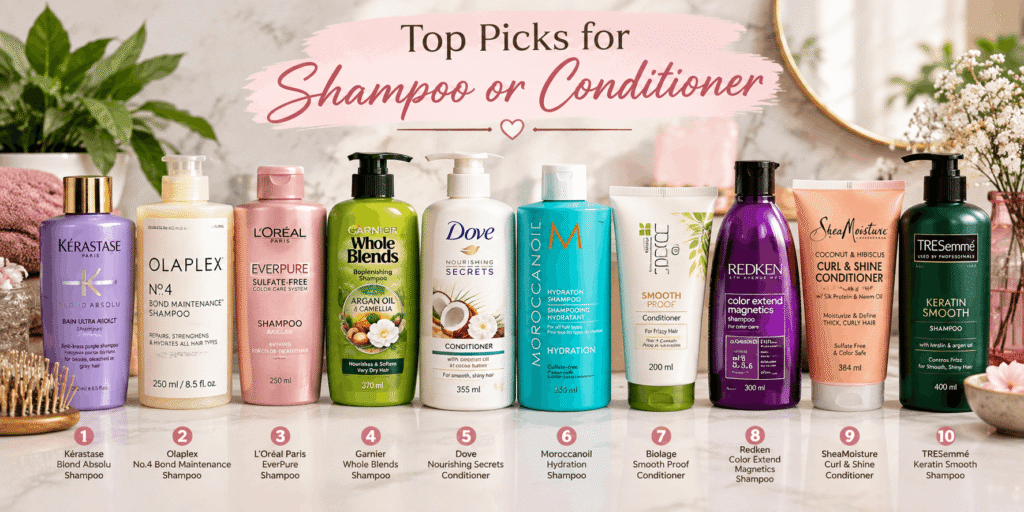
Choosing a shampoo conditioner combination is easier when you first identify what your hair is missing. Hair that feels rough may need more conditioning, while hair that looks dull or becomes tangled easily may benefit from a formula focused on smoothness and manageability.
The products below cover different needs rather than assuming that one formula works for every type of dry hair. Some are designed around hydration, others around strengthening, frizz control, curls, or color-treated strands.
When comparing products, it is also worth looking at how concentrated the formulas are and how they are intended to be used. For example, Olaplex currently describes its No. 4 and No. 5 formulas as concentrated and recommends applying the conditioner mainly from mid-lengths to ends.
Best Overall: Amika Normcore Hydrating Shampoo and Conditioner
Amika’s Normcore Hydrating Shampoo and Conditioner is designed for moisture-focused hair care and is a natural starting point for someone who wants a straightforward hydration routine.
A moisturizing shampoo should cleanse the scalp and hair without leaving the lengths feeling excessively stripped. The conditioner then provides the softness and slip needed to make dry hair easier to handle.
This type of pairing can be especially useful when your main complaint is that your hair feels rough, lacks softness, or becomes difficult to detangle after washing.
Why It Stands Out
The biggest advantage of a dedicated shampoo-and-conditioner pair is consistency. Rather than using a moisturizing shampoo with a completely unrelated conditioner, a coordinated system is designed around complementary performance.
For dry hair, that can make the shower routine feel much more predictable.
Best Budget-Friendly: Dove Shampoo & Conditioner Nourishing Daily Moisture Set for Women
A budget-friendly shampoo conditioner set can make regular moisturizing much easier because you do not have to save a premium product for occasional use.
Dove’s Daily Moisture Renewal line is currently positioned around hydration and manageability. Pantene’s current Daily Moisture Renewal range similarly describes its shampoo and conditioner as designed to cleanse and replenish dry-looking hair, showing how mainstream drugstore products increasingly focus on moisture without requiring a salon-level price.
For someone who washes frequently or has a large amount of hair, affordability can be particularly important. A moisturizer only helps your routine when you can comfortably use it as often as needed.
What to Consider
Do not judge a budget product only by its price. Compare the amount of product you receive, how much you use per wash, and whether the formula leaves your hair feeling clean without becoming overly dry.
Best for Coarse Hair: Pureology Hydrate Shampoo and Conditioner
Coarse hair can have a naturally substantial texture, but that does not mean it cannot feel dry. The goal is to add softness and manageability without making the hair feel unnecessarily weighed down.
Pureology’s Hydrate line is designed around moisturizing hair care and can be particularly appealing if your coarse strands need more slip during and after washing.
A conditioner is especially important for coarse hair because detangling can be more challenging when the strands feel rough.
Who May Prefer It?
This type of pairing can work well when your main priorities are moisture, softness, and easier styling rather than maximum volume.
Best Softening: Redken All Soft Shampoo and Conditioner
Redken All Soft is specifically positioned for dry, brittle hair. The current All Soft Shampoo is described by Redken as a moisturizing shampoo for dry, brittle hair, while the matching conditioner is designed to transform dry, brittle hair. The line currently includes argan oil, and the broader All Soft routine also includes a leave-in treatment with hyaluronic acid.
This makes the duo particularly interesting if your main complaint is roughness rather than simply lack of shine.
Why We Like It
The line is built around a clear goal: making dry hair feel softer and more manageable. Redken currently lists a 4.6 rating for the shampoo from more than 3,800 reviews on its product page, although these ratings include incentivized reviews.
The conditioner is the part to pay particular attention to if your lengths become tangled or feel coarse after shampooing.
Best Drugstore: Pantene Shampoo & Conditioner Set
Pantene’s Daily Moisture Renewal Shampoo and Conditioner provides a familiar drugstore option for people who want a moisture-focused routine without a premium price.
Pantene currently describes the shampoo as a gentle cleansing formula and the conditioner as a product designed to replenish dry, lifeless hair. The brand states that the system provides 2X moisture based on moisturized feel versus a non-conditioning shampoo.
Why It Stands Out
Accessibility is a major advantage. A product that is easy to find and affordable enough for regular use can be much more practical than an expensive formula that you rarely repurchase.
The key is to see how your own hair responds. If your strands feel soft and manageable after washing without a heavy residue, the routine may be a good fit.
Best for Damaged Hair: K18 DAMAGE SHIELD pH Protective Shampoo and Conditioner
When dryness comes with damage from coloring, heat, mechanical styling, or environmental exposure, a basic moisturizing routine may not be your only consideration.
K18’s current DAMAGE SHIELD range includes a pH Protective Shampoo and Protective Conditioner. The brand describes the shampoo as a color-safe, microbiome-friendly formula and the conditioner as providing conditioning protection against UV rays, mechanical styling, and environmental aggressors for up to three days based on its cited testing.
K18 recommends using the DAMAGE SHIELD shampoo every time you wash and applying the conditioner from mid-lengths to ends.
Why It Stands Out
This combination is aimed at people who want more than softness. The focus is on maintaining hair health and protecting against everyday sources of damage.
K18 currently lists the shampoo at $39 and the conditioner at $39 on its site, so it sits firmly in the premium category.
Best for Frizz: Olaplex Bond Maintenance No. 4 Shampoo and No. 5 Conditioner
Frizz and dryness often appear together, particularly when hair lacks smoothness and moisture. Olaplex’s No. 4 and No. 5 pairing is designed around strengthening, hydration, smoothness, and manageability.
Olaplex currently describes the system as suitable for all hair types and textures and says both products are color-safe, vegan, and free of SLS/SLES sulfates.
The brand also recommends using No. 5 on the mid-lengths and ends for one to three minutes before rinsing.
Why It Stands Out
The conditioner is particularly useful when the problem is not just dryness but also tangling, frizz, and difficulty managing the hair after washing.
Olaplex currently describes No. 5 as improving detangling and manageability while replenishing hydration and enhancing softness.
Best for Curly Hair: Ouidad Curl Quencher Moisturizing Shampoo
Curly hair can become especially difficult to manage when it feels dry because roughness can interfere with definition and increase the appearance of frizz.
A curl-focused shampoo needs to cleanse without making the strands feel stripped, while the accompanying conditioner should provide enough slip to support detangling and styling.
What to Look For
If you have curls, think about more than moisture alone. Your ideal shampoo conditioner routine should fit your curl pattern, density, styling routine, and tolerance for heavier products.
Best for Color-Treated Hair: Curlsmith Frizz Control Cleanser
Color-treated hair may need a balance between cleansing and maintaining a softer, smoother feel. Curlsmith’s Frizz Control Cleanser is a useful option to consider if frizz is part of the problem alongside dryness.
When choosing products for colored hair, look for formulas designed to work with chemically treated strands and follow the manufacturer’s recommendations.
Olaplex’s current No. 4 and No. 5 system, for comparison, is explicitly described as color-safe and suitable for chemically treated hair.
Best for Thick Hair: California Naturals Dream Curl Shampoo & Conditioner
Thick hair can require more product simply because there is more hair to cleanse and condition. The challenge is finding a formula that provides enough moisture without leaving the roots feeling coated.
California Naturals’ Dream Curl pairing is positioned toward textured and curly hair, making it an option to consider when thickness and dryness overlap.
Who May Prefer It?
This type of duo can appeal to people who want moisture and manageability while preserving natural movement.
Best Balancing: CeraVe Gentle Hydrating Shampoo & Conditioner
A gentle hydrating shampoo conditioner pairing can be useful when you want moisture without an aggressively rich routine.
CeraVe’s approach to hair care focuses on gentle cleansing and hydration, which can appeal to people who want a relatively straightforward wash routine.
The important consideration is how the products interact with your scalp and lengths. If the roots become oily quickly while your ends remain dry, you may need to adjust where and how much product you apply.
Best for Buildup: Dove Damage Therapy Coconut & Hydration Shampoo and Conditioner
Dry hair and product buildup can sometimes coexist, particularly when you use oils, styling creams, gels, or leave-in products regularly.
A cleansing routine needs to remove accumulated products without leaving the lengths excessively dry.
Finding the Balance
If your hair feels coated, heavy, or difficult to moisturize even after conditioning, buildup may be part of the issue. However, stronger cleansing is not always the answer.
Use your shampoo primarily on the scalp, allow the lather to move through the lengths during rinsing, and focus conditioner on the mid-lengths and ends.
What to Look for in a Shampoo or Conditioner for Dry Hair
Choosing a shampoo conditioner pair starts with understanding what your hair actually needs. Dry hair may need extra softness, better detangling, frizz control, or protection from ongoing damage, and one formula may not be able to do all of those things equally well.
Look for products designed around your specific concern rather than choosing a pair simply because the packaging says “moisturizing.” Ingredients, texture, hair type, washing frequency, and styling habits all matter. If your hair is colored, chemically treated, curly, coarse, or frequently heat-styled, those details should influence your choice.
Ingredients Worth Considering
Humectants such as glycerin can help attract and retain moisture, while conditioning ingredients and emollients can improve softness and manageability. Oils and butters can also contribute to a richer feel, although the ideal combination depends on your hair.
You do not need to search for one “miracle” ingredient. A well-balanced formula often matters more than a single ingredient featured prominently on the label.
Match the Formula to Your Hair
Fine hair may become weighed down by very rich products, while coarse or thick hair may need a more substantial conditioner. Curly hair can benefit from formulas that provide enough slip to make detangling easier.
The goal is to find enough conditioning without leaving the hair feeling coated, limp, or difficult to style.
How to Use Shampoo and Conditioner for Dry Hair
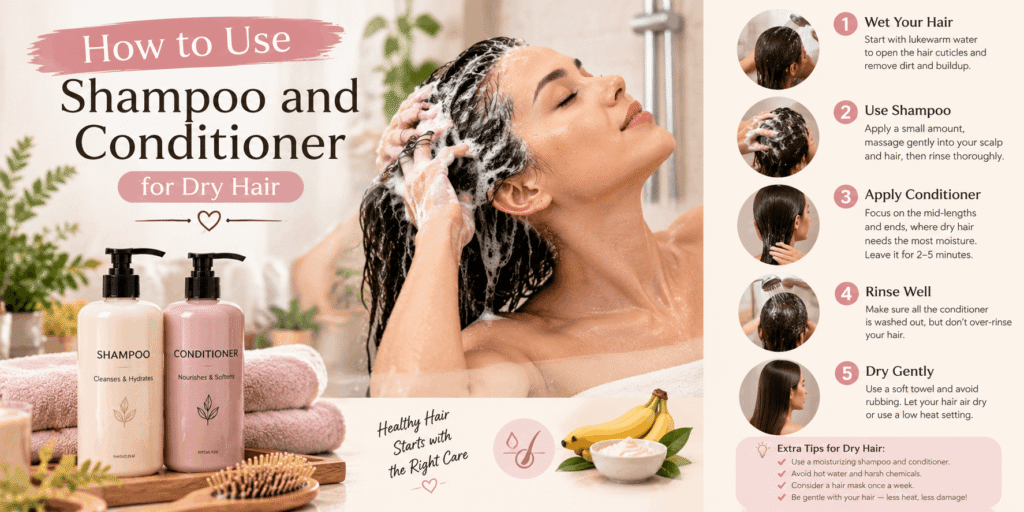
Technique can make as much difference as the products themselves. Shampoo should generally be concentrated on the scalp, where oil, sweat, and product buildup accumulate. As you rinse, the lather can move through the lengths without requiring vigorous scrubbing.
Conditioner is usually more useful on the mid-lengths and ends, especially when the roots become oily more quickly than the rest of the hair.
Allow the conditioner to sit for the amount of time recommended on the label, then rinse thoroughly.
Be Gentle When Washing
Very hot water and aggressive scrubbing can make a wash routine feel harsher. Use comfortable water temperature and massage the scalp gently with your fingertips.
Avoid roughly piling long hair on top of the head while shampooing, as this can increase tangling.
Detangle With Conditioner
Conditioner can provide slip that makes detangling easier. Work through knots gradually with your fingers or a suitable wide-tooth comb instead of forcing a brush through a tangled section.
Start at the ends and work upward.
How We Tested Shampoos and Conditioners for Dry Hair
A useful comparison of shampoo conditioner products should consider more than scent or packaging. We look at the formula’s intended purpose, texture, ease of use, manageability after washing, and how well it fits different hair types.
For dry-hair products, softness and detangling are especially important. We also consider whether a formula seems more appropriate for fine hair, thick hair, curls, color-treated strands, or damaged-looking hair.
Where possible, current manufacturer information is used to verify product claims, directions, and formula details. Product specifications can change, so readers should always check current packaging and official product pages before purchasing.
Why Trust This Guide
The goal of this guide is not to identify one product that everyone should use. Dry hair can look and feel very different depending on texture, chemical processing, heat styling, environment, and everyday care.
That is why the products were divided into practical categories such as overall hydration, budget, softness, damage, frizz, curls, color-treated hair, thick hair, and buildup.
This approach makes it easier to choose a formula based on your actual routine rather than simply buying the most expensive option.
Final Thoughts
The right shampoo conditioner pair can make dry hair feel noticeably softer, smoother, and easier to manage, but there is no universal combination that works perfectly for everyone. Hair texture, thickness, scalp needs, chemical treatments, heat styling, and washing habits all influence the best choice.
Among the products discussed, Amika Normcore is a strong overall hydration-focused option, Redken All Soft is appealing when softness is the main goal, while K18 DAMAGE SHIELD is designed for people who are particularly concerned about protecting damaged or treated hair. Olaplex remains an interesting choice for people dealing with frizz and manageability, while budget-friendly options from brands such as Dove and Pantene can make regular moisturizing care more accessible.
Before buying, focus on the problem you are actually trying to solve. If your hair feels dry but your scalp gets oily quickly, you may not need an extremely rich shampoo. If your strands are thick, curly, or heavily processed, a more substantial conditioner may be more appropriate.
Most importantly, pay attention to how your hair responds over time. A product that leaves your hair soft and manageable without excessive buildup is generally more useful than one that simply has impressive marketing claims.
With the right shampoo conditioner routine, gentle washing habits, and appropriate conditioning, dry hair can become easier to manage while looking smoother and more polished.
3 Comments