
The Caesar haircut has a way of looking familiar without feeling outdated. Its short length, forward styling, and defined shape make it easy to recognize, yet modern barbers have found plenty of ways to adapt it for different hair textures, face shapes, and personal styles. From clean and traditional versions to sharper fades and textured finishes, the Caesar haircut can be surprisingly versatile.
If you want a hairstyle that does not require a complicated morning routine but still has a strong shape, this cut deserves a closer look. Understanding its structure, history, maintenance, and modern variations can also make it much easier to explain exactly what you want at the barbershop.
The Caesar Haircut Is Taking Over Barbershops in 2025
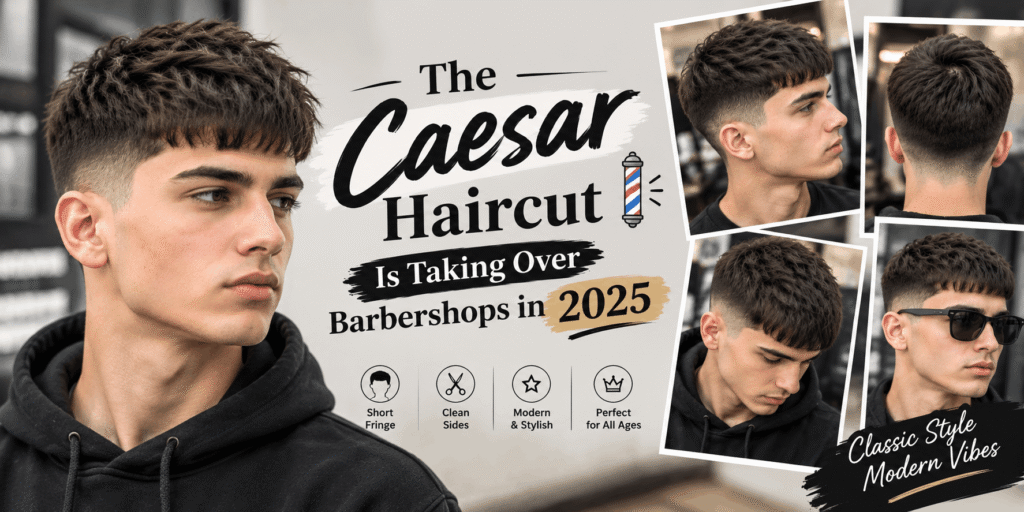
The renewed interest in short, structured hairstyles has helped bring the Caesar haircut back into conversations around men’s grooming. Unlike cuts that depend heavily on length or elaborate styling, the Caesar creates its identity through proportion. The hair remains relatively short, while the front is brought forward to form a distinctive fringe.
One reason the style continues to attract attention is its flexibility. A traditional Caesar can look neat and understated, while a contemporary version can include a fade, textured top, sharp line-up, or slightly uneven fringe. These changes can completely alter the character of the haircut without removing its basic identity.
The cut also works well for people who prefer hairstyles that look intentional without requiring several styling products. A small amount of matte styling product can add separation or texture, while some versions can be worn with almost no styling at all.
Another reason for its popularity is the growing interest in shorter men’s hairstyles with visible structure. Rather than simply cutting everything extremely short, the Caesar keeps enough length on top to create a recognizable silhouette.
What Is The Caesar Haircut?
The Caesar haircut is a short men’s hairstyle characterized by relatively short hair on top and a forward-directed fringe across the forehead. The sides and back can be kept short as well, although their exact length varies depending on the version of the haircut.
The defining feature is not simply having short hair. The front section is important because it gives the hairstyle its recognizable appearance. Instead of pushing the hair backward, upward, or toward one side, the hair is generally brushed or cut forward.
A classic Caesar usually has a compact shape with a relatively uniform top. Modern versions can be more textured, allowing individual pieces of hair to create a less rigid finish.
The fringe can also vary. Some versions have a straight, clearly defined edge, while others use a softer or textured finish. This gives barbers room to adjust the cut according to the client’s hair type and preferred appearance.
For someone considering this hairstyle, the main thing to understand is that “Caesar” describes a specific overall structure rather than one single exact haircut. Two people can both have Caesar cuts while having noticeably different fades, textures, and fringe shapes.
What Makes It a Caesar Cut?
Several details separate a Caesar from other short hairstyles. The most obvious is the forward fringe. Hair at the front is kept short and directed toward the forehead rather than being styled away from it.
The top is another important element. It normally remains short enough to keep the haircut compact, but there is enough hair to create some distinction between the top and the sides. Depending on the design, the top may be cut with scissors, clippers, or a combination of both.
The sides do not have to follow one universal formula. A traditional Caesar can have short sides with a relatively gradual transition, while a modern interpretation might use a skin fade or taper. The choice changes the overall appearance but does not automatically stop the haircut from being a Caesar.
Texture is also increasingly important in modern versions. Instead of creating a perfectly flat top, a barber may point-cut or texturize the hair so that the fringe and top have more movement.
Proportion matters too. If the top becomes significantly longer or the front is styled dramatically upward, the haircut begins moving toward another hairstyle category. The closer the haircut stays to its short, forward-oriented structure, the more recognizable the Caesar remains.
The Julius Caesar Haircut: A History
The name is commonly associated with Julius Caesar, the Roman military leader and statesman, although the modern haircut should not be treated as a precise reconstruction of an ancient Roman hairstyle. Historical artwork and later interpretations have helped connect the short forward fringe with Caesar’s image, but the modern haircut developed into its recognizable form much later.
The association became especially strong because representations of Julius Caesar often show him with relatively short hair and a receding hairline. The forward arrangement of the hair became an easy visual reference for later versions of the style.
During the late 20th century, the Caesar became much more recognizable as a contemporary men’s haircut. Its short construction made it practical, while its compact fringe gave it a distinctive appearance that separated it from a basic buzz cut.
The haircut eventually moved through different cultural and fashion periods, with barbers modifying its proportions, texture, and sides. That history is part of why today’s Caesar can look quite different from the versions that became popular decades ago.
Cultural Impact: The Caesar Haircut in the 90s, 80s, 70s, and 60s
The Caesar’s cultural story is more complicated than simply saying that the exact modern haircut was equally popular throughout the 1960s, 1970s, 1980s, and 1990s. Men’s hairstyles changed considerably during those decades, and the Caesar became particularly recognizable in later interpretations.
In the 1960s, shorter men’s cuts were common, but the defining Caesar structure was not the dominant mainstream style. The following decades brought a much wider variety of lengths and silhouettes, from longer textured hair to shorter, cleaner cuts.
By the 1980s, men’s grooming had become strongly influenced by different subcultures and fashion movements. Short cuts existed alongside much more dramatic hairstyles, meaning a Caesar-style shape could appear without being the defining trend of the period.
The 1990s played a more important role in the modern identity of the Caesar. Short forward fringes, clipped sides, and clean outlines became particularly visible in popular men’s grooming. The style also became associated with actors, athletes, musicians, and other public figures, helping move it beyond its historical name.
This period helped establish the Caesar as something that could be customized rather than treated as a single rigid haircut. The idea of pairing a short forward fringe with different side treatments eventually became a foundation for many modern versions.
How To Ask For A Caesar Cut In The Salon (& What To Expect)
When asking a barber for a Caesar haircut, simply saying “Caesar” may not communicate the exact result you have in mind. The term covers several variations, so it helps to explain the top length, fringe, sides, and overall finish.
Start with the fringe. Tell your barber whether you want a straight, blunt-looking edge or a more textured and irregular finish. If you already have a reference image, showing it can remove much of the uncertainty.
Next, explain how short you want the sides and back. You might prefer a classic short side, a taper, or a stronger fade. These choices can make the finished haircut look significantly different even when the top remains similar.
Your barber may also examine your natural hair growth before deciding how to shape the front. Hairlines are not identical, and a fringe that looks perfectly straight in a reference photograph may need to be adjusted to work naturally with your own hair.
If your hair is curly, wavy, very thick, or fine, mention that as well. The amount of texture and the cutting technique can be adjusted according to how your hair naturally behaves.
The Caesar Haircut: Step-by-Step
A Caesar haircut generally begins with determining the desired length and overall proportions. The barber then works through the sides and back before refining the top and front.
The sides may be clipped shorter using different guard lengths, depending on whether the goal is a classic finish, taper, or fade. The transition between the shorter sides and the top is then blended to avoid an abrupt change unless a deliberately sharper contrast is requested.
The top is kept short and shaped so that it can move forward naturally. The barber pays particular attention to the front because the fringe is one of the main visual features of the style.
For a textured Caesar, the ends may be cut in a way that creates separation instead of leaving one solid block of hair. This can make the finished haircut look more relaxed and contemporary.
Finally, the barber checks the outline around the temples, forehead, and neckline. Small adjustments at this stage can make the haircut look cleaner without changing its overall length.
Before leaving the chair, it is useful to ask the barber how they recommend styling the specific version you received. The correct product and technique depend on your hair texture and how much definition you want.
Who Suits This Haircut?
The Caesar haircut can suit a broad range of people because its proportions can be adjusted rather than following one fixed template. Face shape, hair density, natural texture, and the desired fringe are all factors worth considering.
People with straight hair may find the forward fringe particularly easy to manage because the hair naturally follows the direction required by the cut. Wavy hair can add natural movement, while textured or curly hair can create a more distinctive finish when the cut is adapted properly.
Face shape can also influence the proportions. A barber may adjust the top length, fringe shape, or side treatment to create a balanced overall silhouette. This does not mean there is one “correct” Caesar for every face shape; the haircut can be modified according to individual features.
Hairline characteristics matter as well. Since the fringe sits near the forehead, the barber needs to understand how the hair grows in that area. A customized fringe can often look more natural than forcing a perfectly straight line that does not match the person’s growth pattern.
The Caesar can also be useful for someone who wants a relatively low-maintenance haircut. Its short length generally reduces the amount of daily styling required, although textured or highly polished versions may need additional product.
Tips for Maintaining a Caesar Cut at Home
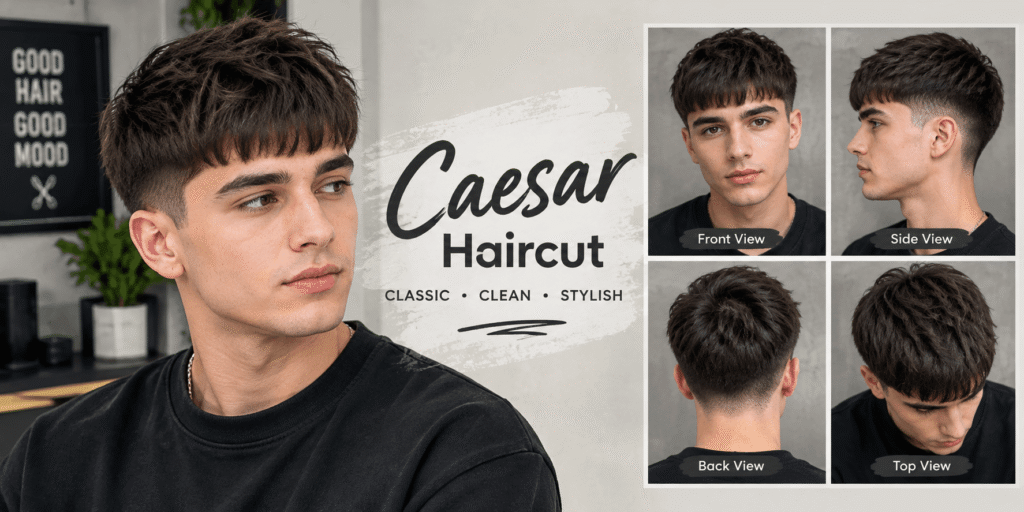
The short length of a Caesar haircut makes everyday maintenance relatively straightforward. The main goal is to prevent the front from becoming uneven and to keep the sides and neckline looking clean.
How often you need a haircut depends on how quickly your hair grows and how sharp you want the edges to remain. Someone with a fade may notice the sides losing their definition sooner than someone wearing a more evenly clipped Caesar.
Washing should also match your hair type rather than following a fixed schedule. Hair that becomes oily quickly may need more frequent washing, while dry or textured hair can benefit from a less aggressive routine.
After washing, avoid aggressively rubbing the hair with a towel. Gently removing excess moisture can help preserve the natural texture and reduce unnecessary roughness.
Styling is usually simple. A small amount of matte paste or clay can add separation to a textured Caesar without making the hair look overly shiny. If you prefer a softer finish, you may not need much product at all.
The fringe should also be checked regularly. If individual strands begin extending noticeably beyond the rest of the front, the haircut can quickly lose its compact appearance.
At home, avoid trying to recreate a professional fade with ordinary household tools. The sides and neckline are areas where uneven trimming can become obvious. Regular barber visits are generally easier than repeatedly correcting an uneven cut.
Why Is It So Popular?
The Caesar haircut combines several qualities that continue to appeal to men who prefer practical hairstyles. It is short, recognizable, adaptable, and does not depend on complicated styling.
Its strongest feature may be how easily the basic shape can be modified. A person can choose a softer classic version, while another can pair the same forward fringe with a modern fade and textured top. Both can still be recognized as Caesar-inspired hairstyles.
Another factor is the relatively small amount of time required to style many versions. Someone who prefers to get ready quickly can keep the hair short and allow its natural direction to do most of the work.
The hairstyle also works across different settings. A neat version can look appropriate with formal clothing, while a textured version can feel much more relaxed with casual outfits.
There is also a practical advantage to keeping the top short. Long hair often requires more time to control, while a Caesar usually needs only a small amount of adjustment in the morning.
The haircut’s history gives it another layer of appeal. Although its connection to Julius Caesar has been shaped by later interpretations, the name gives an otherwise simple short hairstyle a distinctive identity.
Most importantly, the Caesar does not depend on one particular age group or fashion moment. Its details can be changed as men’s grooming trends evolve, which helps prevent the basic concept from becoming locked into one decade.
Upgraded Caesar Haircuts
The modern Caesar is much more varied than the classic short version. Barbers can change the fade, texture, fringe, length, and finishing technique while keeping the central forward-styled structure.
If you are looking for a Caesar haircut that feels more current, these 20 variations show how different the same basic concept can become.
1. Classic Caesar
The traditional approach keeps the hair short and compact with a straightforward forward fringe. The sides are kept neat without creating an extremely dramatic contrast. It is a simple interpretation for someone who wants the original character of the haircut.
2. Caesar Fade
A fade gradually reduces the hair on the sides and back, creating a cleaner transition around the head. Keeping the top short preserves the Caesar identity while the fade gives it a sharper contemporary finish.
3. Low Fade Caesar
A low fade keeps the transition closer to the lower portion of the sides. This creates a less aggressive contrast and allows more hair to remain around the temples.
4. Mid Fade Caesar
A mid fade starts higher on the sides, producing a more noticeable difference between the short sides and the top. Combined with a defined fringe, it creates a strong and structured silhouette.
5. High Fade Caesar
The high fade creates a much stronger separation between the top and sides. The short forward fringe becomes the main focal point, making this version particularly noticeable from the front.
6. Caesar Taper
Instead of fading the sides dramatically, a taper gradually cleans up the hair around the temples and neckline. This produces a more understated appearance while maintaining the short top.
7. Textured Caesar
Texture changes the entire mood of the haircut. Rather than leaving the top looking uniform, the hair is cut to create visible separation between individual strands.
8. Short Textured Caesar
This version keeps the top especially compact while adding small amounts of texture. It is useful for someone who wants definition without maintaining significant length.
9. Caesar With a Blunt Fringe
The front is cut with a stronger, more noticeable horizontal edge. The result has a highly structured appearance, particularly when paired with clean sides.
10. Caesar With a Soft Fringe
A softer fringe uses less rigid separation at the front. The ends can have more movement, making the haircut appear relaxed rather than sharply geometric.
11. Curly Caesar
Curly hair can give the Caesar a completely different character. The curls remain relatively short while the forward shape is preserved, creating a compact but naturally textured result.
12. Wavy Caesar
Natural waves can add movement across the top without requiring heavy styling. The fringe remains short while the texture gives the haircut a less uniform finish.
13. Caesar With a Skin Fade
The sides are reduced very close to the skin, creating a dramatic contrast with the top. The forward fringe then becomes especially prominent.
14. Caesar With a Beard
Pairing the haircut with facial hair creates a stronger overall frame around the face. The beard length can vary, while the Caesar keeps the upper portion
Final Thoughts
The Caesar haircut has remained recognizable because its foundation is simple: short hair, a forward direction, and a defined front. Everything beyond that can be adjusted.
Modern barbers have turned the basic shape into a broad family of hairstyles by experimenting with fades, tapers, texture, fringe shapes, and different lengths. That means choosing a Caesar today does not necessarily mean getting the same haircut that became popular decades ago.
The most useful approach is to decide what you want from the haircut before sitting in the barber’s chair. Think about how short you want the sides, how much texture you prefer, whether the fringe should be sharp or soft, and how much styling you are realistically willing to do.
A reference photograph can help communicate the overall direction, but your barber may need to modify the proportions according to your hair texture, hairline, and natural growth pattern.
Whether you choose a traditional Caesar, a fade variation, a textured crop, or one of the more contemporary versions, the defining forward fringe gives the haircut its identity. With the right proportions and regular maintenance, it can remain neat without requiring an elaborate daily routine.
A Caesar haircut is a short men’s hairstyle featuring a compact top and a short fringe that is styled or cut toward the forehead. The sides can be finished in several ways, including a taper or fade.
The name is associated with Julius Caesar, whose traditional depictions have contributed to the haircut’s identity. The modern Caesar, however, is a contemporary hairstyle rather than an exact recreation of an ancient Roman cut.
Many Caesar haircuts are relatively easy to maintain because the hair is kept short. The amount of styling required depends on the texture, length, and finish of the particular version.



One Comment