
Hair porosity test methods can help you understand how your hair absorbs, retains, and loses moisture. If your hair often feels dry, takes a long time to get wet, or becomes frizzy shortly after washing, understanding your hair porosity may help you choose a more suitable hair care routine.
Hair porosity refers to how easily water and other substances move into and out of the hair shaft. It is influenced by the structure of the outer hair layer, known as the cuticle, as well as factors such as chemical treatments, heat styling, and general hair condition.
Many people discuss low, medium, and high hair porosity, but identifying your hair type is not always as simple as performing one test. Different sections of your hair can behave differently, and results may change as your hair becomes damaged or grows out.
In this guide, you will learn how to perform a hair porosity test, recognize common signs of different porosity levels, and use your results to make better hair care decisions.
What Is Hair Porosity?
Hair porosity test describes the ability of your hair to absorb and retain moisture. The hair cuticle consists of overlapping outer cells that help protect the inner structure of each strand. How these cells are arranged and how much the hair has been damaged can influence the movement of water into and out of the hair.
Understanding hair porosity can help explain why one person’s hair becomes wet quickly while another person’s hair takes longer to absorb water. It can also provide clues about why certain conditioners, leave-in products, or styling methods work better for some people than others.
However, porosity is only one part of hair care. Hair thickness, curl pattern, scalp condition, product buildup, and environmental conditions can also affect how your hair behaves.
The Three Main Types of Hair Porosity
Hair porosity test is generally described using three categories: low, medium, and high. These categories provide a useful starting point for understanding your hair’s moisture behavior.
Low Hair Porosity
Low-porosity hair tends to resist water entering the hair shaft. Its cuticle layers may lie relatively flat and closely together, making it more difficult for moisture to penetrate quickly.
Common experiences associated with low-porosity hair include:
- Hair that takes longer to become fully wet.
- Products that seem to sit on the hair instead of spreading easily.
- Buildup when heavy creams, oils, or butters are used frequently.
- Hair that takes a long time to dry, depending on its thickness and density.
Low-porosity hair does not necessarily mean unhealthy hair. Hair with a relatively intact cuticle may have low porosity naturally.
People with this hair type may benefit from lightweight conditioners, thorough rinsing, and using fewer products at a time. Gentle warmth during conditioning may help some products spread and work effectively, provided the temperature is comfortable and not damaging.
Medium Hair Porosity
Medium-porosity hair is often described as having a balance between moisture absorption and retention. Water and conditioning products may enter the hair relatively easily, while the hair can retain moisture reasonably well.
Possible signs include:
- Hair that becomes wet without excessive effort.
- Manageable styling and detangling.
- A relatively balanced response to conditioners.
- Moisture that lasts reasonably well between washes.
Medium porosity is sometimes called normal porosity. However, it does not guarantee that hair will always feel soft or healthy. Hair can still become dry because of weather, frequent washing, chemical treatments, or unsuitable products.
A balanced routine with an appropriate shampoo, conditioner, and occasional treatment is usually a sensible starting point.
High Hair Porosity
High-porosity hair tends to absorb water readily but may also lose moisture quickly. Its cuticle can be raised, irregular, or damaged, allowing water to move in and out more easily.
Possible signs include:
- Hair that becomes wet very quickly.
- Hair that dries relatively quickly under similar conditions.
- Frequent tangling or frizz.
- Dryness soon after washing.
- Increased breakage, particularly when chemical or heat damage is present.
High porosity may be natural, but it can also develop when hair is affected by bleaching, repeated coloring, chemical straightening, or excessive heat styling.
People with high-porosity hair may benefit from conditioning products that improve slip and reduce friction. Leave-in conditioners and suitable creams can help hair feel smoother, but no cosmetic product can completely reverse severe structural damage.
How to Perform a Hair Porosity Test at Home
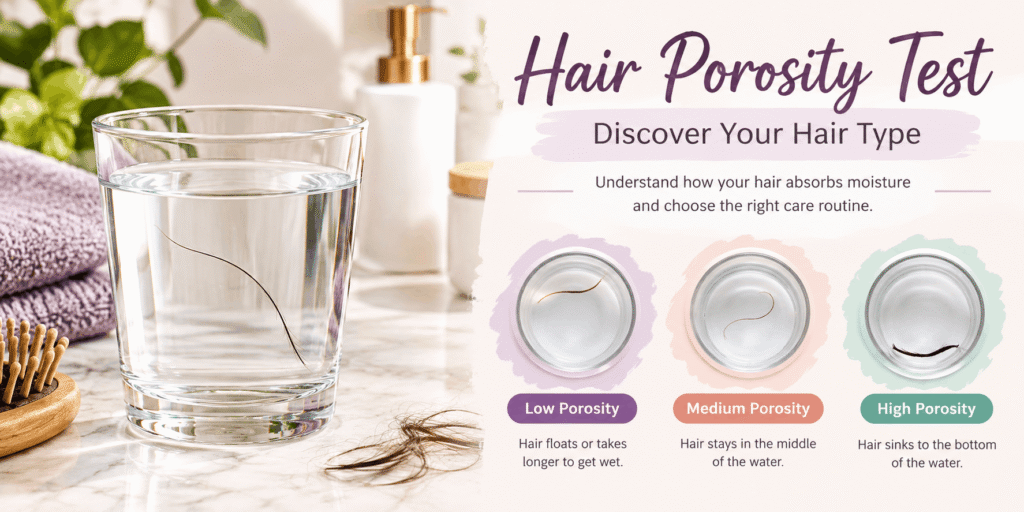
A hair porosity test can help you investigate how your hair responds to water and products. Several home methods are popular, but they do not all provide equally reliable information.
The most useful approach is to observe your hair over several washes instead of relying on one quick experiment. Start with clean hair, pay attention to how it behaves when wet, and compare those observations with how it feels after drying.
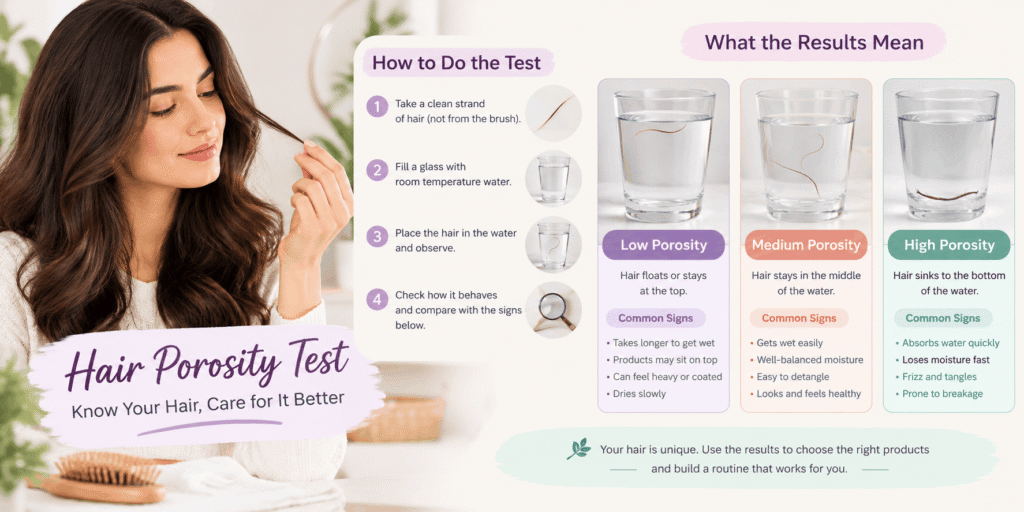
1. The Float Test
The float test is one of the most widely discussed hair porosity tests. It involves placing a strand of hair in a glass of water and observing whether it floats or sinks.
To try this method:
- Wash your hair and rinse it thoroughly to remove styling products and excess oils.
- Allow a loose strand of shed hair to dry completely.
- Fill a clean glass with room-temperature water.
- Place the strand gently on the water’s surface.
- Observe its movement without pushing it down or stirring the water.
Some popular explanations suggest that a strand that remains on the surface indicates low porosity, a strand suspended in the middle indicates medium porosity, and a strand that sinks indicates high porosity.
However, the float test is not a scientifically reliable way to determine hair porosity on its own. Surface tension, trapped air, strand thickness, water conditions, and residue on the hair can all influence the result.
If your hair floats, it does not automatically mean you have low-porosity hair. Likewise, a sinking strand does not conclusively prove high porosity.
Use the float test as a simple observation rather than a definitive diagnosis.
2. The Water Absorption Test
Observing how your hair becomes wet during washing can provide more practical information than relying only on a floating strand.
Follow these steps:
- Begin with dry hair that is free from heavy styling products.
- Stand under a comfortable stream of lukewarm water.
- Notice how long it takes for the water to spread through your hair.
- Gently separate sections to see whether the inner layers are becoming wet.
- Pay attention to whether water seems to bead on the surface or spreads readily.
Hair that consistently resists becoming wet may have lower porosity, although thick hair, dense curls, oils, and product buildup can produce similar effects.
Hair that becomes wet quickly may have higher porosity, but this observation is not conclusive by itself.
The key is to compare your hair under similar conditions over multiple washes.
3. The Drying Time Test
Drying time is another commonly used clue in a hair porosity test. People often associate slow drying with low porosity and fast drying with high porosity.
After washing, observe how long your hair takes to dry under similar conditions. Consider whether you air-dry your hair, use a towel, or use a blow-dryer.
However, drying time depends on more than porosity. Hair length, strand thickness, density, curl pattern, humidity, airflow, and the amount of water left after washing can all affect the outcome.
For example, thick, dense hair may take several hours to dry even when its porosity is relatively high. Fine, low-density hair may dry much faster.
For this reason, drying time should be considered alongside other observations rather than used as the only measurement.
4. The Product Absorption Test
Your hair’s response to conditioners and styling products can offer additional clues about its porosity.
Observe how your usual products behave after washing. Does a conditioner spread easily? Does a cream leave a heavy coating? Does your hair feel smooth initially but become dry or rough soon afterward?
These observations may help you adjust your routine, but they cannot determine porosity with certainty. Product formulation, the quantity applied, water hardness, and existing buildup all influence the outcome.
For a more useful comparison, try one product at a time and observe the results over several washes. Avoid changing your entire routine at once, because doing so makes it difficult to identify which changes actually help.
How to Understand Your Hair Porosity Test Results
After completing a hair porosity test, the next step is to compare your observations with the way your hair behaves during washing, conditioning, drying, and styling. No single home test can accurately identify every person’s hair porosity, so it is better to look for consistent patterns over time.
For example, if your hair takes longer to become wet, feels coated after applying heavy products, and responds better to lightweight conditioners, you may have characteristics associated with low-porosity hair. If your hair becomes wet quickly, tangles easily, and feels dry shortly after washing, it may show characteristics associated with higher porosity.
However, these signs can overlap. Product buildup, hair thickness, curl pattern, and chemical damage can influence the results.
Signs That May Indicate Low Hair Porosity
Low-porosity hair often takes longer to absorb water, especially when it is covered with oils or styling products. You might notice that water initially sits on the surface instead of spreading through the strands.
Another common experience is product buildup. Heavy conditioners, thick butters, and multiple styling products may leave the hair feeling greasy or coated rather than soft.
To care for hair with these characteristics, consider using lightweight conditioners and applying products in small amounts. A clarifying shampoo may help remove buildup when needed, although it should be used according to your hair and scalp’s requirements.
Signs That May Indicate Medium Hair Porosity
Hair with medium porosity may become wet relatively easily, respond well to conditioning, and remain manageable between washes.
If your hair does not consistently resist moisture or become excessively dry shortly after washing, you may have some characteristics associated with medium porosity.
A simple hair care routine is often sufficient. Use a suitable shampoo, condition the lengths, and add a leave-in conditioner when your hair needs extra softness or detangling support.
There is no need to purchase numerous specialized products simply because you have performed a hair porosity test.
Signs That May Indicate High Hair Porosity
High-porosity hair may absorb water quickly but lose moisture relatively easily. You might notice frizz, tangling, roughness, or breakage, particularly if your hair has been bleached, chemically treated, or exposed to frequent heat styling.
In these cases, conditioning products that improve slip can help reduce friction during detangling. A leave-in conditioner or a suitable cream may also help your hair feel smoother.
Limit excessive heat and harsh chemical treatments where possible. Severely damaged hair cannot be restored to its original structural condition by a conditioner alone, although appropriate products can improve its appearance and manageability.
Best Hair Care Routine for Different Porosity Types
Your hair porosity test results can help guide product choices, but your routine should also reflect your scalp condition, hair texture, and personal styling needs.
The goal is to keep the scalp clean, reduce unnecessary damage, and help the hair remain manageable without applying too many products.
Hair Care Routine for Low-Porosity Hair
Low-porosity hair may respond well to a simple routine that avoids excessive product buildup.
1. Choose a suitable shampoo. Cleanse your scalp regularly to remove oil, sweat, and styling residue. The appropriate frequency depends on your scalp and lifestyle.
2. Use a lightweight conditioner. Apply conditioner mainly to the lengths and ends, following the product instructions. Rinse thoroughly if your hair tends to feel coated.
3. Avoid excessive layering. Using several oils, creams, and leave-in products together can make some low-porosity hair feel heavy.
4. Use gentle warmth when appropriate. A comfortably warm environment during conditioning may help some products spread through the hair. Avoid excessive heat, which can damage the hair and scalp.
5. Clarify when necessary. If your hair feels coated despite regular washing, an occasional clarifying shampoo may help remove accumulated residue.
Hair Care Routine for Medium-Porosity Hair
A balanced routine is often a practical choice for hair that responds reasonably well to water and conditioning products.
1. Cleanse according to your needs. Wash often enough to keep your scalp comfortable and clean without unnecessarily drying the lengths.
2. Condition after washing. Use a conditioner that leaves your hair easy to detangle and manageable.
3. Protect your hair when styling. If you use heat tools, apply a suitable heat-protectant product and choose a moderate temperature.
4. Adjust products seasonally. Humidity, cold weather, and indoor heating can change how your hair feels. You may need to adjust your routine as conditions change.
5. Monitor changes. If your hair becomes more fragile after coloring or heat styling, reassess your routine rather than assuming its porosity will remain unchanged.
Hair Care Routine for High-Porosity Hair
High-porosity hair may benefit from extra attention to conditioning and reducing friction, especially when the hair is chemically treated or damaged.
1. Use a gentle cleanser. Select a shampoo that cleans your scalp effectively without leaving the lengths feeling unnecessarily rough.
2. Apply a conditioning treatment. A rinse-out conditioner can improve softness and detangling. Follow the directions for any deep-conditioning treatment you use.
3. Consider a leave-in conditioner. This may help the hair remain manageable between washes and reduce friction while brushing.
4. Detangle carefully. Work gently through small sections, beginning at the ends and gradually moving upward. Avoid pulling through knots.
5. Reduce heat and chemical stress. Frequent bleaching, straightening, and high-temperature styling can contribute to further damage.
6. Protect fragile ends. Gentle handling, suitable conditioning, and occasional trims can help reduce the appearance of split and damaged ends.
Common Hair Porosity Test Mistakes to Avoid
A hair porosity test can be useful for learning about your hair, but common mistakes can lead to misleading conclusions.
Relying Only on the Float Test
The float test is popular online, but it does not reliably measure porosity. Surface tension, trapped air, strand thickness, and residue can affect whether a hair strand floats or sinks.
Instead of using one result to label your hair permanently, compare several observations from your regular hair care routine.
Confusing Hair Thickness With Porosity
Hair thickness describes the diameter of individual strands, while porosity describes how easily water moves into and out of the hair.
Fine hair can have low, medium, or high porosity. The same is true of coarse hair. A strand that feels thick or rough does not automatically have high porosity.
Understanding this difference can prevent you from selecting products based on the wrong characteristic.
Ignoring Product Buildup
Oils, styling creams, conditioners, and other products can accumulate on the hair. This buildup may affect how water spreads and how products perform during a hair porosity test.
If you suspect buildup, consider washing your hair appropriately before evaluating its behavior. Avoid using harsh cleansing products repeatedly in an attempt to force a particular test result.
Testing Hair After Chemical Treatments
Bleaching, coloring, relaxing, and other chemical processes can alter the hair’s structure. As a result, previously untreated hair may behave differently from treated lengths.
If your roots feel different from your ends, consider that the sections may have different levels of damage and moisture behavior. You do not need to force every part of your hair into one porosity category.
Changing Too Many Products at Once
If you purchase several new products immediately after performing a hair porosity test, it becomes difficult to identify which products help.
Introduce changes gradually. Observe how your hair responds to a cleanser, conditioner, or leave-in product before making additional changes.
This approach can help you build a routine based on actual results rather than marketing claims.
How Often Should You Perform a Hair Porosity Test?
You do not need to perform a hair porosity test every week. Hair porosity is not a daily measurement, and repeating an unreliable test will not necessarily provide more accurate information.
Instead, pay attention to changes in your hair after chemical treatments, frequent heat styling, or significant changes in your routine.
If your hair starts absorbing water differently, becomes unusually tangled, or feels more fragile, consider whether product buildup or damage could be contributing to the change.
New hair growth may also behave differently from older, chemically treated lengths. In these situations, comparing different sections can be more informative than testing a single strand repeatedly.
Remember that hair porosity is only one factor in choosing hair care products. Your scalp health, curl pattern, strand thickness, and personal preferences are also important.
Conclusion
A hair porosity test can help you understand how your hair responds to moisture and make more informed hair care choices. Low-porosity hair may resist water absorption, medium-porosity hair may show a more balanced response, and high-porosity hair may absorb water quickly while losing moisture relatively easily.
However, home methods such as the float test cannot determine porosity with complete accuracy. The most useful approach is to observe how your hair behaves during washing, conditioning, drying, and styling over time.
Choose products according to your hair’s actual needs, avoid unnecessary buildup, handle wet hair gently, and limit damaging heat or chemical treatments. With consistent care, you can develop a routine that supports healthier-looking, more manageable hair without relying on a single test result.
Final Thoughts
A hair porosity test can help you understand how your hair absorbs and retains moisture, making it easier to choose suitable hair care products and routines. Whether you have low, medium, or high porosity hair, the right approach depends on your hair’s needs, texture, and condition.
Remember that a single hair porosity test may not give you a complete picture. Use it alongside other signs, such as how quickly your hair dries, how it responds to conditioners, and how well it retains moisture. With consistent care, gentle handling, and the right products, you can build a hair care routine that supports softer, healthier-looking hair.

2 Comments