A small hair accessory can change the entire feel of a hairstyle. A simple ponytail may look casual with a basic elastic, playful with a colorful fabric tie, or polished with a velvet accessory that matches an outfit. Hair scrunchies make these changes easy because they combine the practical job of holding hair in place with the decorative appeal of a wearable accessory.
Their usefulness goes beyond appearance. The fabric covering can provide a softer barrier between an elastic and your hair, although the level of protection depends on the material, construction, and how tightly you wear it. A well-made scrunchie can be a comfortable option for everyday styling, workouts, relaxed updos, and occasions when you want your hairstyle to look intentional without much effort.
The challenge is choosing the right one for your hair type, preferred hairstyle, and daily routine. A large satin scrunchie may look beautiful in a thick ponytail but feel bulky in fine hair. A small cotton version may work well for a casual bun but lack the hold needed for a long, heavy ponytail. Understanding these differences makes it easier to build a useful collection rather than buying accessories that rarely leave the drawer.
Why Hair Scrunchies Deserve a Place in Your Everyday Styling Routine
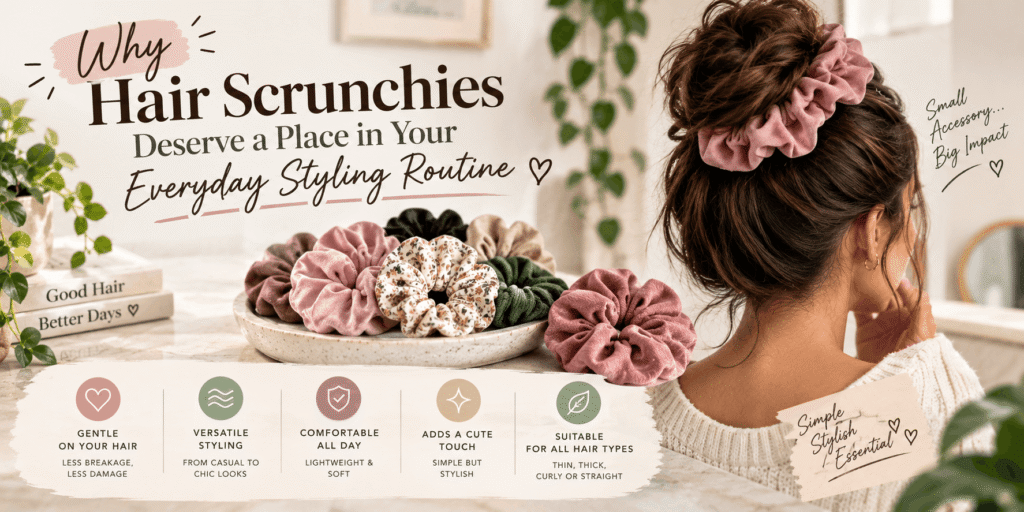
Hair Scrunchies often have to perform two jobs: keep the hairstyle secure and complement the rest of your appearance. Hair scrunchies can do both without requiring complicated styling techniques. You can use one to gather your hair before leaving home, secure a loose bun while working, or add a decorative finish to a ponytail that would otherwise look ordinary.
Their fabric-covered design is one reason many people prefer them to narrow, exposed elastic bands. Depending on the construction, the material may reduce direct friction between the elastic and individual strands. This can be helpful when putting your hair up regularly, particularly if you are trying to minimize unnecessary pulling and breakage.
However, a scrunchie is not automatically gentle simply because it has fabric around it. A tight elastic core, rough seams, snagging threads, or an overly small size can still place stress on the hair. Pulling a ponytail tightly against the scalp can also create tension, regardless of which accessory you use.
The most useful scrunchie is one that holds your hair securely without requiring you to stretch it excessively or wrap it around your hair several times. It should feel comfortable when you put it on and remain comfortable throughout the day.
A Small Accessory That Changes the Mood of an Outfit
Hair Scrunchies can make a hairstyle feel coordinated without requiring every accessory to match exactly. For example, a cream-colored scrunchie can complement a neutral outfit, while a burgundy velvet version can add contrast to a simple black sweater. A patterned fabric may bring color to an outfit that otherwise has very few details.
The same accessory can also create different impressions depending on how you wear it. A high ponytail with a bright scrunchie feels energetic and casual. A low ponytail secured with a slim satin version may look more understated. A loose bun with a soft fabric accessory can suit a relaxed weekend outfit or a comfortable work-from-home routine.
This flexibility makes scrunchies useful for people who want variety without learning an entirely new hairstyle every time. You can keep the hairstyle simple and let the accessory provide the visual interest.
They are also easy to carry. A spare scrunchie can live in a handbag, backpack, desk drawer, or travel pouch. When you need to tie your hair back, you have an option that can look more intentional than an ordinary elastic band.
Finding the Right Scrunchie for Your Hair Type
The size, fabric, and elasticity of a scrunchie matter more than its appearance alone. Hair thickness, strand texture, and length all affect how an accessory fits and how securely it holds a hairstyle.
If your hair is fine, a large scrunchie may overwhelm a small ponytail or slide down because there is not enough hair to support it. A slim or lightweight version may provide a better fit. Look for a smooth fabric and a flexible elastic core that holds your hair without requiring several tight wraps.
For thick hair, a larger scrunchie with a stronger elastic core may be more practical. It should have enough room to gather the hair without pulling sharply or stretching to its limit. If the accessory becomes difficult to remove, it may be too small or unsuitable for the amount of hair you are gathering.
Curly and coily hair can benefit from accessories that slide smoothly over the strands without catching individual curls. Satin or silk-covered options may be worth considering because their smooth surfaces can reduce some friction compared with rougher fabrics. Nevertheless, the fit and quality of the stitching remain important.
Long hair may need a scrunchie that can hold a substantial amount of hair without slipping. Medium-sized options can work for everyday ponytails, while larger versions may be more suitable for loose buns. Very short hair, on the other hand, may be easier to secure with a small scrunchie or a different type of accessory designed for shorter lengths.
Matching the Material to the Way You Wear Your Hair
Different fabrics create different looks and offer different practical advantages. There is no single material that is ideal for every hairstyle or occasion.
Satin scrunchies have a smooth surface and a subtle sheen. They are often chosen for their sleek appearance and may be useful when you want to reduce friction during everyday styling. Satin is a type of fabric weave, not necessarily a natural fiber, so check the product description if the material itself matters to you.
Silk scrunchies offer a smooth, soft finish and can feel luxurious. They may be appealing to people who prefer silk accessories, but they usually cost more than many synthetic alternatives. Silk also requires suitable care to preserve its appearance.
Cotton scrunchies provide a casual, textured look and come in many prints and colors. They can work well for relaxed ponytails and everyday outfits. Depending on the weave, some cotton fabrics may create more friction than smoother materials, especially if the surface is rough or the stitching is exposed.
Velvet scrunchies have a plush texture that makes them particularly noticeable. They can add richness to a simple hairstyle and pair well with autumn and winter outfits. Their thicker construction may feel bulky in very fine hair, so size matters.
Chiffon scrunchies offer a light, airy appearance. Their gathered fabric can make a simple ponytail look fuller without adding much visual weight. Because delicate chiffon may snag or fray, check the seams and avoid pulling it roughly when removing it.
Stretch-knit scrunchies can provide a relaxed, sporty, or casual appearance. Their flexibility may make them convenient for daily use, although the amount of hold depends on the elastic inside and the quality of the construction.
Instead of choosing a material solely because it is popular, consider how the accessory will interact with your hair. Smooth fabrics may be useful when friction is a concern, while textured or decorative fabrics may be more suitable when appearance is the main priority.
Hairstyles That Make Scrunchies Look Intentional
A scrunchie can become the focal point of a hairstyle or remain a small finishing detail. The difference often comes from its placement, size, and relationship to the shape of your hair.
A ponytail is the simplest place to start. Gather your hair at the height you prefer, then secure it with a scrunchie that suits the amount of hair you have. A high ponytail creates a lively, sporty impression, while a low ponytail feels more relaxed and understated. A middle-height ponytail offers a practical balance for everyday wear.
For a softer look, avoid pulling every strand tightly against the scalp. Leave the hair at a comfortable tension and allow a few loose pieces around the face if that suits your style. The scrunchie can provide a decorative finish without making the hairstyle look overly constructed.
A bun offers another easy option. Gather the hair into a ponytail, twist it loosely, and wrap it around the base before securing it with the scrunchie. The amount of twisting depends on the thickness and length of your hair. A loose bun can look relaxed, while a more compact shape may feel appropriate for work or an occasion where you want your hair out of the way.
Half-up hairstyles are particularly useful when you want to keep hair away from your face without tying everything back. Gather the top section and secure it at the back of the head. A small scrunchie can add color or texture without overwhelming the style.
Turning Simple Hairstyles Into Personal Style
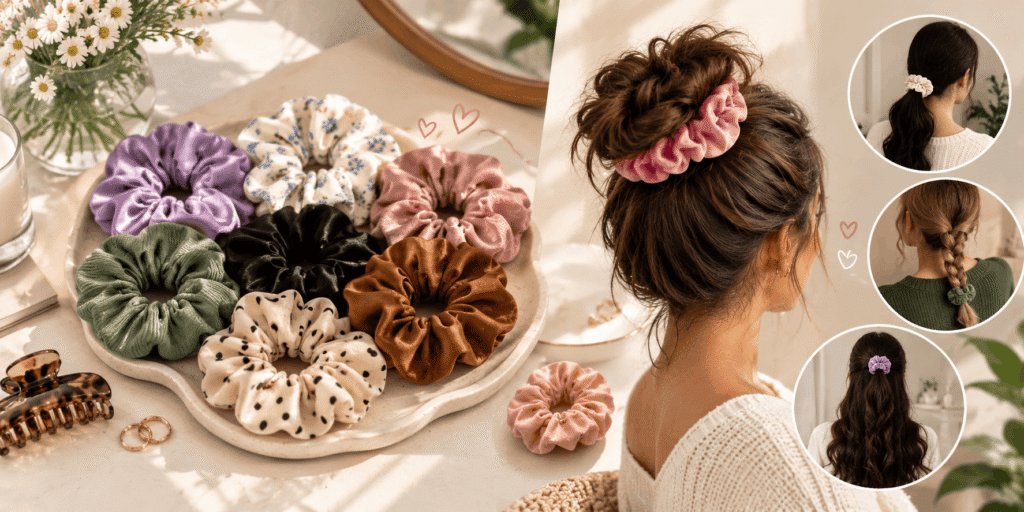
The same ponytail can look completely different with a change of accessory. A neutral satin scrunchie creates a clean finish, while a floral cotton version gives the hairstyle a more playful feel. A velvet scrunchie in a deep color can add contrast to a plain outfit.
You can also use scrunchies to create balance. If your outfit already includes a busy print, a solid-color accessory may prevent the overall look from feeling crowded. If your clothing is simple, a patterned scrunchie can introduce a small amount of visual interest.
For a polished low ponytail, brush or smooth the hair into place before adding the accessory. You do not necessarily need to make every strand perfectly flat. The goal is to create the finish you prefer, whether that is sleek, softly textured, or deliberately relaxed.
For a casual bun, a slightly larger scrunchie can add volume around the base. Choose a size that complements your hair rather than covering most of the hairstyle. If the accessory dominates the entire look, try a smaller version or a less bulky fabric.
Braids can also work with scrunchies. Secure the end of a braid with a small accessory, or use a larger one at the base of a ponytail before braiding the remaining length. This creates a coordinated detail without requiring additional clips or pins.
The most important consideration is comfort. A hairstyle can look attractive in a mirror but become irritating after several hours if the accessory is too tight or pulls the hair in one direction. Adjust the placement whenever you feel unnecessary tension.
Can Hair Scrunchies Help Reduce Breakage?
Hair breakage can occur for many reasons, including repeated tension, friction, chemical processing, heat styling, and rough handling. The accessory you choose is only one part of that picture, but it can influence how much stress your hair experiences during everyday styling.
A fabric-covered scrunchie may help reduce direct contact between a narrow elastic and the hair. Its wider surface can distribute pressure over a larger area, depending on its design. This may make it a comfortable alternative to some tight elastic bands.
That does not mean every scrunchie protects hair equally. A poorly made version may have exposed elastic, rough seams, loose threads, or a closure that catches strands. An overly tight scrunchie can also create tension at the point where the hair is gathered.
How you remove the accessory matters, too. Pulling a scrunchie quickly through tangled hair can catch strands and cause unnecessary breakage. If it feels stuck, loosen it gradually rather than yanking it away from the scalp.
People with fragile, bleached, chemically treated, or naturally delicate hair may want to pay particular attention to these details. A smooth accessory and a loose hairstyle can be more comfortable than repeatedly tying the hair into a tight ponytail.
Small Changes That Make Everyday Styling Gentler
You do not need to stop wearing ponytails or buns to reduce unnecessary stress. A few adjustments can make your routine more comfortable.
- Avoid tying your hair so tightly that your scalp feels sore or stretched.
- Alternate between high, middle, and low hairstyles instead of placing tension on exactly the same area every day.
- Choose a scrunchie that fits your hair without excessive stretching.
- Remove the accessory slowly, especially if your hair is tangled.
- Avoid tying wet hair tightly, as wet strands can be more vulnerable to mechanical damage.
- Replace scrunchies with damaged seams, exposed elastic, or loose threads that catch your hair.
If you regularly experience scalp discomfort, breakage around the hairline, or thinning in areas where you often tie your hair, reconsider your styling habits. Persistent or unexplained hair loss should be assessed by a healthcare professional rather than treated as an accessory problem alone.
Building a Scrunchie Collection Without Buying Too Many
Because scrunchies come in countless colors, textures, and sizes, it is easy to collect more than you actually use. A practical collection starts with the hairstyles you wear most often rather than the number of designs available.
Begin with one or two everyday options in colors that work with much of your wardrobe. Neutral shades such as cream, brown, beige, or muted gray can be versatile, while black, navy, or other deeper tones may suit outfits that call for a more understated accessory.
Next, consider whether you need different sizes. A small scrunchie may work well for a half-up hairstyle, while a medium or large version could be more useful for thick hair or loose buns. Buying several accessories in the same size may not be helpful if they all struggle to hold the same hairstyle.
A decorative option can add variety. You might choose a floral print for warm-weather outfits, velvet for cooler months, or a bright shade that adds contrast to simple clothing. The goal is to select accessories that you will genuinely reach for, not to follow every passing trend.
If you exercise regularly, keep a separate scrunchie for workouts. Choose one that holds your hair securely without excessive tension and can be washed easily. Sweat and product buildup can affect both the fabric and the elastic, so regular cleaning is useful.
What to Check Before Buying
A scrunchie can look beautiful on a product page and still be inconvenient to use. Before purchasing, consider the following details.
Elastic strength: The elastic should hold your hair without stretching so much that the scrunchie becomes loose after a few uses. Extremely tight elastic may be uncomfortable, particularly if you need to wrap it around your hair several times.
Fabric quality: Examine whether the material looks smooth, durable, and appropriate for the way you intend to wear it. Delicate fabrics can be attractive but may need more careful handling.
Seam construction: The stitching should hold the gathered fabric securely. Loose threads or rough seams can catch strands and shorten the accessory’s useful life.
Size and volume: Large scrunchies create a stronger visual statement, while smaller ones offer a more discreet finish. Choose a size that works with your hair’s thickness and the proportions of your preferred hairstyles.
Cleaning instructions: Some accessories can be hand-washed, while others may need more delicate care. Check the label, especially for silk, velvet, or decorative designs.
Comfort: If possible, test the scrunchie with the hairstyle you intend to wear. It should stay in place without making your scalp feel tight or causing your hair to tangle when removed.
A small, well-chosen collection often proves more useful than a large assortment of accessories that do not fit your hair properly.
Keeping Hair Scrunchies Clean and in Good Condition
Scrunchies come into contact with hair products, natural oils, sweat, and everyday dust. Over time, these can accumulate in the fabric, especially if you wear the same accessory frequently.
Cleaning helps maintain the appearance of the material and can reduce product buildup. However, the right method depends on the fabric and construction. A cotton scrunchie may tolerate washing differently from a silk or velvet version.
Check the care label first. If hand-washing is recommended, use a gentle method and avoid twisting the fabric aggressively. Rinse according to the instructions and allow the accessory to dry completely before using it again. Excessive heat can damage some fabrics or weaken the elastic inside.
For delicate materials, avoid harsh detergents and rough scrubbing unless the care instructions specifically allow them. If the scrunchie includes beads, metal details, embroidery, or decorative attachments, inspect it carefully before washing.
It is also worth checking the elastic periodically. A scrunchie may still look attractive even after the inner elastic has lost its strength. If it no longer holds your hair securely, repeatedly wrapping it tightly is not a good solution. Replacing it may be more comfortable and practical.
Store your accessories in a dry place where they will not become tangled with jewelry, hairpins, or other items. Keeping them together in a small pouch or organizer makes it easier to find the right size and reduces the chance of delicate fabrics catching on other objects.
Hair Scrunchies for Different Occasions
The right scrunchie depends not only on your hair but also on where you plan to wear it. An accessory that works perfectly for a workout may feel too casual for a formal outfit, while a delicate silk scrunchie may be less practical for a day involving exercise or outdoor activities.
For everyday errands, cotton or knit scrunchies can be comfortable and easy to coordinate with casual clothing. Choose colors you wear regularly so that the accessory becomes a useful part of your routine rather than an item reserved for a single outfit.
At work or school, a simple satin, cotton, or understated velvet scrunchie can keep hair in place without drawing too much attention. A low ponytail or bun secured with a matching accessory can look neat while remaining comfortable for long periods.
For parties and special occasions, a decorative scrunchie can complement your clothing or other accessories. Satin, velvet, chiffon, and embellished designs may provide a more dressed-up finish. If you are wearing statement earrings or a detailed neckline, a simpler scrunchie may create a better balance.
During exercise, prioritize hold and comfort over appearance alone. A scrunchie that slides down repeatedly can become distracting, while an excessively tight one may cause discomfort. Choose a design that fits securely and can be cleaned according to its care instructions.
For travel, a lightweight scrunchie is easy to carry and can help manage hair during long journeys. Keeping a spare in your bag is useful if you want to change from a loose hairstyle to a ponytail or bun during the day.
Final Thoughts
Hair scrunchies offer a simple way to combine everyday convenience with personal style. Their fabric-covered design, wide range of materials, and variety of sizes make them useful for ponytails, buns, half-up hairstyles, and many other looks.
The best choice depends on your hair’s thickness, the styles you prefer, and how much hold you need. Smooth fabrics may be useful when reducing friction is a priority, while cotton, velvet, chiffon, and patterned designs can help you create different looks. Construction matters just as much as appearance, so pay attention to the elastic, seams, and overall comfort.
Although a scrunchie may be gentler than some narrow elastic bands, it cannot prevent all breakage. Avoid excessive tension, remove the accessory carefully, and give your hair a break from tightly secured styles when needed.
You do not need a huge collection to make the most of these accessories. A few well-made scrunchies in useful sizes and colors can cover most everyday situations while giving familiar hairstyles a fresh finish.
Hair scrunchies may reduce direct friction because fabric covers the elastic. However, their effect depends on the material, construction, and tightness. A comfortable scrunchie used gently can be a good alternative to a narrow elastic band.
Smooth satin or silk scrunchies may help reduce friction during styling. Choose a suitable size, avoid overly tight hairstyles, and remove the accessory carefully to minimize unnecessary pulling and breakage.
Large scrunchies with strong, flexible elastic are often useful for thick hair. Look for a design that holds your ponytail or bun securely without requiring excessive stretching or multiple tight wraps.