Viking braids men styles have become a popular way to combine rugged character with modern grooming. Instead of simply growing long hair and tying it back, today’s Viking-inspired looks use braiding patterns, undercuts, textured layers, ponytails, and shaved sections to create a distinctive appearance. The best part is that you can adapt the idea to your own hair length and texture rather than copying one historical style.
From a simple single braid to more intricate combinations of multiple braids, there are plenty of ways to wear Viking-inspired hair. Some styles look dramatic and warrior-like, while others are surprisingly clean enough for everyday wear. Choosing the right version mainly depends on your hair length, thickness, face shape, maintenance routine, and how noticeable you want the style to be.
Viking-Inspired Hair Has More Variety Than You Think
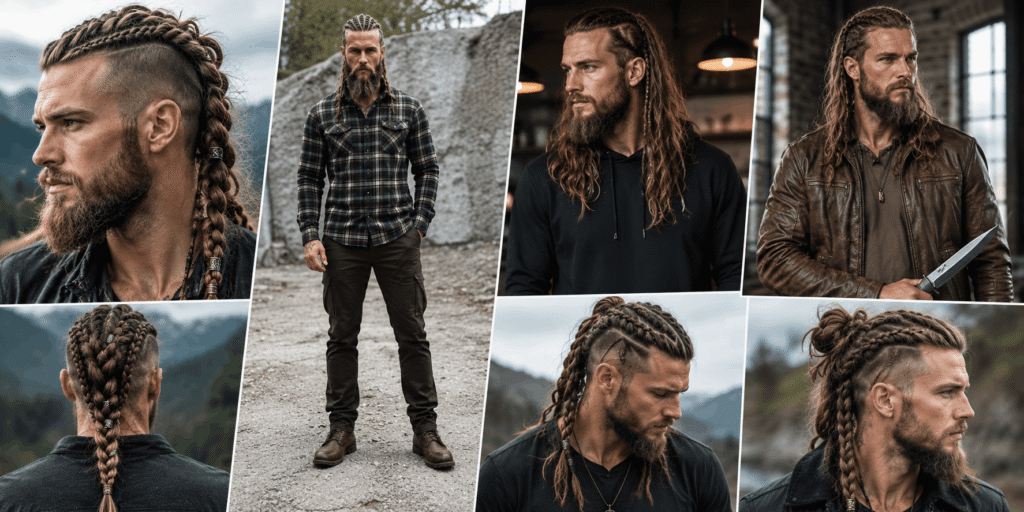
When people picture Viking hair, they often imagine extremely long hair, a thick beard, and a complicated braid running down the back. Modern Viking hairstyles are much more flexible. You can create the same rugged impression with medium-length hair, a shorter haircut, or even a carefully placed braid.
The key feature is usually texture and structure. Viking-inspired hairstyles tend to look more natural when the hair has some movement instead of appearing perfectly polished. Braids can be tight and defined, while the rest of the hair can remain loose and textured.
Another reason these hairstyles have become so versatile is the combination of traditional-looking elements with contemporary cuts. An undercut, fade, shaved side, or top knot can completely change the appearance of a braid. This allows you to create something that feels modern while still carrying the adventurous character associated with Viking-inspired grooming.
10 Viking Braids Men Can Adapt to Their Own Hair
There isn’t one correct way to create a Viking-inspired hairstyle. The following ideas range from relatively simple looks to more noticeable braided designs, giving you options depending on how adventurous you want your haircut to be.
1. Undercut With a Statement Braid
An undercut creates a strong contrast between shorter sides and longer hair on top. That contrast makes it particularly useful for Viking-inspired styles because the longer section becomes the main focus.
Instead of leaving the top completely loose, you can gather part of it into a thick braid that travels toward the back. The remaining hair can be tied into a small ponytail or left flowing behind the braid.
The sides do not necessarily need to be completely shaved. A closely trimmed undercut can produce a cleaner appearance, while a more dramatic contrast gives the hairstyle a stronger warrior-inspired character.
This option works particularly well when the hair on top is thick enough to produce a visible braid. If your hair is naturally fine, keeping the braid slightly looser can help preserve some visual volume.
2. Long Hair With a Loose Texture
Long hair is one of the easiest foundations for Viking-inspired styling because it provides enough length for different braiding techniques.
Rather than turning all the hair into a complex braid, you can leave most of it loose and create one or two smaller braids through the sides or front. This produces a relaxed appearance without requiring the entire hairstyle to be tightly controlled.
The loose sections are important because they prevent the hairstyle from looking overly formal. Natural waves and texture can make the finished look feel more rugged.
For straight hair, adding subtle texture before styling can help the braid stay in place. Naturally wavy or curly hair can create an even more dimensional result because the loose sections already have movement.
3. Top Knot With Braided Sections
A top knot offers another way to introduce Viking-inspired elements without requiring extremely long hair everywhere.
The hair on top can be pulled into a knot while selected sections are braided before being incorporated into the style. You can create a single braid from the front or use smaller side braids that lead toward the knot.
This design has a strong visual contrast because the knot creates height while the braids add detail around it. The sides can remain shorter for a sharper modern finish.
The top knot also gives you flexibility. You can wear the hair more tightly when you want a clean appearance or leave a few strands loose for a relaxed style.
One advantage of this approach is that the hairstyle doesn’t depend entirely on having extremely long hair. Medium-length top hair can often be enough for a small knot combined with shorter braids.
4. Textured Warrior Layers
Not every Viking-inspired hairstyle needs an obvious braid. Layered, textured hair can create the rugged foundation for adding one later.
A textured warrior-style cut usually focuses on movement rather than perfectly smooth strands. Longer layers can be allowed to fall naturally around the face and neck, while a small braid can be added to one section.
This is a useful option for men who like the Viking aesthetic but don’t want a hairstyle that looks too elaborate every day.
The texture also makes the style more forgiving. Small imperfections in the hair do not necessarily ruin the appearance because the overall look is supposed to have movement and dimension.
If your hair is naturally thick, ask for layers that reduce excessive weight without making the ends too thin. The goal is to preserve enough density for the hair to look substantial when styled.
5. Half-Up Viking Style
A half-up hairstyle is one of the easiest ways to combine loose hair with a controlled braided section.
The upper portion of the hair is gathered toward the back while the lower section remains loose. You can braid the upper section before tying it, or simply add one or two narrow braids before securing the hair.
This style creates a balanced appearance because the top looks structured while the lower hair maintains its natural movement.
For a more traditional-inspired appearance, the braid can be slightly thicker and paired with textured loose hair. For a contemporary version, keep the braid neat and the remaining hair smooth.
A half-up style can also work well when you’re growing your hair out. Instead of waiting until every section reaches extreme length, you can begin experimenting with smaller braids as the top becomes long enough to manage.
Viking Braids Men Can Wear With Modern Haircuts
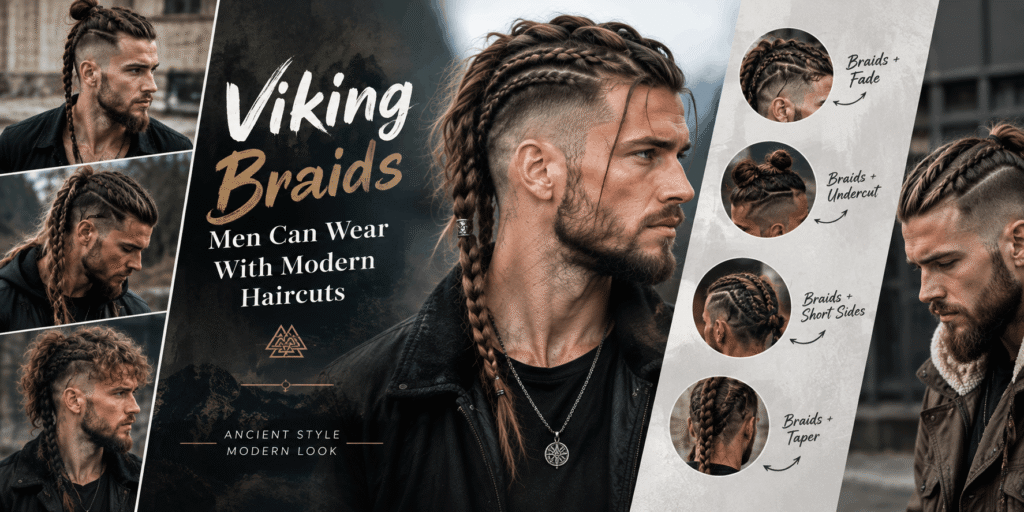
Viking braids become especially interesting when they are combined with a modern haircut. Rather than treating the braid and haircut as separate elements, think of them as parts of the same design.
For example, shorter sides can make a braid across the top more visible. A fade can create a gradual transition from the braided section to the shorter areas. A longer fringe can also be incorporated into a front-to-back braid.
The amount of contrast determines how noticeable the finished hairstyle becomes. A subtle difference between the sides and top gives you something easier to wear every day, while dramatically shortened sides make the braid the center of attention.
Hair texture matters too. Thick hair can produce substantial braids without much additional styling. Medium-density hair may benefit from slightly looser braiding to maintain fullness. Curly or wavy hair can give the finished style additional texture naturally.
6. Single Back Braid
The single back braid is one of the simplest ways to enter the world of Viking-inspired hair.
Instead of creating multiple complicated sections, most of the hair remains loose or tied back while one central section is braided from the crown toward the back.
The braid can be narrow for a subtle detail or wider if you want it to become the main feature of the hairstyle.
This style is particularly useful for men who don’t want to spend a long time styling their hair. Once the section is separated, the actual braid can be relatively straightforward.
You can also change the appearance simply by adjusting its position. A braid placed directly down the center creates a symmetrical look, while shifting it slightly to one side produces a more relaxed appearance.
For longer hair, the braid can continue into the ponytail rather than stopping at the back of the head.
7. Side Braids With Loose Length
Side braids offer a more detailed alternative to the single-braid approach.
One or two narrow braids can be created along the side of the head while the remaining hair stays loose. This arrangement creates contrast without requiring the entire hairstyle to be braided.
If both sides are braided similarly, the result can look balanced and deliberate. A single side braid creates an asymmetrical appearance that feels more casual.
The braids can also vary in thickness. Thin braids provide small details that are visible when someone looks closely, whereas thicker braids immediately become part of the hairstyle’s overall shape.
For an especially textured appearance, leave the remaining hair natural instead of trying to make every strand perfectly smooth.
Building a Viking Braid That Actually Fits Your Hair
Before choosing a particular braid, consider what your hair is already capable of doing.
Length is the first factor. A braid needs enough hair to overlap and hold together. Very short hair may not have enough length for a conventional braid, but smaller accent braids can still become possible as the hair grows.
Thickness is equally important. Thick hair naturally creates fuller braids, while finer hair may produce narrower braids. Neither is necessarily a problem; the hairstyle simply needs to be adjusted to the amount of hair available.
Texture can also influence the final appearance. Straight hair generally produces clearer braid patterns, while waves and curls can create a more textured result. Hair that tends to slip out of braids may need gentle styling preparation to improve hold.
Finally, think about how much time you realistically want to spend styling your hair. A hairstyle that looks impressive but takes too long to recreate every morning may not be practical for your routine.
More Braided Styles to Explore
The following styles build on the basic braid ideas from Part 1 but introduce more structure. They can be adjusted depending on how much hair you have available.
8. Ragnar-Inspired Braids
A Ragnar-inspired hairstyle usually combines several elements instead of relying on one simple braid. Multiple braids, tied-back sections, shorter sides, and textured length can work together to create a bold appearance.
Rather than copying a specific character’s hairstyle exactly, you can use the general concept as inspiration. For example, the sides can be kept shorter while the longer top is divided into several sections and braided toward the back.
The important feature is the combination of braids. Using different braid sizes can create more depth than making every braid identical.
This style tends to work particularly well with thick hair because there is enough volume to separate the hair into multiple sections. Men with medium-density hair can achieve a similar effect by using fewer braids and leaving more of the hair loose.
9. Braided Ponytail
A braided ponytail combines two practical ideas into one hairstyle. First, the hair is gathered into a ponytail, and then some or all of the length is braided.
You can keep the upper portion relatively clean while allowing the braid to become the main feature toward the back. Another option is to create a small braid along the top before gathering everything into a ponytail.
The finished result can be adjusted from subtle to dramatic depending on the thickness of the braid.
A loose braided ponytail gives the style a relaxed appearance, while a tighter braid creates a more structured finish. If your hair is very long, you can also leave a short unbraided section at the end rather than braiding all the way down.
10. Braided Mohawk
A braided mohawk takes the central section of the hair and makes it the visual focus.
The sides are kept significantly shorter while the longer middle section is styled into one large braid or several smaller braids. Because the sides are shorter, even a relatively simple braid can look much more prominent.
This style is especially suitable for someone who wants a noticeable haircut rather than a subtle hairstyle.
The central section doesn’t have to be perfectly upright or extremely long. A medium-length strip of hair can create the foundation, although additional length provides more options for braiding.
For a softer modern interpretation, use a gradual fade on the sides instead of completely shaving them.
Choosing a Viking Hairstyle That Matches Your Hair
The most important part of choosing a Viking-inspired hairstyle isn’t simply finding a picture you like. You also need to consider whether the style works with your current hair.
Short Hair
Short hair limits the number of traditional-looking braids you can create, but that doesn’t mean Viking-inspired styling is impossible.
Small accent braids can be added to the top or side if there is enough length to secure them. A textured crop with one narrow braid can create a subtle interpretation without waiting years for long hair.
As the hair grows, you can gradually experiment with larger braids and tied-back styles.
Medium-Length Hair
Medium-length hair provides a useful middle ground. It is long enough for several braiding options but generally easier to manage than very long hair.
A half-up style, small side braids, top knot, or short ponytail can work particularly well at this length.
If you’re growing your hair specifically for Viking braids, this is also the stage where you can start developing a consistent styling routine. Learning how your hair behaves now will make longer styles easier later.
Long Hair
Long hair gives you the greatest variety.
You can create thick central braids, multiple side braids, ponytails, half-up styles, and combinations involving knots and braids. However, having more length also means more responsibility when it comes to detangling and protecting the hair.
Long hair should not automatically mean complicated styling. Sometimes a simple braid through the back can look more effective than several competing braids.
Thick Hair
Thick hair is naturally suited to bold braid styles because it can produce substantial-looking sections.
If your hair feels heavy, layers can help distribute the weight while preserving enough length for braiding. Avoid removing too much density if you want thick, prominent braids.
Fine or Thin Hair
Finer hair can still work with Viking-inspired designs, but extremely large braids may not produce the desired shape.
Smaller braids, half-up styles, and textured looks can be more suitable. Keeping the style relatively simple can help the available hair look intentional rather than overly stretched.
How to Keep Viking Braids Looking Good Every Day
A good braid starts with healthy, manageable hair. Styling alone cannot compensate for hair that is constantly tangled, excessively dry, or difficult to control.
Keep the Hair Clean Without Overdoing It
A regular washing routine helps remove sweat, oil, and product buildup. However, washing frequency depends on your hair type and scalp rather than a universal schedule.
Very dry hair may become difficult to manage if it is repeatedly stripped of natural oils, while oily hair may need more frequent cleansing.
Choose products according to how your hair behaves instead of simply buying something marketed as a “Viking” product.
Condition Longer Hair
Conditioner can make a major difference when your hair is long enough to braid.
It helps improve manageability, which can make detangling easier and reduce unnecessary pulling while preparing the hair. Apply it primarily through the lengths and ends according to the product instructions.
If your hair becomes tangled easily, gently work through knots instead of aggressively pulling a comb through them.
Don’t Braid Extremely Tight
A braid can look neat without being painfully tight.
Constantly pulling the hair tightly from the same areas can cause unnecessary tension. If a style feels uncomfortable, loosen it rather than trying to endure it for the sake of appearance.
This is particularly important around the hairline and temples, where excessive tension can be noticeable.
Protect Long Hair
Long hair needs some extra care when it is not being styled. Avoid repeatedly putting it into the same tight position, especially if the hairstyle creates tension in one particular area.
When sleeping, loosely securing long hair or keeping it arranged in a way that reduces tangling can make the next styling session easier. A smooth pillowcase can also help reduce friction.
When detangling, start from the ends and gradually work upward rather than pulling through the entire length at once. This approach can make the process more manageable and reduce unnecessary stress on the hair.
Give Your Hair a Break From Styling
You do not need to wear a braid every day just because you have grown your hair long enough for one.
Alternating between loose hair, a relaxed ponytail, and braided styles can give you more flexibility and prevent the same areas from being repeatedly pulled into one position.
The goal is to make Viking-inspired styling part of your routine rather than something that requires constant tension or complicated preparation.
How to Style Viking Braids for Different Occasions
Viking-inspired hair does not have to be limited to dramatic or costume-like settings. The amount of braiding and contrast can be adjusted depending on where you are going.
For everyday wear, a single back braid, small side braid, or half-up style can provide the Viking influence without becoming the entire focus of your appearance.
For a more noticeable look, multiple braids, an undercut, or a braided ponytail can create stronger visual structure. These styles work especially well when you want the hairstyle itself to make more of a statement.
You can also simplify the style for formal settings. A clean half-up braid with controlled texture can look more polished than a heavily layered combination of braids and loose sections.
The same basic haircut can therefore produce several different looks depending on how you arrange the hair.
What to Tell Your Barber or Stylist
Before getting a Viking-inspired haircut, be specific about the parts of the style that matter most to you.
Explain whether you want to keep significant length on top, how short you want the sides, and whether you plan to create braids regularly. If you want an undercut or fade, show how much contrast you prefer between the sides and top.
It can also help to bring a reference photo that has a similar hair length and texture to your own. A style that looks full on very thick hair may appear different when recreated on finer hair.
If you are growing your hair out, tell your stylist that maintaining enough length for future braiding is important. They can shape the hair without removing more length than necessary.
Final Thoughts
Viking braids men styles offer plenty of room to experiment without requiring one specific haircut or hair length. A simple single braid can create a subtle interpretation, while multiple braids, an undercut, top knot, braided ponytail, or mohawk can produce a much stronger statement.
The most practical approach is to start with your existing hair rather than forcing it into a style that requires a completely different length or texture. Short, medium, and long hair can all incorporate Viking-inspired elements when the braid size and overall structure are adjusted accordingly.
Texture also plays an important role. Thick hair can support fuller braids, while finer hair may work better with smaller sections and simpler arrangements. Waves and curls can add natural movement, while straight hair can provide clearer and more defined braid patterns.
Ultimately, the appeal of Viking-inspired hair comes from combining structure with individuality. Whether you choose one narrow braid or a complete braided hairstyle, the right combination of length, texture, and modern haircut details can make the look feel distinctive while still being practical enough for everyday wear.
Yes. Short hair can support smaller accent braids and textured styles when there is enough length to secure the hair. You may not be able to recreate a long central braid immediately, but a shorter interpretation can still capture the overall aesthetic.
There is no single minimum length because different braids require different amounts of hair.
A small accent braid needs considerably less length than a full ponytail braid. For more elaborate styles, additional length gives you more flexibility.
Instead of focusing on a specific number of inches, consider whether you can comfortably gather and overlap enough hair to create the braid you want.
It depends on the design.
A single braid with loose hair can be relatively simple, while multiple braids combined with an undercut or top knot require more preparation.
Hair length also affects maintenance. Long hair generally takes more time to wash, dry, detangle, and style than shorter hair.
One Comment