
Weak, soft, peeling, or easily splitting nails can make even a simple manicure feel frustrating. A nail strengthener is designed to help improve the feel and durability of the nail, but not every formula works in the same way. Some products are designed to create a harder protective layer, while others focus more on conditioning and reducing dryness that can contribute to splitting.
The right choice depends on what your nails are actually struggling with. Nails that bend easily may need a different approach from nails that repeatedly peel at the tips. Likewise, someone recovering from frequent gel manicures may benefit from a conditioning treatment rather than simply applying the hardest possible coating.
Understanding what these products do, how to apply them, and when to use them can make your nail-care routine much more effective.
What Does a Nail Strengthener Actually Do?
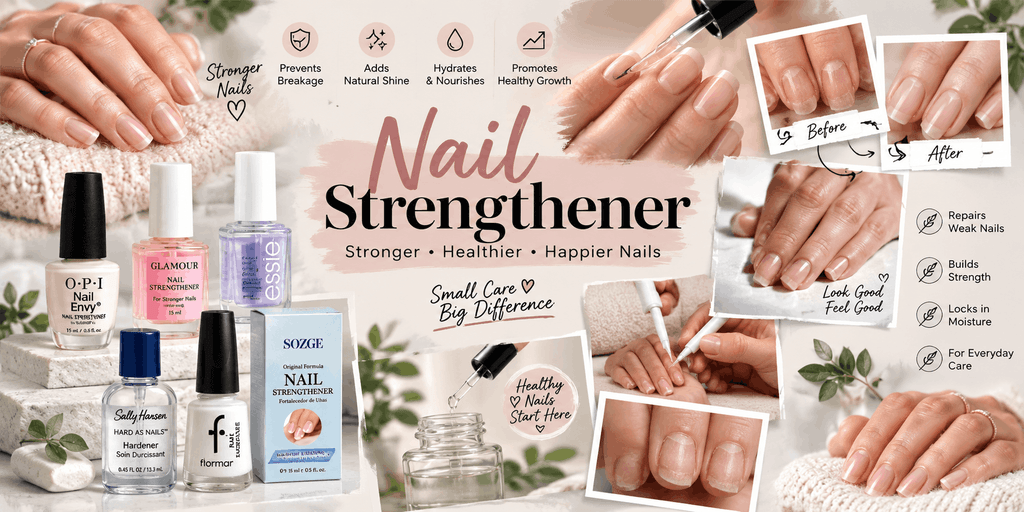
A nail strengthener is a nail-care product intended to improve the resilience or appearance of the natural nail. Depending on its ingredients and formulation, it may form a protective film over the nail, help condition the nail plate, or temporarily make the nails feel firmer.
That distinction matters because “stronger” does not always mean “harder.”
Extremely rigid nails are not automatically healthier. Natural nails need a certain amount of flexibility, and making them excessively hard can sometimes make them more prone to breaking when they encounter pressure.
Many modern nail treatments therefore combine strengthening ingredients with conditioning components. The goal is to help the nail withstand everyday activities while maintaining a reasonable level of flexibility.
A nail strengthener can also be useful as part of a broader routine. Keeping the nails moisturized, avoiding unnecessary picking, protecting your hands during household chores, and being gentle when removing polish can all matter alongside the treatment itself.
Why Nails Become Weak in the First Place
Before choosing a product, it helps to understand why nails may feel weak.
Frequent exposure to water is one common factor. Repeatedly getting the nails wet and allowing them to dry can contribute to changes in the nail’s flexibility. Household cleaning products can also be irritating to the surrounding skin and nails.
Another factor is repeated manicure processing. Gel polish, acrylic enhancements, aggressive filing, and frequent removal can leave nails feeling thinner or more fragile, particularly when the natural nail is repeatedly buffed or scraped.
Mechanical damage matters too. Using your nails to open packages, scratch surfaces, peel labels, or perform other tasks can put stress on the nail plate.
Dryness can also make the nails and surrounding skin feel rough. Regularly applying a suitable hand or cuticle moisturizer can therefore be a useful part of nail care even when you’re using a dedicated strengthening product.
If nail changes are sudden, severe, persistent, painful, or accompanied by discoloration or changes in the surrounding skin, a nail cosmetic product may not address the underlying cause. In those situations, getting professional medical advice is more appropriate.
Choosing a Nail Strengthener for Your Nail Type
There isn’t one universal formula that is ideal for every person. Your nail condition should influence what kind of product you look for.
For Nails That Bend Easily
If your nails feel soft and flexible, a product that provides a light protective coating may make them feel more resistant during everyday activities.
However, avoid assuming that the strongest-feeling formula is automatically the best choice. The objective is to improve durability without making the nails excessively rigid.
A strengthening base coat can be particularly convenient if you regularly wear nail polish because it can become part of your normal manicure routine.
For Peeling or Splitting Nails
Peeling nails often need more than a hard coating.
If the layers of the nail are separating at the tips, focus on reducing mechanical stress and keeping the nails conditioned. A treatment that combines protective properties with moisturizing or conditioning ingredients may be more appropriate than simply choosing an extremely hard formula.
Keeping the nails at a manageable length can also reduce the amount of leverage placed on the free edge.
When filing, use gentle strokes rather than repeatedly sawing back and forth. Smooth edges are less likely to catch on clothing and other surfaces.
For Nails Recovering From Gel or Artificial Enhancements
After repeated gel or artificial nail applications, some people notice that their natural nails feel thinner or more delicate.
This is a situation where patience matters. Nails grow gradually, so a topical treatment cannot instantly replace damaged nail tissue.
A conditioning treatment can be incorporated into a break from artificial enhancements. During this period, keep the nails relatively short, moisturize regularly, and avoid aggressively buffing the surface.
A nail strengthener can provide temporary protection as the nail grows, but it should be viewed as one part of the recovery routine rather than an instant repair solution.
Different Types of Nail Strengtheners
Nail strengtheners are not all formulated to perform exactly the same job. Looking at the category of product can help you choose one that matches your routine.
A strengthening base coat is useful for people who want something that can sit underneath regular nail polish. It can provide a protective layer while helping the manicure adhere properly.
A treatment-style strengthener is generally intended to be used on its own according to the product’s instructions. These formulas may be more convenient if you aren’t interested in wearing colored polish.
A conditioning treatment takes a somewhat different approach. Rather than focusing primarily on hardness, it may emphasize hydration, flexibility, or the overall condition of the nail and surrounding skin.
There are also products marketed specifically for ridges, peeling, or post-manicure care. These can be useful when the main concern is not simply weakness but the texture or appearance of the nail surface.
The important thing is to read the product instructions instead of assuming every strengthener should be applied in exactly the same way.
Ingredients Matter More Than Marketing Claims
The word “strengthening” on a bottle doesn’t tell you everything about how the product works.
Look at the ingredient list and product instructions to understand whether the formula is primarily creating a protective film, conditioning the nail, or combining several functions.
Some formulas contain ingredients intended to reinforce the nail surface, while others include conditioning agents designed to improve flexibility and reduce dryness.
It is also worth remembering that cosmetic claims can vary between products. A formula that makes one person’s nails feel noticeably stronger may not produce exactly the same experience for someone else.
Instead of searching for a magical ingredient, consider the entire formula and how it fits your specific problem.
How to Apply Nail Strengthener Properly
Application seems simple, but technique can affect how comfortable and useful the product is.
Start with clean, dry nails unless the manufacturer’s directions specify otherwise. Remove old polish and allow the nails to dry completely.
Apply a thin, even layer rather than flooding the nail with product. Getting large amounts onto the surrounding skin can make the application messy and may not provide additional benefit.
Some products are designed to be reapplied after a certain period, while others should be removed and replaced according to a specific schedule. Follow the instructions on the particular product rather than creating a universal routine.
If the product causes burning, significant irritation, redness, or another unexpected reaction, stop using it.
A Simple Routine for Stronger-Looking Nails
A nail strengthener works best when you aren’t constantly undoing its benefits through rough nail habits.
Keep your nails at a practical length, especially if they are currently splitting. Longer nails experience more leverage when they hit or catch on objects.
Moisturize your hands and cuticles regularly. Dry skin around the nails can make the entire area look rough even when the nail itself is in good condition.
Wear suitable gloves when your hands are exposed to household cleaning products or prolonged wet work. This can reduce unnecessary exposure to irritating substances.
Be gentle when removing polish. Avoid scraping or peeling product from the nail because doing so can remove layers from the natural nail surface.
Also pay attention to how often you use intensive manicure techniques. Taking occasional breaks from enhancements can give you an opportunity to observe the natural condition of your nails.
Nail Strengthener vs. Nail Hardener
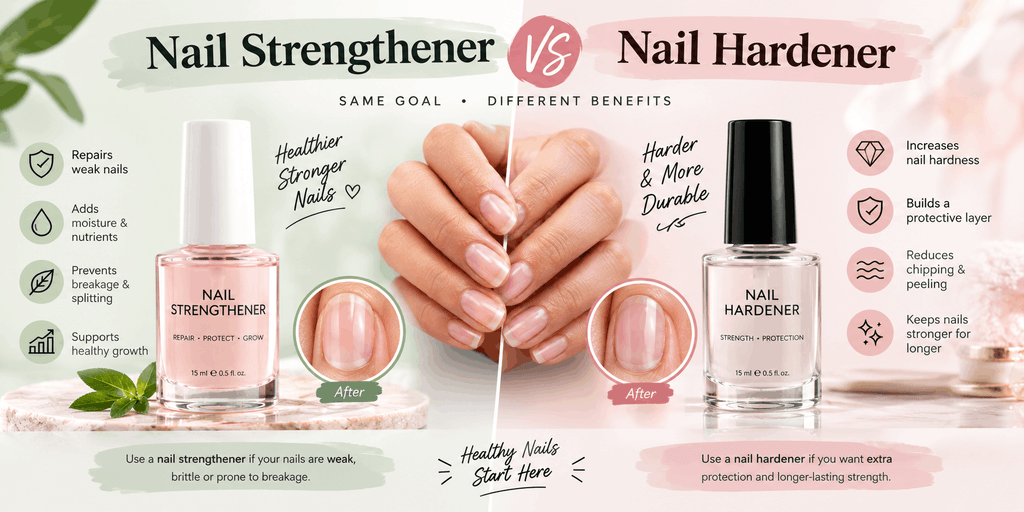
The terms are sometimes used interchangeably, but they can describe somewhat different approaches.
A hardener generally emphasizes making the nail surface feel firmer. This can be useful for very soft nails, but excessive rigidity isn’t necessarily desirable.
A strengthener is a broader term that can refer to products designed to improve durability through a protective coating, conditioning, or a combination of approaches.
If your nails bend excessively, you might prefer a formula with a strengthening or hardening effect. If they are dry and peeling, a conditioning-focused treatment may make more sense.
This is why choosing based solely on the strongest marketing claim can be misleading. Think about the actual behavior of your nails first.
How Long Does It Take to Notice a Difference?
Nails don’t transform overnight.
A coating can make the surface feel different immediately, but meaningful improvement in the condition of the natural nail depends on consistent care and the growth of new nail.
If the nail has already been damaged, the affected portion generally needs time to grow out. Fingernails grow gradually, so the visible result of changing your routine may take weeks rather than a few days.
Consistency is therefore more useful than constantly switching between products.
Give a product enough time to follow its recommended routine, observe how your nails respond, and avoid adding several new treatments simultaneously. That makes it easier to understand what is actually helping.
When a Strengthener Isn’t the Answer
Not every nail problem is simply a cosmetic weakness.
Persistent changes in nail color, significant thickening or thinning, pain, swelling, separation from the nail bed, or unexplained changes affecting several nails can have causes that require professional evaluation.
A strengthener is a cosmetic product, not a treatment for every nail condition.
If you notice something unusual or a nail problem continues despite gentle care, it is better to ask a healthcare professional about it rather than repeatedly applying stronger cosmetic products.
How to Get More From Your Nail Strengthener
Consistency is one of the simplest ways to make your nail-care routine easier to manage. Applying a product randomly whenever your nails feel weak makes it difficult to determine whether it is helping.
Follow the manufacturer’s recommended application schedule. Some treatments are intended for daily use, some are designed to be applied periodically, and others are meant to function as a base coat underneath polish.
Avoid applying increasingly thick layers in the hope that more product will automatically mean stronger nails. A thick coating can become uneven, peel away, or make the manicure look bulky.
Preparation also matters. Unless the product instructions say otherwise, start with clean nails free from leftover polish, oils, and debris. A clean surface generally makes application easier and more consistent.
If you regularly use nail polish, a strengthening base coat can be particularly convenient because it can fit into your normal manicure without requiring a completely separate routine.
What to Look for When Comparing Products
When comparing nail strengtheners, don’t judge them only by the words printed on the front of the bottle.
First, consider the type of problem you’re trying to address. A formula aimed at hardening soft nails may not be the most suitable choice for nails that are already dry and peeling.
Next, check how the product is intended to be used. A treatment that requires several steps may not be practical if you prefer a quick routine. A base-coat formula may be more convenient if you already polish your nails frequently.
Pay attention to the finish as well. Some products dry clear, while others can leave a noticeable sheen or tint. If you want to wear the treatment alone, the appearance may matter more to you.
Finally, read the instructions carefully. Application frequency, removal method, and compatibility with other nail products can vary significantly between formulas.
Nail Strengthener and Regular Polish Can Work Together
A strengthening product doesn’t necessarily mean giving up colored nail polish.
If the product is designed as a base coat, you can generally use it underneath your normal manicure according to its instructions. This can make the treatment easier to maintain because it becomes part of a routine you already follow.
However, not every nail strengthener is intended to sit underneath other products. Some are treatment formulas that should be used alone or according to a specific schedule.
Check the manufacturer’s directions before layering products.
When removing the manicure, avoid picking or peeling polish away from the nail. That habit can take portions of the natural nail surface with it and undermine the purpose of your strengthening routine.
The Role of Moisture in Nail Care
Strength and flexibility aren’t completely separate concepts.
Nails that are repeatedly exposed to water, cleansers, solvents, and other drying conditions can become more difficult to manage. The surrounding skin can also become dry and rough, making the hands look less polished.
A moisturizer or cuticle-conditioning product can complement a nail strengthener by supporting the overall condition of the nail area.
Apply your chosen moisturizer consistently, particularly after washing your hands or whenever the skin feels dry. Pay attention to the cuticles and surrounding skin rather than focusing exclusively on the nail plate.
The goal is not to make the nails permanently soft or permanently hard. Healthy-looking nails generally benefit from a balance between durability and flexibility.
Habits That Can Undermine Your Results
Even a well-formulated nail strengthener can’t completely protect nails from repeated physical damage.
Using your nails as tools is one of the easiest habits to change. Opening cans, scraping stickers, separating objects, or prying at small items can put unnecessary pressure on the nail.
Picking at polish is another common problem. When a corner begins to lift, it can be tempting to pull it away rather than remove the manicure properly.
Aggressive filing can also contribute to unnecessary wear. Keep the edges smooth and use a gentle technique instead of repeatedly filing the same area.
If you frequently receive gel or artificial manicures, consider how the nails are prepared and removed. Aggressive removal or excessive filing can contribute to a thinner-feeling natural nail.
Small changes in these habits can sometimes be just as important as changing the product you use.
Final Thoughts
A nail strengthener can be a useful part of a nail-care routine, but getting better results is about more than simply applying more product. Choosing a formula that matches your nail concerns, following its recommended schedule, and using it consistently can make the routine much easier to manage.
At the same time, everyday habits matter. Moisturizing the nails and surrounding skin, avoiding unnecessary pressure, removing polish gently, and being careful with frequent manicure treatments can all support healthier-looking nails.
The goal isn’t to make your nails as hard as possible. It’s to help them handle normal daily activity while maintaining enough flexibility to stay comfortable and manageable. With the right product and a consistent routine, nail care can become simpler rather than more complicated.
There isn’t one product that is universally best for every type of weak nail. The right choice depends on whether your nails are soft, peeling, splitting, dry, or recovering from manicure-related damage.
Look for a formula that addresses your specific concern and follow its directions consistently.
A nail strengthener does not necessarily make the natural nail grow faster. Its primary purpose is generally to improve protection, durability, or the condition of the nail surface.
Some can, particularly products specifically formulated as strengthening base coats. Others are intended to be used alone.
Always check the instructions for the particular product before applying polish over it.
2 Comments