
If your hair naturally forms tight, springy curls with plenty of texture, you may have a 3C curl pattern. 3C hair is often recognized by its well-defined curls, noticeable shrinkage, and tendency to need consistent moisture. While the curl pattern itself gives you a useful starting point, every person’s hair can behave differently depending on strand thickness, density, porosity, length, and previous treatments.
Taking care of 3C curls does not have to mean following an extremely complicated routine. In fact, using too many products or constantly changing your routine can make it harder to understand what your hair actually needs. A simpler approach usually works better: keep the hair conditioned, detangle it carefully, choose products that suit its texture, and protect the curls from unnecessary manipulation.
What Is 3C Hair and What Does It Look Like?
3C hair falls within the curly category of the commonly used hair typing system. It generally has tighter curls than 3A and 3B hair, with curls that can form small, spring-like loops. The individual curls may appear clearly defined when the hair is properly moisturized and styled, although the exact pattern can vary across the head.
One of the most noticeable characteristics is shrinkage. Hair can appear considerably shorter when it dries because the curls contract toward their natural shape. This does not mean the hair has actually become shorter; it is simply a result of the curl pattern pulling the strands inward.
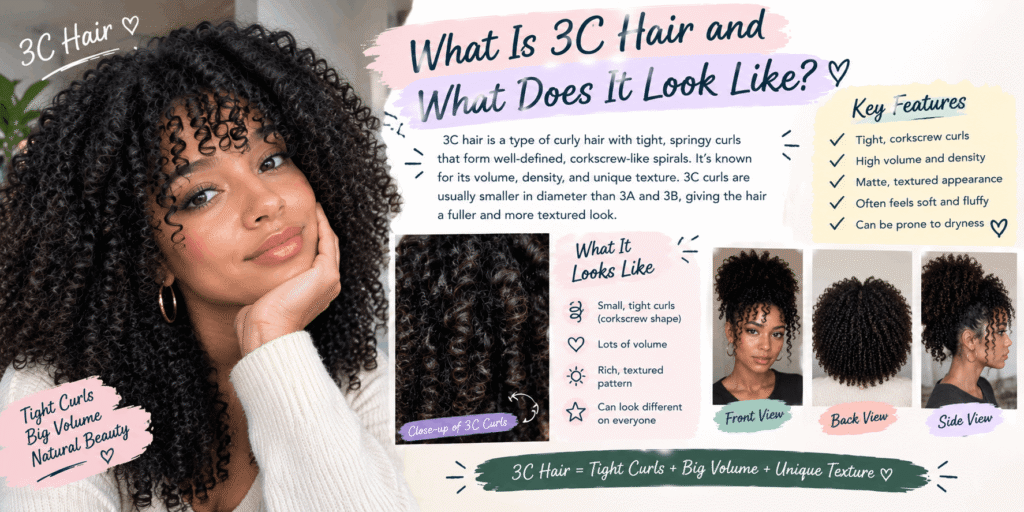
The texture can also vary from person to person. Some people with a 3C pattern may have relatively fine strands, while others may have thicker or denser hair. This difference matters because a product that feels lightweight on one person’s curls could feel too heavy on another’s.
Another important point is that curl patterns are not always perfectly uniform. You may notice looser curls in one area and tighter curls in another. Sections around the hairline, crown, or underneath the hair may behave differently, and that is completely normal.
3C Hair vs. Other Curl Types
The easiest way to understand 3C hair is to compare the general curl shape with neighboring patterns. Type 2 hair is usually categorized as wavy, while type 3 hair is curly. Within type 3, 3A generally has looser curls, 3B has more defined and tighter curls, and 3C has an even smaller, springier curl pattern.
However, these categories should be treated as descriptions rather than strict rules. Hair typing does not tell you everything about your hair. Two people can have a similar curl pattern but completely different levels of density, porosity, thickness, or moisture needs.
This is why choosing products only because they say “for 3C hair” is not always enough. It is more useful to observe how your own hair reacts. If a product leaves your curls soft and manageable without making them feel coated or weighed down, it may be a better match for your routine.
How to Care for 3C Hair Without Overcomplicating Your Routine
Moisture is often an important part of caring for curly hair because the bends and curves of the strands can make it harder for natural scalp oils to travel down the entire length. As a result, the ends may sometimes feel drier than the roots.
Regular conditioning can help make the hair feel softer and easier to detangle. A rinse-out conditioner can be part of your normal wash routine, while a deeper conditioning treatment can be added when your hair feels like it needs extra softness.
The amount of moisture your hair needs will depend on your individual texture. Using more product is not always better. If your curls start feeling heavy, greasy, or coated, your routine may contain more product than your hair needs.
Washing and Detangling 3C Curls
Cleansing your scalp helps remove sweat, excess oil, styling products, and buildup. The ideal washing frequency depends on your scalp, lifestyle, products, and personal preference, so there is no universal schedule that every person with 3C curls needs to follow.
When washing, concentrate cleansing on the scalp and allow the lather to move through the lengths rather than aggressively scrubbing the curls. Follow with conditioner to make detangling easier.
Detangling is usually more manageable when curly hair has moisture and enough slip. Instead of pulling through large knots, separate the hair into manageable sections and work gradually from the ends upward.
Your fingers, a wide-tooth comb, or a suitable detangling brush can all work depending on your preference. The most important thing is to avoid rushing through knots or repeatedly pulling at the same section.
Choosing Products for Your Hair
Product selection should be based on what your curls need rather than simply how they are labeled. A lightweight leave-in conditioner may work well if your hair becomes weighed down easily, while someone with drier or thicker strands may prefer a richer conditioning product.
Styling products can also serve different purposes. Curl creams may provide softness and definition, while gels can offer stronger hold. Mousses can be useful when you want some definition without a particularly heavy finish.
You do not need to use all of these products together. Starting with one styling product makes it easier to see how your curls respond.
If your hair becomes dull or coated after repeated styling, buildup may be part of the problem. In that situation, adjusting your cleansing routine may be more useful than adding another styling product.
Protecting Curls Between Wash Days
The way you treat your hair between washes can affect how easy it is to manage on the next wash day. Constantly brushing, touching, or reshaping curls can disrupt their natural grouping and contribute to frizz.
At night, some people prefer a loose protective style or a satin or silk-style pillowcase to reduce friction. Whatever method you use, it should be comfortable and should not create excessive tension.
You can also refresh curls with a little water and a small amount of styling product. There is no need to completely restart your routine every morning. Focus only on the sections that actually need attention.
The Best Hairstyles for 3C Hair
One of the advantages of having a defined curl pattern is the number of ways you can style it. You can wear your natural texture loose, gather it into a puff, create twists or braids, or put the curls into an updo.
The best hairstyle is ultimately the one that fits your preferences and feels comfortable. You do not need to manipulate your curls into a particular shape simply because it is considered popular.
Wash-and-Go Curls
A wash-and-go is a straightforward way to wear your natural curl pattern. After washing and conditioning, apply a suitable styling product to damp hair and distribute it evenly.
Gently scrunching the curls can encourage them to group together. Once the product has been applied, allow the hair to dry without constantly touching it.
If you use a styling product that creates a firmer feel after drying, gently scrunching the fully dry curls can help soften the finish.
Puff Hairstyles
A puff is a simple option when you want your curls gathered away from your face while keeping their texture visible. You can position it high, low, or somewhere in between depending on your preference.
Avoid pulling the hair excessively tight. A comfortable hair tie or suitable accessory can help secure the style without creating unnecessary tension.
A puff can also be adapted depending on how much definition you want to keep. Some people prefer a more defined texture, while others enjoy a softer and fuller finish.
Braids and Twists
Braids and twists can be practical protective styling options and can also create a different texture when the hair is later released.
When creating these styles, avoid making them uncomfortably tight. Your scalp should not feel painful or excessively pulled.
You can experiment with simple two-strand twists, individual braids, or combinations of twists and loose curls. The style can be as simple or detailed as you prefer.
Easy Updos for 3C Curls
An updo can be useful when you want your hair gathered without completely hiding its natural texture. A loose bun, pinned curls, or a half-up style can all work with curly hair.
Instead of trying to make every strand perfectly smooth, you can allow some curls to remain visible. This can also reduce the amount of brushing and manipulation required to create the hairstyle.
If you use pins, clips, or elastics, choose options that hold the hair comfortably and remove them carefully rather than pulling them out quickly.
Common 3C Hair Problems and How to Manage Them
Curly hair can come with challenges, but most of them become easier to manage once you understand what is affecting your particular curls. Frizz, dryness, tangling, and shrinkage are common topics among people with tighter curl patterns.
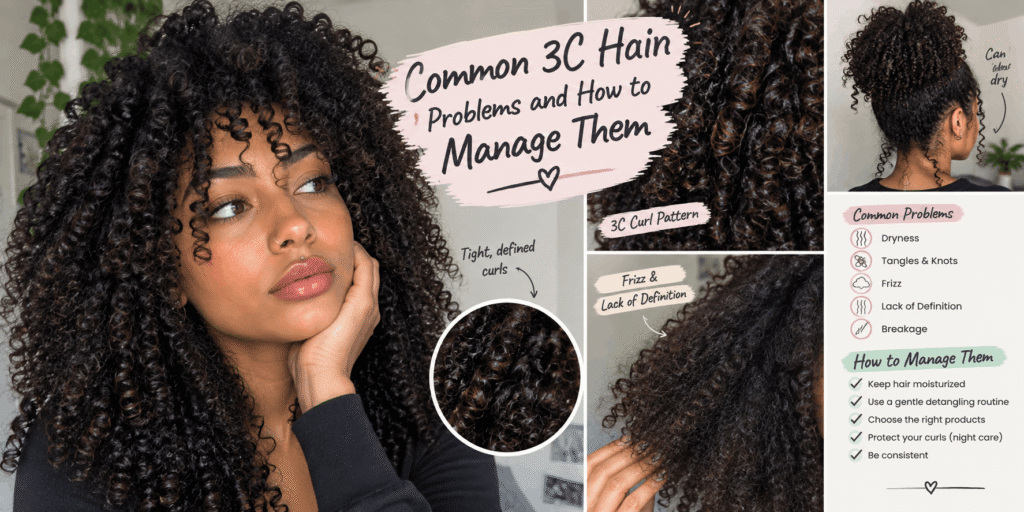
Frizz and Humidity
Humidity can change the way curly hair behaves because the hair interacts with moisture in the surrounding environment. Even a well-defined hairstyle may become less uniform on a humid day.
Rather than trying to eliminate every strand of frizz, focus on keeping your hair conditioned and reducing unnecessary manipulation. A styling product with enough hold may also help the curls stay grouped for longer.
The amount of frizz you experience can change from day to day, and it does not necessarily mean something is wrong with your hair.
Dryness and Tangling
Dryness can make detangling more difficult, particularly around the ends. Regular conditioning, gentle handling, and avoiding excessive heat can help keep the hair easier to work with.
If your hair frequently becomes tangled, consider whether your detangling method, sleeping routine, or styling habits could be contributing to the problem. Working in sections and using enough conditioner can make the process much easier.
You should also pay attention to how your hair feels rather than following a routine simply because someone else uses it. Your curls may need different amounts of conditioning at different times.
Shrinkage and Curl Definition
Shrinkage is a natural characteristic of tightly curled hair. The curls contract as they dry, so the hair may look significantly shorter than it appeared while wet.
There is nothing inherently wrong with shrinkage. Some people enjoy seeing their curls spring upward, while others prefer hairstyles that temporarily stretch the appearance of their hair.
If you want more elongated curls, gentle stretching techniques can be incorporated into your styling routine. The important thing is to avoid excessive heat or tension simply to change the appearance of the curl pattern.
Building a Simple 3C Hair Routine
A good 3C hair routine does not need to contain a long list of complicated steps. The goal is to create a routine that keeps your curls manageable while fitting naturally into your schedule. Start by paying attention to how your hair behaves after washing, conditioning, and styling. This will tell you much more than a generic routine ever could.
For many people, wash day begins with cleansing the scalp and following with a conditioner that makes the hair easier to detangle. Once the hair is conditioned, gently work through any knots before applying your styling products. Taking your time during this stage can make the rest of the routine much easier.
After washing, avoid aggressively rubbing your curls with a regular towel. Gently squeezing excess water from the hair can help reduce unnecessary disturbance to the curl pattern. Some people prefer a microfiber towel or a soft cotton T-shirt for this step.
Styling is usually easiest when the hair is still damp. Apply your chosen product in sections so that it reaches the hair evenly. You can then scrunch the curls or gently shape them with your hands. Try not to repeatedly touch the hair while it is drying because constant manipulation can make the finished style less defined.
Once your curls are completely dry, you can decide whether you like the finish as it is or want to soften it slightly. The right routine is not necessarily the one that creates the most definition; it is the one that gives you a result you actually enjoy wearing.
How to Keep 3C Curls Looking Good Between Washes
The days between wash days can be just as important as wash day itself. You do not need to completely restyle your hair every morning. In many cases, a small amount of water and a little styling product can revive curls that have become flattened overnight.
Start by identifying the areas that actually need refreshing. If only the front or sides have lost their shape, there is no reason to soak the entire head. Lightly dampen the affected sections and reshape the curls with your fingers.
Sleeping habits can also influence how your curls look the next morning. A loose style can help keep the hair from becoming heavily compressed while you sleep. Satin or silk-style materials may also reduce friction compared with some rougher fabrics.
Another useful habit is avoiding unnecessary brushing when your hair is dry. Running a brush through fully formed curls can separate the curl groups and create a much different texture. If you need to detangle, it is generally easier when the hair has moisture and enough conditioner or product to provide slip.
Over time, you will probably discover that some areas of your hair need more attention than others. The front may lose definition faster, while the back may stay curly for longer. Adjust your refresh routine accordingly instead of treating every section exactly the same.
Heat, Color, and Other Things That Can Affect 3C Hair
Heat styling can temporarily change the appearance of curly hair, but frequent or excessive heat can contribute to dryness and damage. If you regularly use heated tools, follow the manufacturer’s safety directions and use an appropriate heat-protecting product.
You do not have to completely avoid heat if you enjoy occasional stretched or straightened styles. The important thing is to avoid treating high heat as the only way to manage your hair.
Chemical treatments and hair color can also change how your curls behave. Lightening, coloring, relaxing, or other chemical processes may affect the feel and condition of the strands. If your hair has been chemically treated, you may need to adjust your conditioning and styling routine.
Pay attention to changes in texture. If your curls suddenly feel rough, break more easily, or no longer behave the way they normally do, it may be worth simplifying your routine and reducing stressful styling practices.
Regular trims can also help keep the ends manageable. A trim does not change your natural curl pattern, but removing damaged or excessively split ends can make the hair easier to style.
3C Hair Styling Ideas for Different Occasions
One of the easiest ways to keep 3C hair interesting is to change the styling approach rather than constantly changing the products you use. Your natural curls can work for casual everyday looks as well as more polished hairstyles.
For a simple everyday appearance, defined curls worn loose can be enough. A side part can create a slightly different shape without requiring major manipulation. You can also gather part of the hair into a half-up style while leaving the rest of the curls loose.
For days when you want the hair away from your face, a puff or loose ponytail can be practical. Adding a simple headband or hair accessory can change the overall appearance without requiring a completely new hairstyle.
Braids and twists offer another option. You can create a few simple sections rather than styling the entire head. This can give the hair structure while still allowing some of your natural texture to remain visible.
For a more polished event style, a low updo can work beautifully with curly texture. Instead of trying to make every curl perfectly smooth, allow some natural texture to remain. This can create a softer and more natural finish.
The best part about experimenting with hairstyles is that you can find several looks that work with the same basic routine. You do not need a different set of products for every hairstyle.
Mistakes to Avoid When Caring for 3C Hair
One common mistake is constantly changing products because the curls do not look perfect after one use. Hair often needs consistency before you can properly judge whether a routine is working.
Another mistake is using too much product. It can be tempting to add more when you want stronger definition, but excess product can leave curls feeling heavy or create buildup. Start with a smaller amount and add more only when necessary.
Detangling too aggressively is another habit worth avoiding. Curly hair can become difficult to manage when knots are pulled apart quickly. Working in sections and starting at the ends can make the process more controlled.
It is also easy to focus too much on achieving perfectly uniform curls. Natural hair does not have to look identical from root to tip. Different curl sizes, textures, and levels of definition can all exist on the same head.
Finally, avoid copying another person’s entire routine simply because they also have 3C curls. Their density, strand thickness, porosity, lifestyle, and styling preferences may be completely different from yours.
How to Find What Works Best for Your 3C Hair
The best 3C hair routine is the one that fits your actual hair rather than a generic checklist. Start with the basics and make one change at a time. This makes it much easier to understand what is helping and what is not.
For example, if your hair feels dry, look at your cleansing and conditioning habits before immediately buying several new products. If your curls lose definition quickly, consider whether your styling product provides enough hold or whether you are touching the hair too much while it dries.
If your hair feels heavy, try reducing the amount of product instead of automatically adding another cleansing step. If detangling takes too long, look at whether you are working in smaller sections and whether your conditioner provides enough slip.
Keep your routine flexible. Your hair may behave differently depending on weather, activity, styling, and how long it has been since your last wash. A routine that works perfectly during one season may need small adjustments during another.
Most importantly, give yourself time to learn your curls. Understanding how your own hair responds is much more valuable than trying to follow every new curly-hair trend.
Final Thoughts
3C hair has a naturally defined and versatile curl pattern, but maintaining it is less about following strict rules and more about learning what your individual hair needs. Moisture, gentle handling, thoughtful styling, and consistent care can make everyday maintenance much easier.
You do not need dozens of products or a complicated schedule. A cleanser, conditioner, suitable styling product, and a few simple habits can provide a strong foundation. From there, you can adjust your routine depending on how your curls respond.
Whether you prefer loose defined curls, a puff, twists, braids, or an updo, there are plenty of ways to work with your natural texture. Instead of trying to make your hair behave exactly like someone else’s, focus on understanding your own curl pattern and creating a routine that feels practical.
With patience and consistency, caring for 3C hair can become much simpler. The goal is not perfection—it is finding a routine that keeps your curls comfortable, manageable, and easy for you to enjoy.

4 Comments