A middle part haircut gives men a balanced, versatile look by dividing the hair near the center and allowing it to fall toward both sides. Depending on the length, texture, and cut, it can look relaxed and casual, neat and polished, or full of natural movement. From classic curtain hairstyles to textured waves and longer layered cuts, there are plenty of ways to make a middle part your own.
The secret is choosing a version that works with your natural hair rather than forcing every strand into the same shape. A good middle part haircut should feel comfortable, suit your preferred level of styling, and fit the way you want to wear your hair every day.
What Is a Middle Part Haircut?
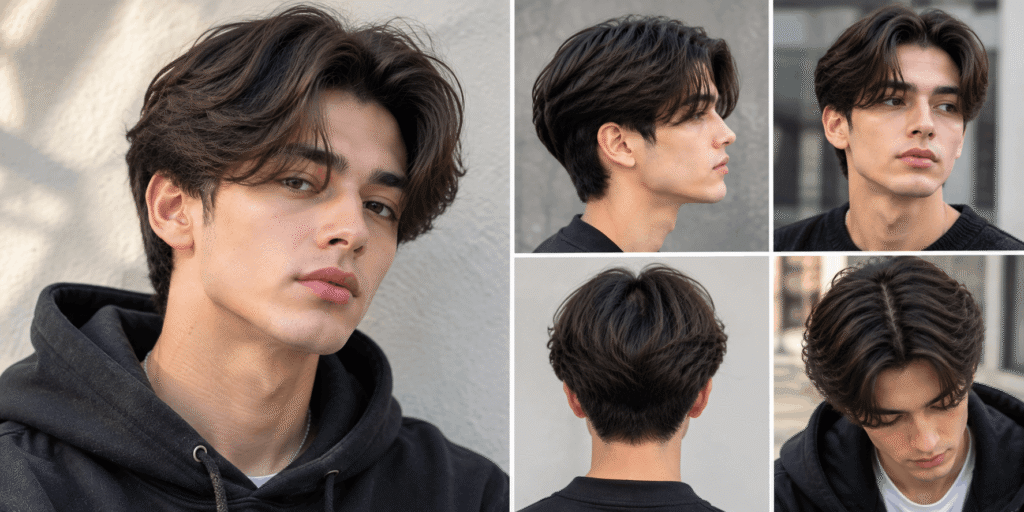
A middle part haircut is a hairstyle in which the hair is separated around the center of the head, creating two sections that fall toward the left and right. The part itself can be sharply defined or softly blended into the hair, depending on the finish you prefer.
This hairstyle is often associated with curtain-like front pieces, but it isn’t limited to one specific cut. You can combine a middle part with a taper, undercut, layers, waves, curls, or longer hair. The result may be neat and structured or loose and natural.
One reason the style offers so much flexibility is that the parting and the haircut are two separate choices. The part determines how the hair is divided, while the cut shapes its length, volume, and movement. You can keep the sides relatively full, ask for a subtle taper, or create more contrast with shorter sides.
Your natural growth pattern matters, too. Some people’s hair separates easily near the center, while others have a natural cowlick or growth direction that makes a perfectly straight part difficult to maintain. A stylist can help find a parting position that works with your hair instead of fighting it.
10 Middle Part Haircut Styles to Consider
1. Classic Taper with Middle Part
The classic taper with a middle part combines a traditional, gradual side trim with a longer top that can fall into two sections. It gives the haircut a tidy outline while leaving enough length around the front to create the center-parted shape.
This option is useful if you want a middle part that feels organized rather than overly dramatic. The taper can be kept subtle around the temples and neckline, while the top remains long enough to sweep outward.
For styling, start with damp hair and create the part using your fingers or a comb. Use a small amount of lightweight cream to guide the front pieces into place. If your hair tends to fall forward, gently direct it away from the face while drying.
2. Messy Textured Middle Part
A messy textured middle part is designed to look relaxed, with individual strands moving naturally instead of forming perfectly smooth curtains. The cut usually includes some variation in length to prevent the hair from appearing too heavy or flat.
This style can work particularly well for hair that already has a slight bend or irregular texture. Straight hair can also take on a tousled appearance with the right cut and styling method.
Avoid trying to make every strand identical. After creating the part, use your fingers to lift and separate sections. A small amount of texture cream or a lightweight styling product can help define movement without making the hair feel stiff.
3. Medium-Length Curtain Haircut
The medium-length curtain haircut is one of the recognizable ways to wear a middle part. The front sections are long enough to sweep toward the sides, creating a curtain-like frame around the forehead and temples.
The rest of the hair can be cut to blend naturally with the front, or it can include soft layers for additional movement. This gives you room to adjust the shape depending on whether you prefer a fuller or lighter appearance.
To style it, establish the part while the hair is damp. Use a blow-dryer on a gentle setting and direct each front section outward. A lightweight cream can help keep the hair flexible, while a small amount of hairspray may be useful if you want extra hold.
4. Undercut with a Defined Middle Part
An undercut creates a noticeable difference between the longer hair on top and the shorter sides. When paired with a middle part, the contrast makes the top sections stand out and gives the hairstyle a more deliberate shape.
This version is suited to people who enjoy a clear distinction between the top and sides. The length left on top can be worn smooth, slightly messy, or with a natural wave.
Because the sides are kept shorter, the undercut may need more frequent trimming to preserve its shape. When styling, concentrate on the longer sections and avoid applying too much product near the roots. A flexible cream or light pomade can help guide the hair without making it look overly rigid.
5. Layered Flow with a Middle Part
A layered flow haircut lets the hair move naturally around the head while keeping the center part as the main feature. The layers help distribute the length so that the hairstyle doesn’t form one heavy block.
This is a good option for people who enjoy longer hair and want a shape that can move when they walk or turn their head. It can be worn with a soft center part, or the part can be shifted slightly to one side for a less symmetrical finish.
Ask your barber or stylist to consider how your hair falls when it is dry. Layers that look balanced when wet may behave differently once natural waves or curls appear. For styling, use a light leave-in conditioner or cream and allow the hair to dry with minimal handling.
6. Wavy Middle Part
A wavy middle part uses the natural bends in the hair to create volume and movement around the face. Instead of trying to make the waves perfectly straight, the haircut allows them to form their own shape on either side of the part.
The length can be short to medium, depending on how much movement you want. Soft layers can help prevent the sides from becoming bulky, while a longer front gives the waves room to fall naturally.
To style, gently squeeze excess water from the hair with a towel. Apply a lightweight curl or wave cream, then arrange the part with your fingers. Let the hair air-dry or use a diffuser on a gentle setting. Avoid repeatedly brushing it once the waves begin to form, as this can disrupt their pattern.
7. Curly Middle Part
A curly middle part haircut allows curls to frame both sides of the face while keeping the center division visible. Unlike a straight curtain style, the shape is formed by the natural curl pattern, so the two sides may not fall in exactly the same way.
The haircut should account for how much the curls shrink as they dry. A stylist familiar with curly hair can help choose a length that works with the natural pattern and avoids an unwanted shape.
For daily styling, use a moisturizing product suitable for your hair and distribute it gently through damp curls. Create the part without pulling the curls too tightly, then let them dry with as little disturbance as possible. If you need to detangle, do so carefully while the hair is damp and conditioned.
8. Shaggy Middle Part
A shaggy middle part combines a center division with layers and a deliberately loose outline. The front may fall around the temples, while the sides and back contain varied lengths that create a relaxed, textured appearance.
This hairstyle can be adapted to straight, wavy, or loosely curly hair. The exact shape depends on how much layering is used and whether you prefer a shorter, more compact shag or a longer version.
The main styling goal is to preserve movement. Use a small amount of texture cream or mousse and work it through the hair with your fingers. Avoid applying too much heavy product, which can weigh down the layers and make the style look less lively.
9. Middle Part with Wispy Fringe
A wispy fringe creates a softer variation of the middle part. Instead of thick, solid front sections, the fringe is cut or styled to allow some separation between strands.
This can be a useful option if you like the curtain shape but don’t want the front to look too dense. The fringe can be kept around eyebrow level or a little longer, depending on the desired finish and how the hair naturally falls.
Ask for the front to be shaped with your natural texture in mind. When styling, use a small amount of lightweight product and separate the fringe with your fingertips. A little movement is part of the design, so there’s no need to make every strand sit perfectly.
10. Long Middle Part with a Low Ponytail
For men who prefer longer hair, a center part can be combined with a low ponytail. The hair is divided near the middle at the front, then gathered loosely at the back of the head or near the nape.
This creates two different ways to wear the same haircut. You can leave the hair down when you want its length and movement to show, or tie it back when you need a more practical style.
A soft hair tie can help secure the ponytail without pulling too tightly. Keep the front sections comfortable, and avoid tying the hair back when it is soaking wet or repeatedly placing tension on the same area. A little leave-in conditioner can help manage dryness and tangles in longer hair.
How to Choose a Middle Part That Works for You
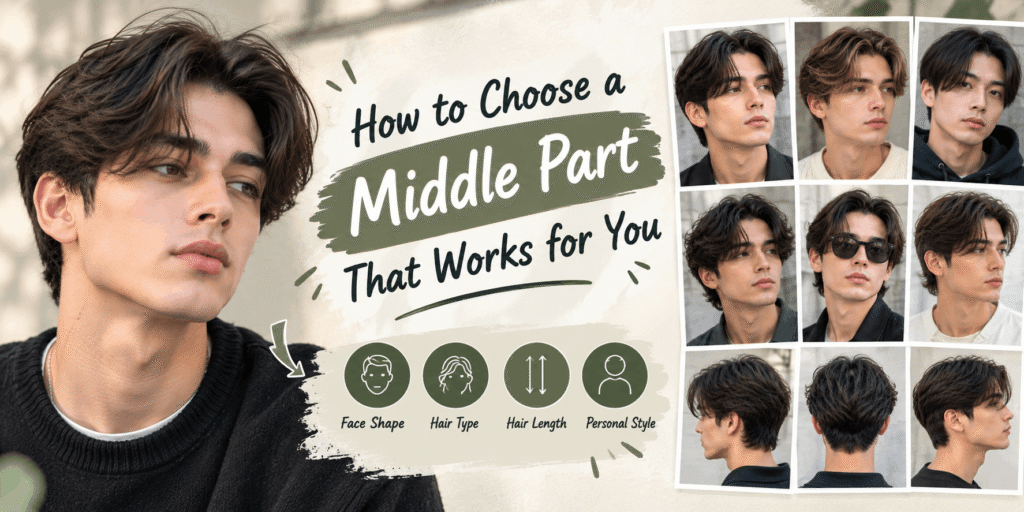
The right middle part haircut depends on more than face shape. Hair texture, length, natural growth direction, and how much time you want to spend styling all affect the result.
Start with your natural texture. Straight hair can create smooth, defined curtains, while wavy hair adds movement without much effort. Curly hair can form a more rounded, textured middle part, but the cut should be shaped around the way the curls shrink and settle.
Think about your preferred length. Shorter versions can combine a center part with a taper or textured top. Medium-length hair gives the front more room to fall outward, while longer hair can be layered or tied back. Choose a length that fits your routine rather than focusing only on a reference photo.
Consider your face shape as a styling guide, not a strict rule. A middle part can be adjusted with the length and width of the front sections. Longer curtains may create a different frame from a short, textured center part. If you’re unsure, ask your stylist to show you how the front could be shaped around your features.
Be realistic about maintenance. A defined undercut may need more frequent barber visits to keep the contrast clear. A layered, natural middle part may be easier to grow out, though longer hair can require more detangling and conditioning. The best choice is one you can comfortably maintain.
How to Ask Your Barber for a Middle Part Haircut
A reference photo is a useful starting point, but explain what you like about it. You might prefer the length around the forehead, the softness of the layers, or the contrast between the top and sides. Naming the specific feature helps your barber understand the result you want.
Tell them whether you want a taper, an undercut, or fuller sides. If you’re growing your hair out, mention that before asking for major length changes. You can request light shaping while keeping enough length for the center part to develop.
It’s also helpful to discuss your natural hair pattern. If your hair has a cowlick or tends to fall toward one side, your barber can suggest a parting position that works with it. Ask how the cut will look when dry, especially if your hair is wavy or curly.
Before leaving, ask for a simple styling demonstration. Seeing how to create the part, direct the front sections, and apply a small amount of product can make your everyday routine much easier.
How to Style and Maintain a Middle Part
Start with clean, damp hair and gently detangle it. Use a comb or your fingers to find the center, then guide each section in the direction you want it to fall. If the part looks too sharp, soften it with your fingertips for a more natural finish.
For extra volume, use a blow-dryer on a comfortable, moderate setting while directing the front sections away from the center. A round brush can help create a curved curtain shape, while fingers are often enough for a loose, textured style. Avoid excessive heat, and use a heat protectant when using hot styling tools.
Choose products according to your desired finish. Lightweight creams and leave-in conditioners can help with softness and manageability. Mousse may provide volume, while a small amount of flexible styling paste can add separation. Heavy products are not always necessary, especially if your hair is fine or easily weighed down.
Maintenance depends on the haircut rather than the middle part itself. Tapered or undercut sides may need regular trims to retain their shape, while longer layered hair can often be maintained with occasional shaping. Keep the hair and scalp comfortable, condition as needed, and avoid forcing the part into place with excessive product.
If your hair refuses to stay in the center, try adjusting the part slightly or working with its natural growth direction. A middle part does not need to be perfectly straight to look intentional.
Final Thoughts
A middle part haircut can be neat, relaxed, textured, or long and flowing. The classic taper, curtain cut, shag, wavy style, and long ponytail all show how much the look can change depending on the haircut around the part.
Choose a version that works with your natural texture, preferred length, and everyday routine. Bring a clear reference photo to your barber, explain which details matter most, and learn a simple styling method that you can repeat at home. With the right shape and manageable care, a middle part can become a flexible part of your personal style.