
A blowout fade combines noticeable volume on top with clean, gradually tapered sides and a neckline that keeps the haircut looking sharp. Instead of flattening the hair close to the head, the style pushes it outward and upward, creating the distinctive blown-out shape that gives the haircut its name.
What makes this haircut interesting is how easily the basic idea can change. A low fade creates a more relaxed appearance, while a higher fade makes the volume on top stand out more. Curly, wavy, straight, and textured hair can all produce different results, so there is plenty of room to personalize the look.
10 Blowout Fade Styles for Men
1. Classic Blowout Fade
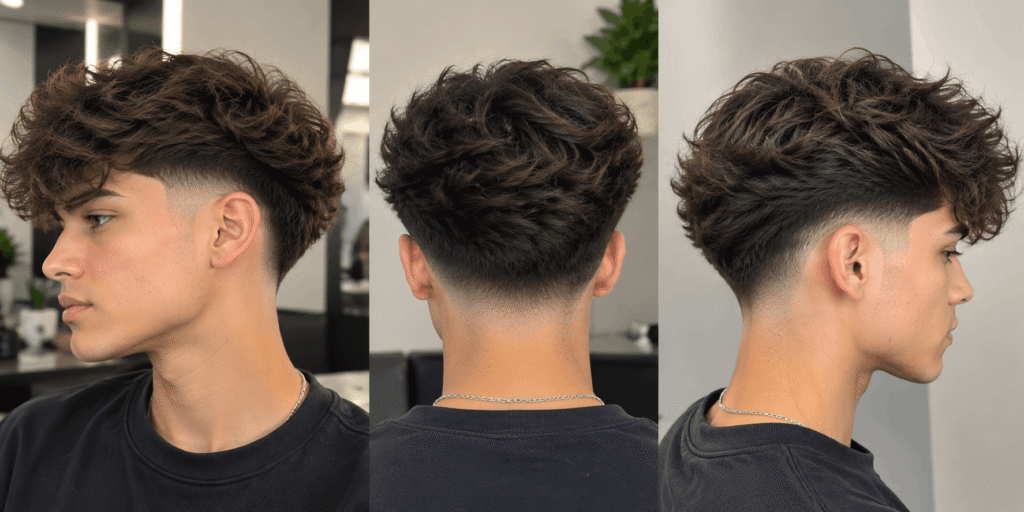
The classic blowout fade is the simplest way to understand the haircut. The sides gradually become shorter while the hair around the top and upper sides is left long enough to build visible volume. The top is then styled away from the head rather than combed flat.
The finished shape has movement and height without requiring an extremely complicated cut. A barber can adjust the amount of length depending on how much volume you naturally have. Thicker hair generally creates a fuller silhouette, while lighter hair can be styled with products that add texture and body.
The classic version also works well when you want a haircut that can move between casual and more polished settings. You can keep the top slightly messy for an effortless appearance or spend more time shaping it for a cleaner finish.
2. Low Blowout Fade
A low blowout fade keeps the shorter section relatively close to the bottom of the sides. This leaves more hair around the temples and upper sides, creating a softer transition between the fade and the fuller top.
This version is useful if you like the blowout effect but don’t want the sides to look extremely short. The extra length around the upper sides can make the overall haircut feel fuller and less dramatic.
The top can be pushed backward, outward, or slightly forward depending on your preferred shape. For a relaxed everyday finish, use a lightweight styling product and let some natural texture remain visible instead of trying to make every strand perfectly controlled.
3. Mid Blowout Fade
A mid blowout fade sits between the low and high versions, making it a flexible option for people who want a noticeable fade without taking the sides extremely high.
The transition begins around the middle area of the sides, giving the haircut a balanced relationship between the shorter sections and the longer top. Because the fade isn’t too low or too high, the hairstyle can work with several different top lengths.
You can pair the mid fade with a textured top, messy finish, curls, waves, or a more controlled blowout. The important part is maintaining enough length above the fade to create the outward volume that defines the haircut.
For a more modern result, ask your barber to preserve texture instead of making the top completely uniform. Small differences in length can help the hair move naturally when it is styled.
4. Curly Blowout Fade
Curly hair can give a blowout fade a completely different personality. Instead of relying mainly on a blow dryer to create movement, the natural curl pattern provides much of the shape and volume.
The sides can be tapered while the curls on top remain longer and more prominent. This creates a strong contrast between the cleaner lower sections and the fuller texture above them.
The key is not to treat curly hair like straight hair. Excessive brushing can disturb the curl pattern and make the finished style look less defined. A curl-friendly styling product can help keep the hair shaped while allowing the natural texture to remain visible.
The amount of length should also match the curl pattern. Tighter curls may appear considerably shorter once dry, so a barber should account for shrinkage when deciding how much length to leave.
A curly blowout fade can be worn fairly controlled or intentionally loose. Keeping a little irregularity in the curls often makes the haircut look more natural than trying to force every curl into exactly the same position.
5. Blowout Fade with Textured Fringe
Adding a textured fringe gives the blowout fade a more contemporary direction. Rather than pushing all the top hair backward, part of the front is allowed to fall toward the forehead while the rest maintains the lifted blowout shape.
The fringe can be short and broken up or slightly longer with more movement. Your hair’s natural texture will influence which version works best. Straight hair can benefit from deliberate texturizing, while naturally wavy hair may already have enough movement to create the effect.
This style is particularly useful if you don’t want a traditional swept-back blowout. The fringe changes the outline of the haircut and gives the front more visual interest.
Avoid making the fringe too heavy if you want the blowout effect to remain obvious. Some separation between the strands helps maintain the airy, textured appearance.
A matte styling product is often useful for this variation because it can provide control without making the hair appear overly shiny. Apply a small amount first and build gradually rather than coating the entire top at once.
The biggest advantage of this version is flexibility. On some days, you can push the fringe upward and turn the haircut into a more traditional blowout. On others, you can leave the front slightly forward for a softer and more relaxed appearance.
A good blowout fade should look intentional without appearing overly rigid. The fade creates the clean foundation, while the top supplies the personality through volume, texture, and direction. Choosing the right combination depends less on copying a specific haircut and more on matching the shape to your natural hair.
In the next part, we’ll look at five more variations, including messy, slicked-back, wavy, designed, and mullet-inspired blowout fades, followed by practical styling and maintenance advice.
5 More Blowout Fade Ideas
6. Blowout Fade with Messy Hair
A messy blowout fade is built around controlled volume rather than a perfectly arranged finish. The sides remain clean and tapered, while the top is allowed to move in different directions.
The messy appearance should still have some structure. If the hair is simply left untouched, it can lose the recognizable blowout shape. Instead, use your fingers to lift the roots while drying the hair, then lightly separate sections with a styling product.
This version works especially well with medium-length hair because there is enough length to create movement without making the top difficult to control. Natural texture can make the finished result even more interesting.
For a casual appearance, avoid excessive product. A matte paste or lightweight clay can provide enough hold while keeping the hair soft and touchable.
7. Blowout Fade with Slicked-Back Hair
The slicked-back variation takes the volume of a blowout and gives it a more controlled direction. Instead of spreading the top in several directions, the hair is guided backward while retaining lift near the roots.
The sides provide a clean contrast to the longer top, making the hairstyle look more structured. This can work particularly well when the hair is naturally straight or slightly wavy.
The trick is to create volume before applying the finishing product. Blow-dry the roots upward and backward first, then use a small amount of styling product to control the surface. Applying too much product too early can weigh the hair down.
You can choose between a glossy or matte finish depending on the overall look you want. A subtle finish generally keeps the haircut looking more modern, while stronger shine gives it a more traditional styled appearance.
8. Blowout Fade with Wavy Hair
Wavy hair naturally brings movement to a blowout fade, making it possible to create volume without forcing the strands into a completely uniform shape.
The fade keeps the lower part of the haircut neat while the waves remain visible on top. Medium-length waves usually give enough room for the hair to expand and create the characteristic blown-out silhouette.
When styling, focus on the roots first. Lift the hair while drying it and direct the waves outward or slightly backward. Once the hair is dry, use a small amount of product to reduce unwanted frizz without removing the natural movement.
This style doesn’t need to look perfectly symmetrical. Slight differences between the waves can actually make the haircut feel more natural.
If your hair becomes flat during the day, gently lifting the roots with your fingers can restore some of the original volume without requiring a complete restyle.
9. Blowout Fade with Design
A shaved or lightly carved design can turn a conventional blowout fade into a more personalized haircut. The design is usually placed within one of the shorter sections, where it stands out against the surrounding hair.
A simple line can create a clean detail without competing with the volume on top. More noticeable patterns are possible too, but the design should work with the shape of the fade rather than being added randomly.
Placement matters. A barber can use the natural direction of the fade to determine where the design will be most visible. This is especially important because the sides of a blowout haircut already contain several transitions in length.
Keep in mind that designs grow out relatively quickly. A pattern that looks extremely sharp immediately after the haircut may become less defined as the surrounding hair gets longer.
If you’re trying a design for the first time, a simple detail can be easier to maintain and easier to change at the next appointment.
10. Blowout Fade Mullet
The blowout fade mullet combines the volume of a blowout with extra length toward the back. The result has a stronger silhouette than a conventional blowout and gives the haircut a more adventurous character.
The sides can be faded or tapered while the top remains lifted and textured. The back is then allowed to retain additional length instead of being blended into a short neckline.
The contrast between the clean sides, voluminous top, and longer back is what gives this version its identity. Because the haircut contains several different lengths, communication with your barber is especially important.
You can make the style subtle by keeping the back only moderately longer than the top, or make it more noticeable by allowing considerably more length to remain behind the ears and neckline.
Texture can also change the result. Wavy or curly hair can create a softer transition, while straight hair tends to produce a more defined outline.
How to Style and Maintain a Blowout Fade
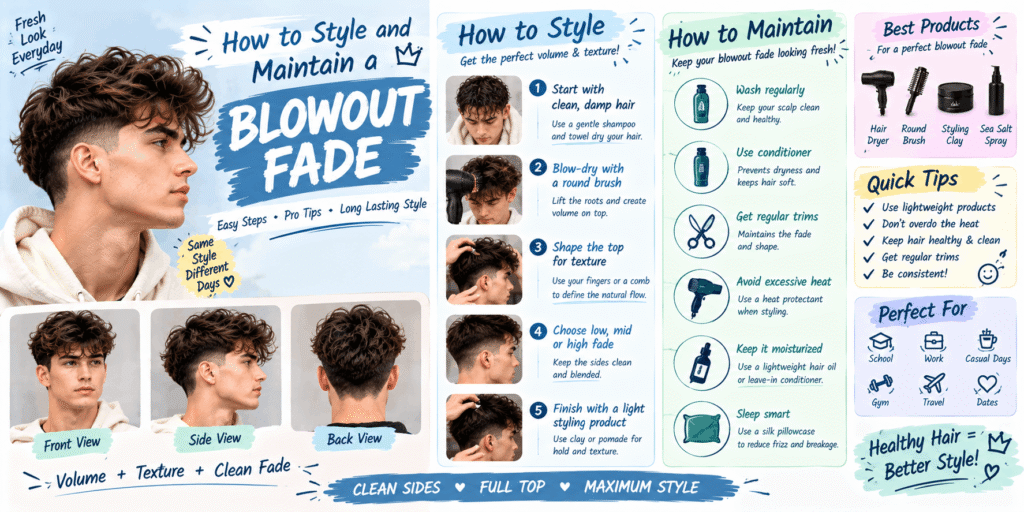
A blowout fade depends on two things working together: a well-shaped haircut and the right styling technique. Even an excellent cut can lose its effect if the top is flattened or overloaded with product.
Creating the Blowout Effect
Start with clean, damp hair rather than soaking-wet hair. Use a towel to remove excess water, then begin drying while lifting the roots.
A blow dryer is useful because the goal is to create volume rather than simply dry the hair. Direct the airflow in the direction you want the hair to sit while using your fingers or a brush to lift sections away from the scalp.
Work through the top gradually instead of trying to style everything at once. The front usually needs extra attention because it has a major effect on the final silhouette.
Once the hair is dry, apply a small amount of styling product. Rub it between your hands first, then distribute it through the hair. Start with less than you think you need and add more only if necessary.
The product should support the shape rather than completely cover the hair. A heavy layer can make the top look flat and remove the airy appearance that makes a blowout distinctive.
What to Tell Your Barber
Instead of simply saying that you want a blowout fade, explain how you want the top, sides, and back to work together.
Tell your barber whether you prefer a low, mid, or higher fade and explain how much length you want to keep on top. If you want significant volume, make that clear before the cutting begins.
It can also help to show a reference photo that has a similar hair texture to yours. A picture of a blowout on very straight hair may not translate exactly to tightly curled hair, so choosing a reference with comparable texture can make communication easier.
Mention whether you want a clean finish, messy texture, fringe, longer back, or another specific feature. These details can change the final shape considerably.
Keeping the Fade Fresh
The faded sections are usually the first part of the haircut to lose their sharp appearance as the hair grows. Regular barber visits can help preserve the transition, although the ideal timing depends on how quickly your hair grows and how short the fade is.
At home, avoid using excessive heat or aggressive brushing. If you use a blow dryer regularly, keep the airflow moving instead of concentrating it on one spot for too long.
Washing frequency should also suit your hair type rather than following a fixed schedule. Very dry hair may need a gentler routine, while oily hair may require more frequent cleansing.
Keeping the top healthy is important because the blowout effect depends on its ability to hold shape and volume. Conditioning can help the hair remain manageable, especially when it is longer or naturally dry.
Final Thoughts
A blowout fade is less about one exact haircut and more about the relationship between clean sides and noticeable movement on top. That makes it surprisingly adaptable. You can keep the style subtle with a low fade, make it more defined with a mid fade, or change the entire character by adding curls, waves, fringe, a design, or extra length at the back.
The best version is usually the one that works with your natural texture rather than fighting against it. Straight hair can be shaped with a blow dryer, waves can provide natural movement, and curls can supply much of the volume themselves.
Before your next haircut, think about the amount of maintenance you’re comfortable with and how you normally wear your hair. A reference photo can help your barber understand the desired shape, but your natural texture and head shape should still guide the final cut.
With the right length, a suitable fade, and a simple styling routine, a blowout fade can give you a distinctive haircut without requiring an overly complicated daily routine.
2 Comments