
Curly hair gives men plenty of ways to change their look, from clean, short cuts to relaxed, longer styles with natural movement. The key is choosing a haircut that works with your curl pattern, hair density, face shape, and everyday routine instead of fighting against your natural texture.
If you’re exploring curly hair men hairstyles, you don’t have to settle for one standard cut. A well-shaped fade, a textured fringe, a longer layered style, or even a simple side part can make curls feel intentional and easy to manage. This guide explores different looks and explains what to consider before asking your barber for a change.
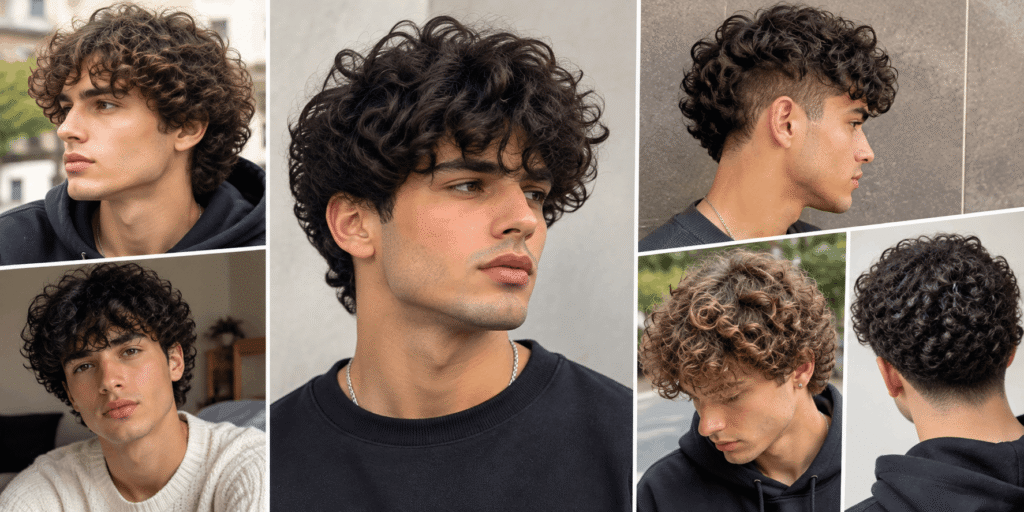
Finding a Curly Hairstyle That Fits Your Look
Before choosing a haircut, think about how you want your hair to sit throughout the day. Some men prefer a neat outline around the ears and neckline, while others like a fuller shape that lets their curls spread naturally. Neither approach requires a particular curl pattern; the right cut depends on how your hair grows and how much styling you enjoy.
It also helps to consider your daily routine. A short haircut may take less time to arrange in the morning, while medium or long curls can offer more styling options but may need extra conditioning and detangling. Your barber can help you decide how much length to keep on top and where to remove bulk without making the finished style difficult to maintain.
Short Curls: Defined, Clean, and Easy to Shape
Short curly hair can look structured without losing its texture. Keeping the sides neat while leaving enough length on top allows curls to remain visible rather than being cut so close that their natural pattern disappears.
Curly Crew Cut
This style keeps the overall shape compact, with slightly more length at the top than around the sides. It can work well if you like a simple, sporty haircut and don’t want to spend much time arranging your hair. Ask your barber to leave enough length for your curls to show, since a crew cut can look quite different depending on how tightly it is trimmed.
Curly Undercut
An undercut creates a noticeable contrast between the longer curls above and the shorter sides. The top can be worn forward, loosely swept back, or allowed to fall naturally. Because the transition can be quite distinct, discuss how dramatic you want the difference to look before the clippers come out.
Curly Fade
A fade gradually blends the hair shorter toward the sides and back. Pairing it with curls on top creates contrast while keeping the outline tidy. A low fade gives a more subtle transition, while a higher fade makes the difference between the top and sides more noticeable. Your barber can adjust the blend to suit your head shape and preferred level of contrast.
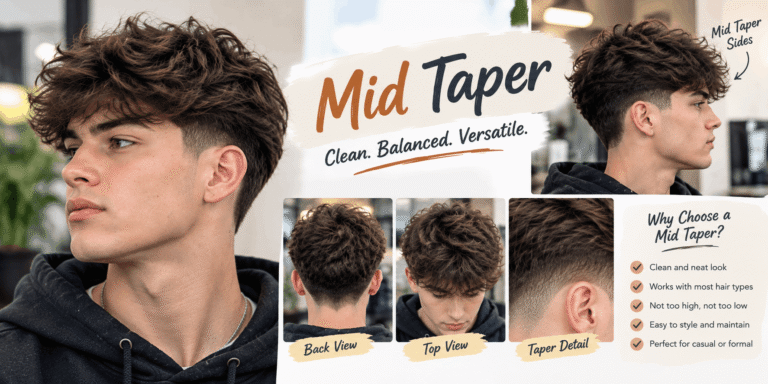
Tapered Curls
A taper focuses on gradually shortening the hair around areas such as the temples and neckline while keeping more of the overall shape intact. It can be a useful option if you want a neat finish without taking the sides extremely short. The curls on top can remain natural, softly defined, or lightly styled.
Curly Quiff
A quiff brings some of the front hair upward and slightly backward while allowing the curls to retain their texture. It can create a fuller appearance around the front without requiring every strand to sit perfectly in place. A lightweight styling cream may help guide the shape, especially when the hair is damp.
Curly Pompadour
This look places more emphasis on height and volume at the front, with the hair gradually directed backward. Curly texture gives it a softer, less uniform finish than a very smooth pompadour. It generally needs enough length at the front to create lift, so it may not be suitable if you prefer an extremely short cut.
Short, Tight Curls
Keeping tightly coiled hair short can create a compact, textured finish that highlights the natural pattern. The important part is choosing a length that feels comfortable and allows the curls to sit evenly. Regular shaping can help maintain the outline, while conditioning supports softness and manageability.
Short styles aren’t automatically maintenance-free. Even when the hair is cropped, your scalp and curls may still benefit from gentle cleansing, conditioning, and a small amount of suitable styling product. The difference is that you may spend less time detangling and arranging the length.
Medium Curls: Room for Movement and Personality
Medium-length curls offer a balance between shape and versatility. There is usually enough length to change the direction of the hair, create a fringe, or experiment with a side part without committing to a long hairstyle.
Natural Medium-Length Curls
A layered cut can help distribute the hair’s volume and encourage the curls to fall with movement. Instead of asking for a specific celebrity-inspired shape, explain whether you want the sides to remain full, the front to sit above your eyes, or the back to have more length. Those details help your barber create a cut that works with your own curl pattern.
Curly or Wavy Mullet
This style keeps more length toward the back while the sides and front are shaped to create contrast. Curls can make the transition look softer and more textured. The overall effect depends on how much length is retained at the back and whether the sides are tapered, faded, or left fuller.
Perm-Inspired Curls and Korean-Style Shapes
Some men look for a salon-created curl pattern or a rounded, layered shape often associated with Korean-inspired hairstyles. A perm changes the hair’s texture through a chemical process, while a haircut alone shapes the hair that naturally grows from your scalp. If you’re considering a perm, talk with a qualified stylist about your hair’s condition, the expected result, and the aftercare before deciding.
Curly Hair With a Part
A side part can give medium curls a little direction without making them look overly formal. The part may be subtle and natural, or more clearly defined depending on your haircut. Try following the direction your hair already tends to fall; forcing a part against your natural growth can make styling more difficult.
Slicked-Back Curls
This style directs the curls away from the forehead while preserving some of their texture. It doesn’t have to mean flattening the hair into a completely smooth finish. A small amount of curl cream or another compatible styling product may help guide the hair backward while keeping it flexible.
Medium curls can change shape as they dry, so it’s useful to see how your hair behaves after washing before deciding how to style it. If the front shrinks upward or the sides expand outward, your barber can account for that when shaping the cut.
Longer Curls: Softer Shapes and Flexible Styling
Longer hair allows curls to form a more noticeable silhouette. It can be worn loose, gathered away from the face, or shaped into a style that keeps the sides and back more controlled. The main consideration is maintaining enough shape that the hair doesn’t become difficult to detangle or uncomfortable to wear.
Curly Bob
A curly bob keeps the hair around a similar general length, often near the jaw or lower, depending on the individual style. Layers can help prevent the shape from becoming too bulky, while a more uniform cut creates a rounded outline. This option is worth discussing with a stylist who has experience cutting curls, because the dry length may differ from the wet length.
Man Bun With Curls
A man bun gathers longer hair into a bun, usually at the back or crown. It can be a practical way to keep curls away from the face during daily activities. Avoid pulling the hair tightly every day; a comfortable, loose hold is easier on the hairline than constant tension.
Top Knot With a Curly Undercut
This combines a gathered top section with shorter sides and back. The contrast can make the shape feel more defined, while the curls remain the focus on top. It’s useful to consider how the style will look when the hair is both tied up and worn loose, since the shorter sides remain visible in either case.
Long curls may need more attention to detangling than shorter cuts. Working gently from the ends upward with a suitable conditioner or detangling product can help reduce unnecessary pulling. A wide-tooth comb or fingers may be useful, depending on your curl pattern and preference.
Curly Fringe: Letting the Front Frame Your Face
A curly fringe allows the hair at the front to fall toward the forehead rather than being swept away. It can be cut short and compact or left longer for a softer, more relaxed finish. The right length depends on how much your curls spring up as they dry.
Curly Fringe With a Classic Taper Fade
The curls at the front provide texture, while the taper keeps the temples and neckline neat. This combination creates contrast without necessarily removing too much hair from the sides. If you want the fringe to sit naturally, ask your barber to consider how your curls fall when dry rather than judging the length only while the hair is wet.
A fringe can also be shaped with a slight separation between curl groups for a less uniform appearance. You don’t need every curl to fall in exactly the same direction; a little natural variation is part of the style.
Before You Choose: Quick Style Comparison
| Hairstyle direction | Overall feel | What to discuss with your barber |
|---|---|---|
| Short curls | Compact and textured | How much curl definition to retain |
| Fade or taper | Neat sides with contrast | Fade height and how short the sides should be |
| Medium-length curls | Flexible and natural | Layers, front length, and overall volume |
| Mullet-inspired cut | Longer back with contrast | How noticeable the length difference should be |
| Long curls or bun | Relaxed and versatile | Shape, layering, and comfortable tying options |
| Curly fringe | Texture around the forehead | Dry length and how the curls fall forward |
A Better Haircut Starts With a Clear Conversation
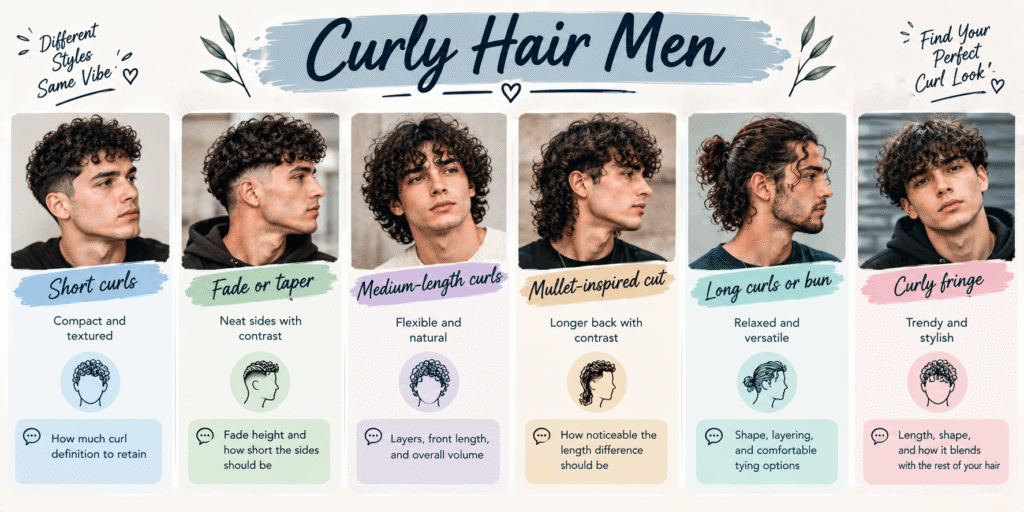
You don’t need to know every barbering term to explain the style you want. Bring a reference photo if you have one, but also describe what you like about it: perhaps the length on top, the softness of the sides, the way the curls frame the forehead, or how much hair remains at the back.
It’s also worth explaining what you don’t want. If you prefer not to expose too much of the scalp, say so before discussing a fade. If you want to keep your curls long enough to tie back, make that clear before the stylist removes length. These small details can help prevent a haircut that looks appealing in a photo but doesn’t suit your everyday preferences.
Remember that a reference image shows someone else’s hair density, curl pattern, and styling routine. Your result may look different, and that’s normal. A skilled barber or stylist can adapt the general idea to your own hair rather than trying to reproduce every detail exactly.
Understand Your Natural Curl Pattern
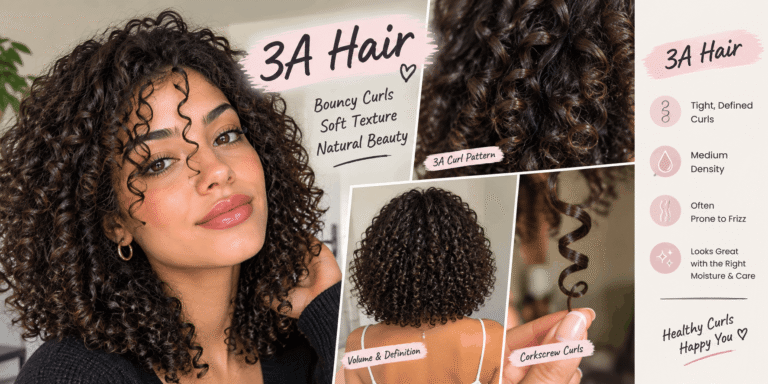
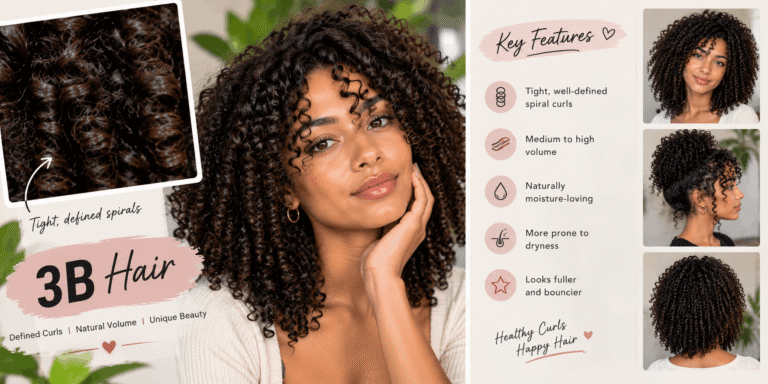
Curly hair can range from loose waves and soft spirals to tighter coils, and no two heads of curls behave exactly the same. Curl-type labels can be useful when discussing your hair with a barber, but they do not explain everything. You may have different curl patterns across your head, and your texture can look different depending on moisture, length, styling, and how much your hair shrinks.
Pay attention to how your own curls behave. Notice whether they become puffy after drying, feel dry at the ends, lose definition when brushed, or take a long time to dry. These details can help you build a routine that actually suits your hair instead of following generic advice.
Consider Shrinkage and Hair Volume
Curly hair often looks shorter once it dries because the strands bend and coil instead of falling straight. This shrinkage is important when choosing a haircut because wet hair may appear noticeably longer than it does when dry.
Volume also affects the final appearance. Some men prefer their curls to have a fuller shape, while others want them closer to the head. The right haircut, drying method, and styling product can help control the overall shape without changing your natural texture.
Create a Simple Hair Care Routine
Curly hair generally benefits from gentle handling. You do not necessarily have to shampoo every day. Your ideal washing schedule depends on your scalp, activity level, products, and how your hair feels.
When shampooing, focus mainly on the scalp instead of aggressively scrubbing the lengths. Avoid twisting or piling long curls together while washing. If your scalp becomes oily or develops product buildup, you may need more frequent cleansing. On the other hand, excessive dryness can be a sign that your routine is too harsh.
Conditioner can make curls softer and easier to detangle. Apply it where your hair needs the most moisture, especially through longer lengths and ends. Detangle while the hair is damp and slippery rather than trying to work through knots when it is completely dry. Your fingers or a wide-tooth comb can be useful depending on your hair’s thickness and length.
Dry Curls Gently
How you dry your hair can make a noticeable difference. Instead of rubbing your curls with a rough towel, gently squeeze out excess water with a soft towel or cotton T-shirt. Less friction can help your curls stay grouped together and reduce unnecessary frizz.
If you air-dry, try not to keep touching your hair as it dries. Constantly rearranging the curls can disturb their natural shape. If you prefer using a blow-dryer, a diffuser on a gentle setting can distribute airflow more evenly. Avoid excessive heat, particularly if your hair already feels dry.
Pick Products According to Your Goal
You do not need a large collection of curl products. Start with one product that addresses your main concern and see how your hair responds.
A leave-in conditioner can provide additional softness and may help with dryness or tangling. Curl cream can improve definition while keeping the hair flexible and natural-looking. If you need stronger hold, gel or mousse can help keep your hairstyle in place. The final result depends on your hair, so experiment with small amounts rather than applying too much at once.
A lightweight oil or serum may add shine and help smooth the appearance of the hair. However, excessive product can leave curls greasy or weighed down. If your hair feels heavy, simplify your routine or reduce the amount you apply.
Style Curly Hair Without Making It Complicated
After washing, remove excess water, apply your chosen product, and use your fingers to guide the curls into place. You can push the front upward, create a side direction, or let the curls fall naturally over the forehead.
For a more relaxed appearance, avoid separating every curl. Allow the natural grouping to form as the hair dries. To refresh curls between washes, lightly mist them with water and reshape individual areas with your fingers.
Men with longer curls should also avoid keeping their hair pulled tightly in the same position every day. A soft hair tie can be useful, but a loose style is generally more comfortable.
Keep Your Haircut Looking Fresh
The right trim depends on your chosen style. Fades and tapers can show growth around the sides quickly, while longer layered curls may remain wearable for a longer period.
When visiting your barber, clearly explain what you want to keep. You might want the neckline cleaned up while maintaining the top length, or you may want the fringe preserved while reshaping the sides. If you are growing your curls, remember that uneven-looking sections do not always mean you need a major cut.
Taking a photo of your curls on a day when they look their best can also help your barber understand how your natural texture falls.
Handle Common Curly Hair Problems
If your curls look frizzy, reduce rough towel drying and unnecessary touching. Humidity, friction, buildup, and dryness can all contribute to frizz.
If your hair feels dry, reconsider how often you shampoo and whether your products are too harsh. Conditioner or a suitable leave-in product may improve manageability.
When curls lose definition, avoid brushing them repeatedly while dry. Try adding a little water and gently reshaping them instead.
If the sides look too bulky, talk to your barber about adjusting the shape, tapering the sides, or changing the length rather than simply adding more styling product.
For a fringe that falls into your eyes, experiment with directing the curls slightly to one side before deciding to cut them shorter.
Give Your Curls the Right Nighttime Care
Longer curls can become tangled during sleep, so avoid tightly tying them into a bun or knot. If you need to secure them, use a soft tie and keep it loose.
A smoother pillowcase may help reduce friction for some hair types. If your curls look flattened in the morning, lightly mist the affected areas and reshape them with your fingers instead of immediately washing your entire head.
Final Thoughts
There are plenty of ways to style curly hair men can enjoy, from short fades and tapers to longer, loose curls. The key is learning how your own texture behaves and building a routine around it.
Keep your care routine straightforward: wash gently, condition when needed, detangle carefully, dry without excessive friction, and choose styling products based on the finish you want. Most importantly, work with your natural curls rather than trying to make every section look identical. A suitable haircut and simple routine can make curly hair easier, more comfortable, and more versatile to style.
3 Comments