Fair skin can describe a naturally lighter range of skin tones, but there is no single shade that defines it. Skin can have warm, cool, neutral, or olive undertones, and the way it looks can change depending on lighting, sun exposure, hydration, and the products used on it.
If you have fair skin, understanding what makes your complexion different can make everyday skincare much easier. Rather than trying to change your natural skin tone, the focus should be on keeping the skin comfortable, protected, and healthy-looking. Sun protection, gentle cleansing, adequate moisture, and choosing suitable products can all make a noticeable difference to how the skin looks and feels.
Understanding Fair Skin and Its Undertones
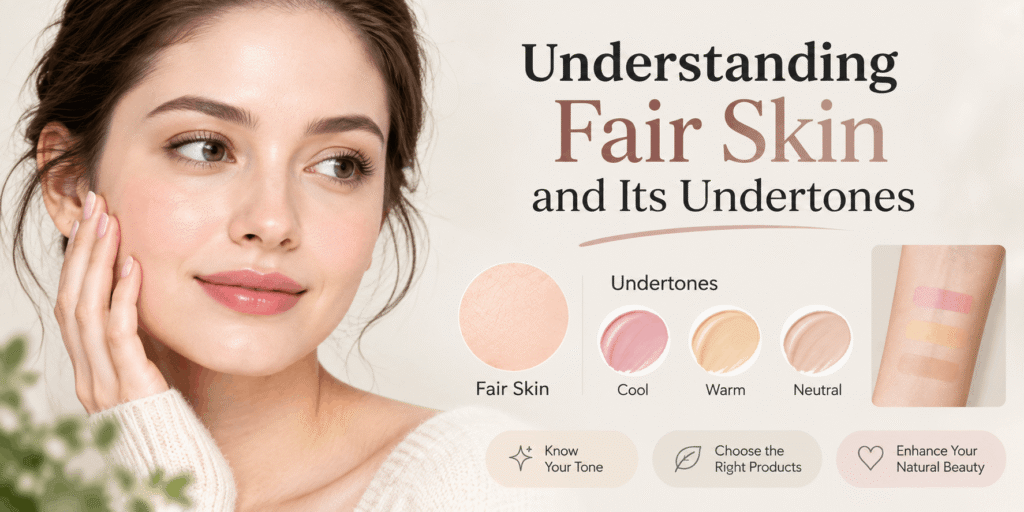
Fair skin generally refers to the lighter end of the natural skin-tone spectrum. However, two people with similarly light complexions can have very different undertones. One person may have a pink or rosy undertone, another may have a golden appearance, while someone else may have a more neutral balance.
Undertone is different from the surface color of your skin. Your visible complexion can change after spending time outdoors or during different seasons, but your underlying undertone tends to remain relatively consistent.
This distinction becomes particularly useful when selecting makeup, clothing colors, or skincare products. A foundation that looks suitable on one fair complexion may appear too yellow, pink, or orange on another because the undertones are different.
Fair skin can also show certain temporary changes more visibly. Redness, dryness, irritation, or uneven pigmentation may stand out more against a lighter complexion. That does not mean every person with fair skin experiences these concerns, but it can make choosing gentle skincare particularly important.
What Fair Skin Needs From a Daily Routine
A simple skincare routine is often easier to maintain than a complicated collection of products. The basic approach is to cleanse the skin without excessive stripping, provide moisture when needed, and protect exposed areas from ultraviolet radiation.
Cleansing helps remove sweat, excess oil, sunscreen, makeup, and environmental residue. However, using harsh cleansers or washing the face excessively can leave the skin feeling tight or irritated. A gentle cleanser is often a better starting point, particularly if your skin tends to feel dry or sensitive.
Moisturizing helps support the skin barrier and can make the complexion feel smoother and more comfortable. The right moisturizer depends on your skin type rather than simply how fair your complexion is. Someone with oily fair skin may prefer a lightweight formula, while dry skin may benefit from a richer moisturizer.
Sun protection deserves particular attention. Ultraviolet exposure can contribute to sunburn and long-term skin damage, so using a broad-spectrum sunscreen and following its application instructions is an important part of daily skin care.
Sunscreen should not be viewed as a way to make fair skin lighter. Its purpose is to reduce ultraviolet exposure and help protect the skin from damage.
How to Protect Fair Skin From the Sun
Sun protection is relevant to every skin tone, but people with fair skin may burn relatively easily depending on their individual skin characteristics. Spending long periods outdoors without protection can increase the chance of sunburn.
A broad-spectrum sunscreen can help protect against both UVA and UVB radiation. The SPF number indicates the product’s sunburn protection under standardized testing, but sunscreen works best as part of a broader approach to sun safety.
When spending extended time outdoors, shade, protective clothing, and a hat can provide additional protection. Reapplying sunscreen according to the product’s directions is also important, particularly after swimming, sweating, or prolonged outdoor activity.
It is also worth remembering that cloudy weather does not eliminate ultraviolet exposure. Daily sun protection can therefore be useful even when the weather does not feel particularly hot or sunny.
Sun exposure can also contribute to visible pigmentation changes over time. If you are concerned about dark spots or uneven tone, protecting the skin from further ultraviolet exposure is an important part of managing the issue.
Keeping Fair Skin Looking Even and Comfortable
A healthy-looking complexion does not have to mean completely uniform skin. Natural skin often contains small variations in color and texture, and these are not necessarily signs of a problem.
If your complexion appears dull or uneven, start by considering the basics before adding several active ingredients. Inconsistent sun protection, dehydration, irritation, or an unsuitable skincare routine can all affect how the skin looks.
Gentle exfoliation may be useful for some people, but more is not always better. Over-exfoliating can irritate the skin and interfere with its protective barrier. If you use exfoliating products, introduce them carefully and pay attention to how your skin responds.
Products containing ingredients designed for specific concerns can also be considered, but the choice should match the actual issue. For example, a product intended for acne may not be necessary simply because the skin is fair.
Patch testing new skincare products can be a sensible precaution, especially if your skin is easily irritated. Applying a small amount according to the product’s instructions before using it more widely can help identify whether your skin reacts poorly to the formula.
Choosing Makeup for Fair Skin
Finding makeup for fair skin becomes easier once you understand your undertone. A fair complexion with a cool undertone may look different in foundation than a fair complexion with warm or neutral undertones.
Instead of choosing a foundation solely because its label says “fair,” compare the undertone and finish as well. Some shades are designed for pink or cool undertones, while others lean yellow, golden, or neutral.
Testing foundation in natural-looking light can make color matching easier. Artificial indoor lighting can sometimes make a shade appear closer to your skin than it actually is.
Blush can also change the overall appearance of a fair complexion. Soft pink, peach, muted rose, and similar shades can create different effects depending on the undertone and the rest of the makeup.
The same principle applies to bronzer and contour products. Extremely dark or strongly warm shades can create a harsh contrast, so choosing a tone that works with your natural coloring generally produces a more seamless result.
Fair skin does not require a particular makeup style. You can choose sheer products for a natural appearance or stronger colors when you want more definition. The important part is finding shades and formulas that work with your complexion rather than trying to hide it.
Common Mistakes to Avoid
One common mistake is assuming that fair skin automatically means sensitive skin. Skin tone and skin sensitivity are not the same thing. A person with fair skin can have oily, dry, combination, normal, or sensitive skin, so products should be selected according to individual needs.
Another mistake is constantly changing products. Using several new products at once makes it difficult to identify which one is helping or causing irritation. A more gradual approach gives you a clearer idea of how your skin responds.
Skipping sunscreen is another issue worth avoiding, particularly if you spend time outdoors. Sun protection is not only about preventing an immediate sunburn; consistent protection is part of long-term skin care.
Harsh scrubbing can also be counterproductive. If the skin feels rough or dull, aggressively rubbing it is unlikely to provide a sustainable solution. Gentle cleansing and an appropriate routine are usually a better foundation.
Finally, avoid treating your natural skin tone as something that needs to be corrected. Fair skin is simply one of many natural complexions. Skincare should focus on maintaining the condition and comfort of your skin rather than pursuing an artificial idea of perfection.
Adjusting Your Routine Through the Seasons
Fair skin can respond differently to changes in weather. Cold, dry conditions may leave the skin feeling tight or flaky, while hot and humid weather can increase sweating and make some products feel heavier.
During colder months, a moisturizer with a more nourishing texture may feel comfortable if your skin becomes dry. You may also want to avoid very hot water when washing your face because it can leave already-dry skin feeling more uncomfortable.
Summer can require a different approach. Lightweight moisturizers may feel easier to wear, particularly if your skin becomes oily in warm weather. Sunscreen remains important when you are spending time outdoors, and reapplication should follow the instructions on the specific product.
Seasonal changes do not mean that you need to replace your entire skincare routine. Often, small adjustments are enough. Changing the texture of a moisturizer or modifying how often you use certain products may be more practical than starting from scratch.
Travel can create another challenge. Changes in climate, water, sleep, and daily routine may temporarily affect your skin. Keeping your basic products consistent can help avoid unnecessary irritation while your routine is already changing.
Ingredients and Products to Consider

There is no ingredient that every person with fair skin needs simply because of their complexion. Skin type and individual concerns should guide product selection.
For basic hydration, ingredients commonly used in moisturizers include humectants and skin-conditioning ingredients that help support moisture. A simple moisturizer may be enough if your skin already feels comfortable and balanced.
If uneven pigmentation is a concern, sun protection remains an important starting point. Some skincare products are also formulated to address the appearance of dark spots, but they should be introduced carefully and used according to their directions.
For people dealing with dryness, a gentle cleanser and moisturizer may be more useful than repeatedly adding exfoliating products. If the skin barrier becomes irritated, reducing the number of active products can sometimes be a more sensible approach.
If you have acne-prone skin, look for products that are suitable for your skin type rather than assuming every product marketed for fair skin will work for you. Fair complexion and acne are separate considerations.
When introducing an active skincare ingredient, change one thing at a time when possible. This makes it easier to notice both positive and negative reactions. If a product causes persistent burning, swelling, or significant irritation, stop using it and seek appropriate medical advice.
Fair Skin and Common Complexion Concerns
People with fair skin can experience the same broad range of skin concerns as people with other complexions. Acne, dryness, redness, sensitivity, uneven pigmentation, and signs of sun exposure can all occur.
Redness can sometimes be more noticeable against a lighter complexion. Temporary flushing may have many possible causes, including heat, exercise, environmental conditions, or skincare irritation. Persistent redness is different and may warrant professional evaluation, particularly if it comes with discomfort or other symptoms.
Dark spots can also become noticeable after inflammation or sun exposure. Protecting the skin from ultraviolet radiation can help reduce additional sun-related pigmentation, while treatment depends on the cause of the discoloration.
Dryness is another common reason a complexion may look rough or dull. Moisturizing regularly can help support the skin barrier, but persistent or severe dryness may require a more specific approach.
If a skin concern does not improve with basic care, repeatedly returns, or causes significant discomfort, a dermatologist can help identify the underlying cause instead of relying on trial and error with cosmetic products.
Building a Routine You Can Actually Follow
A practical skincare routine does not need to contain ten different steps. For many people, the foundation can be built around cleansing, moisturizing, and daytime sun protection.
In the morning, cleansing can be followed by moisturizer if needed and sunscreen. Makeup can then be applied after the skincare products have been given appropriate time to settle according to their instructions.
At night, removing makeup and sunscreen before cleansing can help leave the skin clean. A moisturizer can then be used to support comfort while you sleep.
Additional products should have a clear purpose. If you cannot explain why you are using a particular serum, exfoliant, mask, or treatment, it may not need to be part of your routine.
Consistency is generally more useful than constantly searching for a new product. Skincare results can take time, and changing several products simultaneously can make it difficult to understand what is actually working.
It is also important to remember that a skincare routine should not cause ongoing discomfort. Mild sensations can vary by product, but persistent burning, significant irritation, swelling, or other concerning reactions should not simply be ignored.
Makeup and Style Tips for a Fair Complexion
Makeup can be used to complement fair skin rather than cover its natural characteristics. Choosing shades according to undertone often creates a more natural result than relying only on the lightness of the foundation.
For a soft everyday appearance, sheer base products can allow some natural skin variation to remain visible. A slightly stronger base can be used when more coverage is preferred.
Blush placement can also influence the overall appearance. Soft pinks can create a fresh effect, while peach and muted rose shades can produce a warmer appearance. The most suitable choice depends on both undertone and personal preference.
Lip colors can range from pale pinks and nudes to berry, red, brown, or deeper shades. Fair skin does not restrict you to light colors. Stronger shades can create contrast when that is the look you want.
Eye makeup can be equally flexible. Neutral browns, taupes, soft pinks, bronze tones, and deeper shades can all work depending on the rest of the look.
Rather than following rules about which colors people with fair skin “should” wear, treat these suggestions as starting points. Makeup is ultimately about the combination of undertone, contrast, personal preference, and the result you want.
Final Thoughts
Fair skin does not require a complicated beauty routine or a specific definition of what healthy skin should look like. The most useful approach is to understand your individual skin type and build your routine around its actual needs.
Daily sun protection is an important part of caring for exposed skin, while gentle cleansing and appropriate moisturization can provide a practical foundation. Additional products can be introduced when there is a specific reason to use them rather than simply because they are popular.
Your complexion may naturally change with seasons, sun exposure, hydration, and age. Those changes do not automatically mean something is wrong. Learning how your skin normally behaves can help you recognize when a change is simply temporary and when professional advice may be worthwhile.
When choosing makeup, skincare, or beauty products, focus on compatibility rather than trying to follow a fixed set of rules for fair complexions. Undertone, texture, sensitivity, lifestyle, and personal preferences all matter.
Fair skin generally describes a lighter range of natural skin tones. It can have different undertones, including cool, warm, neutral, or olive, so fair skin does not look exactly the same on everyone.
Not necessarily. Skin sensitivity is different from skin tone. Someone with fair skin may have sensitive skin, but they can also have normal, oily, dry, or combination skin.
Use a broad-spectrum sunscreen as directed and combine it with shade, protective clothing, and other sun-protection habits when spending extended periods outdoors. Reapplication should follow the product’s instructions.