If shaving or other hair-removal methods regularly leave behind tiny bumps, trapped hairs, or irritated-looking skin, you may have come across Tend Skin. The product is specifically marketed for reducing the appearance of razor bumps and ingrown hairs associated with shaving, waxing, electrolysis, and other hair-removal routines.
What makes it different from an ordinary moisturizer or aftershave is its exfoliating-focused formula. Tend Skin Solution contains isopropyl alcohol, butylene glycol, acetylsalicylic acid, cyclomethicone, glycerin, diglycerin, and polysorbate 80.
That ingredient list helps explain why the product can feel very different from a soothing lotion. It is designed to be applied as a thin layer to clean, dry skin rather than used like a traditional moisturizing cream. The official directions also emphasize using only a small amount.
But there is more to understanding this product than simply knowing what it is supposed to do. Your shaving technique, skin sensitivity, hair-growth pattern, and the type of irritation you are dealing with can all affect how useful a product like this may be.
Why Tend Skin Has Become a Go-To for Razor Bumps
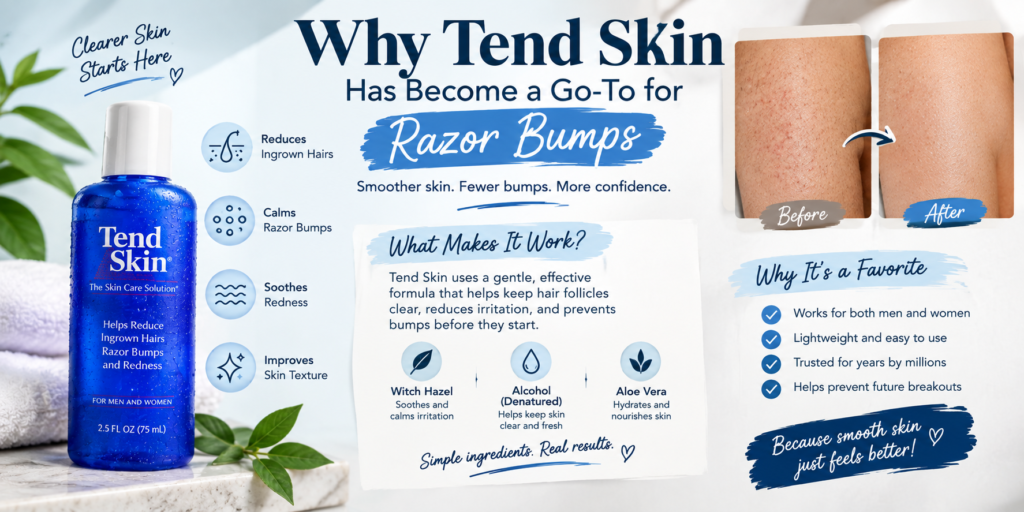
Razor bumps and ingrown hairs can look similar at first, but they are not always exactly the same problem. Hair removal can irritate the skin, and hairs that curl or grow back toward the skin can contribute to bumps.
This is where the idea behind Tend Skin comes in. Its formula includes acetylsalicylic acid, while the product also contains ingredients such as glycerin and glycols. The brand positions the solution as a treatment for the appearance of ingrown hairs and razor bumps rather than simply as a scented post-shave splash.
The product has also been reviewed as an option for people who experience recurring bumps after shaving or waxing. Allure describes it as a treatment for razor bumps and ingrown hairs and notes its exfoliating action.
That distinction matters because many people searching for a product like this are not simply looking for something that makes freshly shaved skin smell or feel different. They are usually trying to deal with the aftermath of hair removal.
A common mistake is assuming that every small bump after shaving has the same cause. Sometimes irritation comes from the shaving process itself. Sometimes a hair becomes trapped beneath the surface. Sometimes friction, product buildup, or another skin issue can look similar.
Because of that, Tend Skin should not be viewed as a universal solution for every type of bump. It is specifically associated with razor bumps and ingrown hairs, and persistent or unusual skin problems may need a different approach.
What Makes the Formula Different?
One of the most frequently discussed ingredients in Tend Skin is acetylsalicylic acid. The complete listed formula also includes isopropyl alcohol, butylene glycol, cyclomethicone, glycerin, diglycerin, and polysorbate 80.
Acetylsalicylic acid is related to aspirin, which is important to know if you have an aspirin allergy. The product’s listed warnings specifically say to avoid it if you are allergic to aspirin.
The large presence of isopropyl alcohol is another reason the product can feel quite different from a typical moisturizer. Some users report a noticeable smell or brief stinging sensation, particularly when the skin has recently been shaved. Consumer reviews show that experiences vary: many users describe it as helpful for bumps, while others report irritation or that it did not work well for them.
This is a useful reminder that a product can have a specific purpose without working identically for everyone. Skin is not a standardized surface, and factors such as sensitivity and the condition of the skin at the time of application can make a noticeable difference.
The official instructions also warn against overusing the product, particularly after procedures that can leave the skin more vulnerable.
Tend Skin and Ingrown Hairs: What Is It Actually Trying to Do?
An ingrown hair happens when a growing hair becomes trapped or curls back toward the skin rather than continuing outward. Hair removal can make this more noticeable because the hair has been cut and is subsequently growing again.
People often focus on the visible bump, but the process underneath the surface is part of why these problems can be frustrating. Simply picking at the area can make irritation worse and may leave temporary marks.
The exfoliating concept behind Tend Skin is intended to help reduce the buildup of dead skin that can contribute to hairs becoming trapped. Allure specifically describes the product as dissolving dead skin that can trap hairs.
That does not mean every ingrown hair will disappear immediately. Results can differ depending on the individual, how established the bump is, and what caused it in the first place.
It is also worth separating prevention from treatment. A person who repeatedly gets bumps after shaving may use a post-hair-removal product as part of their routine, while someone who already has an irritated area may be looking for something to help that existing problem.
The official product directions address both situations, describing use after shaving and additional use for existing ingrown hairs or razor bumps.
However, more product is not automatically better. The manufacturer specifically emphasizes applying a thin coat and says that a small amount is enough.
Is It Really an Aftershave?
This is one area where expectations can become confusing.
Because Tend Skin is often mentioned alongside shaving products, some people may assume it functions like a traditional aftershave designed mainly to provide fragrance or a cooling sensation. Its primary purpose is different.
The product is marketed around razor bumps and ingrown hairs, and its formula contains exfoliating and solvent-type ingredients rather than being primarily a moisturizing product.
That is why the experience can be surprising if you expect a creamy, soothing moisturizer. The liquid formula is intended to sit on the skin and dry rather than behave like a conventional lotion.
A moisturizer can be used afterward once the solution has dried, according to the manufacturer’s directions.
This also explains why someone with very dry or easily irritated skin may have a different experience from someone whose main concern is recurring ingrown hairs.
Instead of asking whether the product is simply “good” or “bad,” a more useful question is whether its purpose matches the problem you are actually trying to address.
When the Problem Starts With Your Hair-Removal Routine
A product can only do so much if the underlying routine repeatedly creates irritation.
Shaving too aggressively, repeatedly passing over the same area, using a dull or unsuitable razor, or putting excessive friction on freshly shaved skin can all contribute to discomfort. Even if a post-shave product helps afterward, improving the hair-removal process itself can be an important part of reducing recurring problems.
This is especially relevant when someone notices the same pattern every time they remove hair. If bumps consistently appear after a particular method, the method may be contributing to the problem.
Waxing can create a different type of post-removal reaction than shaving, but Tend Skin is also marketed for use in connection with waxing and electrolysis. The manufacturer says it can be applied after hair removal and also discusses pre-waxing use.
Still, recently treated skin can be more sensitive. The manufacturer’s instructions specifically caution against overdoing it after waxing, electrolysis, or laser hair removal because these procedures can leave tissue more vulnerable to stinging.
That warning is easy to overlook when people see a product marketed for post-hair-removal care. More aggressive application does not necessarily produce better results.
What People Notice When They Try Tend Skin
The experience reported by users is mixed, although many reviews describe the product as useful for razor bumps and ingrown hairs.
On Influenster, the product currently has thousands of reviews, with numerous users describing improvements in bumps and irritation. At the same time, individual reviews include people who say it did not make enough of a difference for them.
The same pattern appears in other consumer feedback. Some users mention quick improvement, while others mention a strong alcohol smell or a brief stinging sensation.
Those experiences should not be treated as proof that the product will work a certain way for everyone. Reviews are personal experiences rather than controlled medical evidence.
What they do show is that the product has a distinctive sensory experience. If someone expects a gentle, fragrance-free moisturizing lotion, the liquid formula may come as a surprise.
The manufacturer’s own directions are more useful for understanding intended use: apply a thin coat to dry skin, leave it on, and allow it to dry before applying moisturizer if desired.
The Biggest Mistake: Thinking More Product Means Better Results
With concentrated-feeling skincare products, it can be tempting to apply more when a problem is persistent. That is not the approach recommended for Tend Skin.
The manufacturer’s directions repeatedly emphasize a thin application and note that only a small amount is needed.
This matters because the formula contains isopropyl alcohol and acetylsalicylic acid. Applying excessive amounts may increase the chance of discomfort without guaranteeing better results.
Another common mistake is using it on skin that is already significantly irritated or damaged and expecting the product to soothe everything immediately. A recently shaved area with cuts or raw irritation may react differently from intact skin.
The product’s warnings and directions should therefore be treated as part of the product itself, not as an optional extra.
A good skincare routine is not necessarily the one with the most products. It is usually the one where each product has a clear purpose and is used appropriately for the condition of the skin.
Who Should Be More Careful With It?
Anyone considering Tend Skin should pay attention to the ingredient list and warnings rather than assuming that a product marketed for shaving-related concerns is automatically suitable for every skin type.
The listed warnings include avoiding contact with the eyes, avoiding ingestion, and avoiding the product if you are allergic to aspirin. The product is also described as flammable because of its alcohol content.
The manufacturer also says the product has not been tested for use during pregnancy or nursing.
If your skin is very sensitive, easily irritated, or already damaged, it makes sense to be especially cautious with products that contain a significant amount of alcohol and an aspirin-related ingredient.
A small-area sensitivity test is included in product directions available from the product labeling information.
And if a skin reaction is severe, persistent, painful, spreading, or unusual, it is better to stop experimenting with cosmetic products and get advice from a qualified healthcare professional.
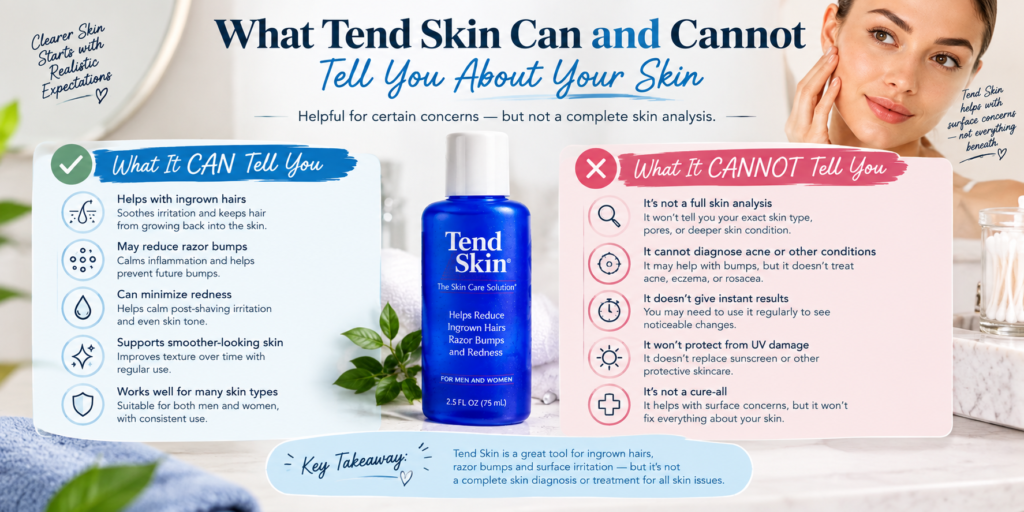
What Tend Skin Can and Cannot Tell You About Your Skin
One reason this product attracts so many searches is that razor bumps and ingrown hairs are highly visible problems. People naturally want something that makes them disappear quickly.
But the appearance of a bump alone cannot tell you exactly what is causing it.
If bumps repeatedly occur after shaving, the hair-removal method may be contributing. If they appear without hair removal, continue for a long time, become increasingly painful, or look unlike your usual shaving irritation, it may be worth considering that something other than a simple ingrown hair is involved.
In those situations, repeatedly applying more products is not necessarily the answer.
Tend Skin makes the most sense when viewed for its intended purpose: a topical solution specifically marketed around razor bumps and ingrown hairs associated with hair removal. It is not a general-purpose treatment for every skin concern.
Understanding that distinction can help set more realistic expectations.
The product may fit into a carefully considered hair-removal routine, but the routine itself still matters. Skin preparation, the hair-removal method, friction, aftercare, and individual sensitivity can all influence the final result.
How to Use Tend Skin Without Overcomplicating Your Routine
The manufacturer’s directions recommend applying the solution to clean, dry skin in a thin coat. It is designed to remain on the skin rather than being rinsed away immediately. The directions also indicate that moisturizer can be applied after the solution has dried.
That means you do not need a large amount to cover the area. A light application is the basic idea, rather than repeatedly saturating the skin.
If you have just shaved, allow yourself to finish the hair-removal process first and then apply the product according to its directions. Avoid treating the solution like a conventional cleanser or body wash.
The manufacturer’s instructions also describe use between hair-removal sessions for existing razor bumps and ingrown hairs.
How frequently you personally need it can depend on your routine and how your skin responds. Using a product more often than directed does not automatically mean that results will happen faster.
One of the simplest ways to keep the routine manageable is to avoid adding several exfoliating products at the same time. If you are already using other strong skincare ingredients on the same area, introducing another active product can make it harder to determine what your skin is reacting to.
What About Using It After Shaving?
Shaving is one of the situations for which the product is specifically marketed. The basic idea is to use it after the hair-removal process on clean, dry skin.
However, freshly shaved skin is not always identical from one day to another. If the shaving process caused small cuts, significant irritation, or unusual discomfort, applying an alcohol-containing solution may feel much stronger than it would on intact skin.
This is one reason shaving technique matters. Pressing the razor too hard, repeatedly going over the same area, or shaving without enough lubrication can create irritation before any aftercare product is applied.
A smoother routine is therefore not simply about finding the right product afterward. It also involves reducing unnecessary friction during hair removal.
If you regularly notice irritation immediately after shaving, changing the way you shave may be just as relevant as changing your post-shave product.
Can It Be Used After Waxing?
The manufacturer also describes Tend Skin as suitable for use around waxing and other hair-removal procedures, but the instructions include specific cautions because these procedures can leave the skin more sensitive.
Waxing removes hair from the root and can temporarily make the skin feel more reactive. Because of that, applying a strong-feeling liquid immediately afterward may not feel the same as applying it after an ordinary shave.
The official directions caution against overuse after waxing, electrolysis, or laser hair removal.
That distinction is important. A product being marketed for hair-removal-related bumps does not mean that more frequent application is automatically appropriate after every type of hair removal.
If your skin is particularly sensitive after waxing, following the product’s instructions and paying attention to how your skin responds is more useful than trying to force a stronger routine.
What About Sensitive or Delicate Areas?
People often search for Tend Skin because they experience bumps in areas where shaving is common. But the fact that a product is intended for razor bumps does not mean that every body area will react to it in exactly the same way.
Areas that experience more friction, sweat, or repeated shaving may already be more prone to irritation. Applying an alcohol-containing formula to skin that is already uncomfortable can make the sensation more noticeable.
The product should also be kept away from the eyes, and its labeling includes specific warnings about use. The listed formula contains isopropyl alcohol and acetylsalicylic acid, which are important considerations for anyone with relevant sensitivities.
The acetylsalicylic acid connection is particularly important for people with an aspirin allergy. Product labeling advises avoiding the product in that situation.
It is also worth remembering that skin concerns in intimate or especially sensitive areas can have causes other than ordinary razor bumps. If something is painful, persistent, spreading, or looks significantly different from your usual shaving irritation, a healthcare professional can help determine what is actually happening.
Why You Might Not See Instant Results
One of the biggest sources of frustration with skincare products is expecting an existing problem to disappear immediately.
An established ingrown hair does not necessarily resolve the moment a product is applied. The appearance of the skin can depend on how long the hair has been trapped, how much irritation is present, and whether the area continues to experience friction or repeated hair removal.
This is why prevention can be a different goal from dealing with an existing bump.
Someone who uses Tend Skin as part of a post-shaving routine may be trying to reduce the chance of recurring bumps. Someone else may already have several irritated areas and expect the product to transform them quickly.
Those are different situations.
Consumer reviews also show why expectations should remain realistic. Some reviewers report that the product helped with razor bumps and ingrown hairs, while others report irritation or little noticeable improvement.
Individual reviews cannot establish how well a product will work for everyone. They are useful for understanding the range of experiences, but they are not a substitute for controlled clinical evidence.
The Shaving Habits That Can Work Against Your Routine
If bumps keep returning, it can be tempting to blame the aftercare product. But sometimes the bigger issue is the way hair is being removed.
Repeatedly shaving over the same area can increase friction. Using too much pressure can also make the skin more irritated. Going too quickly may result in uneven passes and more repeated contact.
The condition of the razor matters as well. A razor that is no longer working smoothly can make the process more irritating because you may compensate by pressing harder or going over the area repeatedly.
Preparation can also make a difference. Giving the hair and skin enough time to become wet and using an appropriate shaving product can make the process more comfortable.
Afterward, avoid immediately rubbing the area aggressively with a towel. Patting rather than vigorous rubbing can be a simpler way to reduce unnecessary friction.
These changes are not alternatives to Tend Skin so much as complementary parts of the bigger picture. A post-shave product cannot completely compensate for a routine that repeatedly irritates the skin.
Common Tend Skin Mistakes to Avoid
One of the easiest mistakes is applying too much. The manufacturer’s instructions specifically emphasize a thin coat and indicate that only a small amount is needed.
Another mistake is assuming that a stronger sensation means a better result. A noticeable sting does not automatically indicate that the product is working more effectively.
Using it on areas that are already significantly irritated can also be uncomfortable. If the skin is reacting badly, continuing to apply more product simply because you want faster results may make the situation harder to manage.
Mixing multiple exfoliating products into the same routine is another unnecessary complication. If several products are introduced at once, it becomes difficult to identify which one is helping or causing irritation.
There is also no reason to turn a targeted product into an entire skincare routine. If your main concern is shaving-related bumps, the simplest routine that addresses the issue may be easier to maintain than a long list of active products.
Tend Skin vs. Simply Changing Your Hair-Removal Method
Sometimes the most useful change is not another skincare product at all.
If shaving repeatedly produces bumps, you can consider whether a different hair-removal approach produces a better response. Some people may prefer trimming, while others may choose waxing or another method. Different methods come with their own advantages and potential irritation, so there is no universal option that works identically for everyone.
For someone whose bumps are strongly connected to very close shaving, changing how closely the hair is removed may alter the way the skin behaves afterward.
This is particularly relevant because ingrown hairs are connected to the way hairs grow and re-enter or remain beneath the skin. Hair texture and growth direction can influence how frequently someone experiences the problem.
The goal is not necessarily to achieve the closest possible shave. If an extremely close shave repeatedly leads to irritation, a slightly different approach may be more comfortable.
Can Moisturizer Be Used With It?
Yes, the manufacturer’s directions indicate that moisturizer can be applied after the solution has dried.
This can be useful because Tend Skin is not primarily a moisturizing cream. Its liquid formula is designed around the razor-bump and ingrown-hair concern, so it serves a different role from a basic moisturizer.
If your skin tends to feel dry after shaving, keeping hydration as part of the broader routine can be helpful. However, adding moisturizer does not mean you should automatically add several other active treatments as well.
A simple sequence is often easier to manage: hair removal, appropriate post-removal care, targeted product if suitable, and moisturizer after it has dried according to the product directions.
When Should You Stop Using It?
Skin can sometimes tell you that a product is not a good match. Persistent burning, significant irritation, swelling, or an unusual reaction should not simply be ignored in the hope that the product will eventually start working.
The product labeling contains warnings and recommends avoiding use in certain situations, including an aspirin allergy.
If you experience a significant reaction, stopping the product and seeking appropriate medical advice is more sensible than increasing the amount or frequency.
Likewise, if the bumps themselves are persistent, increasingly painful, widespread, or repeatedly returning despite changes to your hair-removal routine, the issue may require more than an over-the-counter cosmetic product.
A healthcare professional can help distinguish ordinary shaving-related irritation from other skin conditions that may look similar.
Is Tend Skin Worth Adding to a Routine?
Whether Tend Skin makes sense depends largely on the problem you are trying to solve.
If your main issue is recurring razor bumps or ingrown hairs after hair removal, the product’s intended purpose is directly relevant. Its formula and official directions are specifically centered around these concerns.
If your main problem is general dryness, ordinary sensitivity, or irritation unrelated to hair removal, it may not be the most logical product to reach for because it is not primarily a moisturizer.
This distinction can save you from expecting one product to perform several unrelated jobs.
It is also useful to consider your own response. A product can be popular and still not suit every person’s skin. Consumer feedback includes both positive experiences and reports of irritation or limited results.
Rather than judging it solely by popularity, look at whether its purpose matches your particular concern and whether your skin tolerates the formula.
Final Thoughts
Tend Skin has remained a recognizable option for people dealing with razor bumps and ingrown hairs because it is specifically formulated and marketed around hair-removal-related skin concerns. Its formula includes acetylsalicylic acid and isopropyl alcohol, along with several other ingredients that give the liquid its distinctive characteristics.
The most important thing is to use realistic expectations. It is not a universal solution for every bump, and applying more product does not necessarily produce better results. The manufacturer’s directions emphasize a thin application and provide specific precautions around shaving, waxing, electrolysis, and laser hair removal.
Your hair-removal technique matters too. Reducing unnecessary pressure, repeated passes, friction, and other sources of irritation can make the entire routine more manageable.
If you decide to include it in your routine, pay attention to the ingredient list, follow the product directions, and observe how your own skin responds. People can have very different experiences with the same formula.
Ultimately, the goal is not simply to find the strongest product. It is to create a hair-removal routine that leaves your skin comfortable and minimizes the cycle of shaving, irritation, bumps, and repeated experimentation.