Magnesium lotion has become a popular topic in skincare and wellness discussions. Many people apply it to their feet, legs, or other parts of the body before bedtime, hoping to relax more easily and enjoy a better night’s sleep. Social media posts often describe it as a simple solution for restless nights, muscle discomfort, and everyday tension.
But how much of this attention is supported by scientific research? Does magnesium actually enter the body through the skin in meaningful amounts, or could the relaxing experience of applying lotion explain why some people feel better?
The answer is more complicated than many advertisements suggest. Magnesium is an essential mineral involved in numerous body functions, but the effectiveness of applying it as a lotion for sleep has not been firmly established. Understanding the difference between a popular wellness claim and a proven benefit can help people make more informed choices.
This guide explores the claims surrounding magnesium lotion, what researchers currently know about absorption through the skin, and why the massage itself may be an important part of the experience.
Healthy or Hype?
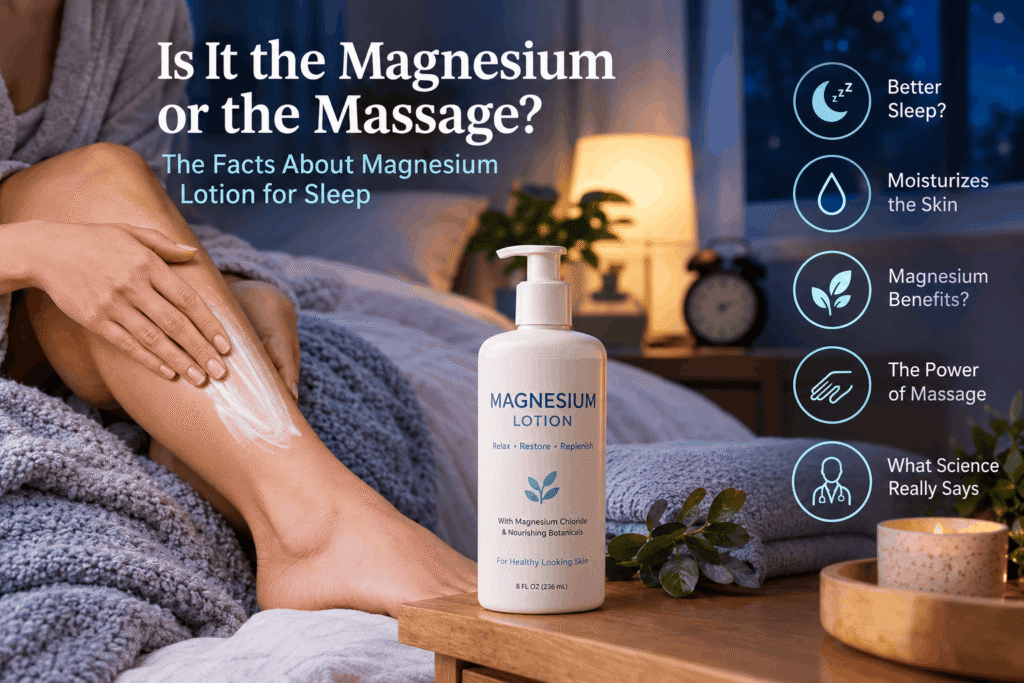
Magnesium lotion sits at the intersection of skincare, relaxation, and sleep wellness. Its growing popularity reflects a wider interest in simple nighttime routines that promise comfort without complicated equipment or major lifestyle changes.
Some products contain magnesium chloride or other magnesium compounds alongside moisturizers, oils, fragrances, and additional skin-conditioning ingredients. Depending on the formula, the lotion may leave the skin feeling softer and create a pleasant sensation when massaged into tired legs or feet.
However, a product can feel soothing without proving that its advertised active ingredient produces the claimed medical effect. A relaxing bedtime ritual and a treatment that changes the body’s magnesium levels are two different things.
Research on topical magnesium remains limited, and current evidence does not establish magnesium lotion as a reliable treatment for insomnia or other sleep disorders. A review published in Nutrients concluded that claims about meaningful magnesium absorption through the skin were not adequately supported by the available scientific evidence.
That does not mean every person who enjoys magnesium lotion is imagining the experience. Massage, comfortable skin, and a consistent bedtime routine may contribute to relaxation. The important distinction is that feeling relaxed does not automatically demonstrate that magnesium has passed through the skin and improved sleep.
Can Using Magnesium Topically Help With Sleep? Medical Experts Are Skeptical
Magnesium plays important roles in normal muscle and nerve function, energy production, and many other physiological processes. Because these functions are essential to overall health, it is understandable that people are interested in whether magnesium products might also support better sleep.
Topical magnesium products are commonly marketed for nighttime relaxation. Some brands recommend applying lotion to the soles of the feet, while others suggest using it on the calves, shoulders, or other areas that feel tense.
The central scientific question is whether the magnesium in these products can cross the skin barrier in sufficient quantities to produce a measurable effect inside the body.
The skin protects the body against environmental substances and helps prevent excessive water loss. Although certain medications are specifically designed to pass through the skin, not every ingredient in a cream or lotion can do so effectively.
Medical experts have therefore questioned whether magnesium lotion delivers enough magnesium into the bloodstream to explain the sleep benefits often advertised. At present, evidence is insufficient to recommend topical magnesium as an established sleep treatment.
People who enjoy using the product may still appreciate its moisturizing qualities or the calming effect of a bedtime massage. Those experiences, however, should not be confused with proof that topical magnesium corrects a deficiency or treats a medical condition.
The Claim
Supporters of magnesium lotion often claim that applying it before bed can help the body unwind, reduce nighttime discomfort, and make falling asleep easier. Foot application receives particular attention in online wellness content, where users frequently share personal experiences and nighttime routines.
Other claims extend beyond sleep. Some advertisements suggest that topical magnesium can help with muscle soreness, leg cramps, stress, or various chronic health complaints. These claims can make a single lotion appear to offer a wide range of benefits.
The reasoning behind these claims usually begins with magnesium’s established role in the body. Since magnesium participates in normal nerve and muscle function, marketers may suggest that delivering it through the skin will support those processes.
However, an essential nutrient’s importance does not prove that every product containing it can deliver that nutrient effectively. A lotion must first allow the active ingredient to cross the skin barrier in meaningful amounts before its proposed effects inside the body can be established.
Personal testimonials also have limitations. Someone may report sleeping better after introducing magnesium lotion, but that improvement alone cannot determine whether magnesium was responsible. Changes in bedtime habits, reduced stress, massage, expectations, or natural variation in sleep could also explain the experience.
For this reason, the claims surrounding magnesium lotion need to be evaluated through controlled research rather than popularity or individual reports alone.
The Evidence
Scientific evidence supporting magnesium lotion as a sleep aid is limited. Researchers have investigated transdermal magnesium, meaning magnesium intended to enter the body through the skin, but the available findings do not establish it as a dependable method of increasing magnesium levels or improving sleep.
The outer layer of healthy skin acts as a protective barrier. Magnesium ions have properties that make their passage through this barrier difficult, and evidence of limited penetration does not necessarily mean that enough magnesium reaches the bloodstream to produce a meaningful health benefit.
A small pilot study published in 2017 examined magnesium cream and measured magnesium-related markers in participants. Although some changes were observed, the study was small, and its findings were not sufficient to establish topical magnesium as an effective treatment. Larger, better-designed studies would be needed to confirm whether meaningful absorption occurs and whether it produces useful clinical outcomes.
Sleep itself is also influenced by numerous factors, including stress, daily activity, caffeine consumption, light exposure, medications, and existing health conditions. Even if someone reports improvement after using a lotion, determining the cause requires more than observing a change over time.
There is also an important distinction between topical and oral magnesium. Research about taking magnesium by mouth cannot automatically be used as evidence for a lotion applied to the skin. The route of delivery, amount absorbed, and resulting effects must be evaluated separately.
For now, the scientific evidence does not support treating magnesium lotion as a proven solution for insomnia. It may be a pleasant addition to a personal care routine, but its specific effects on sleep remain uncertain.
The Nuance
Although the evidence is limited, the discussion does not need to be reduced to a simple choice between a miracle product and a completely useless one.
A magnesium lotion can serve as a moisturizer, depending on its ingredients. Rubbing it gently into the feet or legs can also create a relaxing routine that encourages someone to slow down before bed. If the product feels comfortable on the skin, a person may enjoy using it for these reasons even without proof of magnesium absorption.
Expectations can influence how people experience wellness routines, too. When someone believes that a particular ritual will help them relax, the experience may feel beneficial. This does not mean the improvement is necessarily false; it means the improvement does not identify which ingredient or activity caused it.
Safety and product quality also deserve attention. A lotion may contain fragrances, essential oils, preservatives, or other ingredients that irritate sensitive skin. Anyone experiencing burning, itching, redness, or swelling should stop using the product and seek appropriate advice if symptoms persist or become severe.
People should also avoid relying on magnesium lotion instead of appropriate medical care. Persistent insomnia, severe nighttime discomfort, or recurring leg symptoms may have underlying causes that need assessment. Established treatments may be available depending on the condition.
The most balanced approach is to separate comfort from medical claims. Enjoying a massage or moisturizer is reasonable, but assuming that the lotion corrects a magnesium deficiency or treats a sleep disorder goes beyond what current evidence can establish.
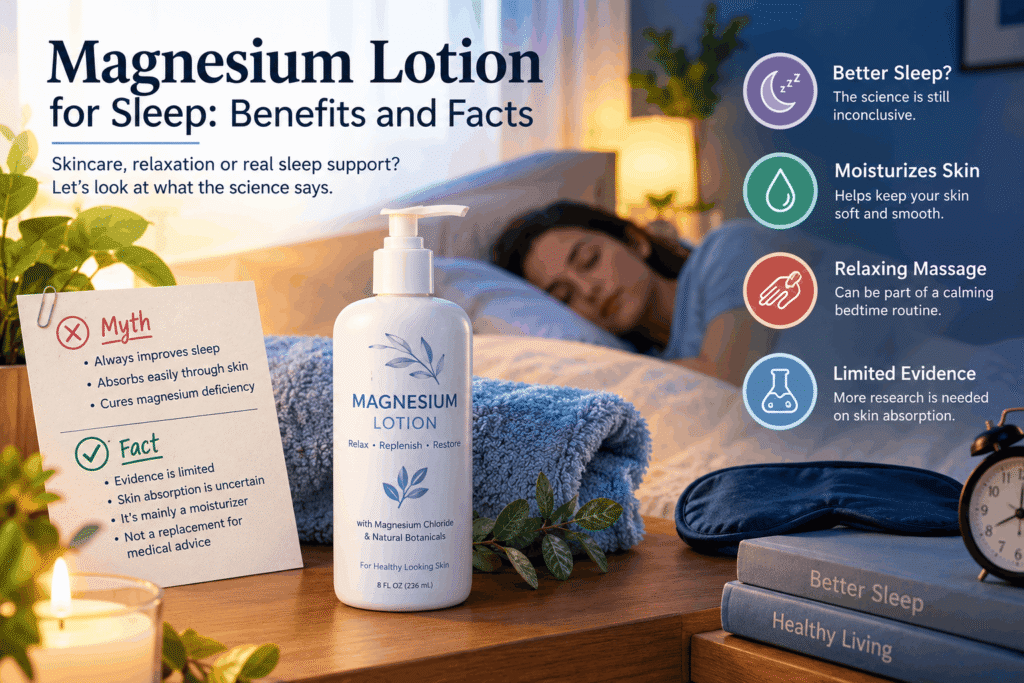
What Does Magnesium Lotion Actually Do for Your Skin?
Magnesium lotion is often purchased for its advertised relaxation benefits, but its most immediate purpose may be much simpler: caring for the skin. Depending on the formula, a lotion can soften rough areas, reduce the feeling of dryness, and make the skin feel more comfortable after a shower or before bed.
The experience depends largely on the other ingredients in the product. Moisturizing agents help the skin retain water, while oils and emollients can improve softness. Magnesium-containing ingredients are part of the formula, but their presence alone does not prove that the product can improve sleep or change magnesium levels inside the body.
This distinction is useful when deciding whether a lotion is worth buying. If your main goal is softer skin, evaluate its moisturizing ingredients and how your skin responds. If you want to address a sleep problem, look for evidence-based approaches rather than judging the product by how relaxing it feels during application.
Why Do Some People Feel Better After Applying Magnesium Lotion?
Personal experiences can help explain why a product becomes popular, but they cannot establish exactly how it works. Someone who applies lotion every night may notice that bedtime feels calmer or that they become less distracted by the day’s activities.
Several factors could contribute to that experience. Taking a few minutes for self-care creates a break from work and screens. Gentle massage can feel comforting, and repeating the same activity before bed may help establish a predictable routine. Expectations about a product can also influence how someone experiences it.
None of these possibilities proves that magnesium has been absorbed through the skin in a quantity that affects sleep. To establish that connection, researchers would need well-designed studies measuring absorption and relevant outcomes.
You do not have to dismiss your own experience to recognize this limitation. If applying lotion helps you relax and does not irritate your skin, you may enjoy the ritual. Just avoid assuming that the same experience will occur for everyone or that the magnesium itself is necessarily responsible.
How to Choose a Magnesium Lotion
Read the Full Ingredient List
Look beyond the product name and check the complete formula. Products may contain different magnesium compounds, fragrances, oils, and moisturizing ingredients. Knowing what is included can help you identify substances that your skin may not tolerate.
Be Careful With Medical Promises
Be skeptical of labels that promise guaranteed sleep, rapid correction of magnesium deficiency, or relief from several unrelated health problems. These are substantial claims that require evidence from appropriate clinical research.
Consider Your Main Purpose
Decide whether you want a moisturizer, a product for massage, or something you hope will address a health concern. A lotion may be useful for skin comfort without being an established treatment for sleep difficulties.
Compare Value, Not Just Price
An expensive product is not automatically more effective than a less costly alternative. Compare the quantity, ingredients, fragrance, texture, and directions before making a decision. Customer reviews may describe personal experiences, but they cannot confirm medical effectiveness.
Mistakes to Avoid When Using Magnesium Lotion
One common mistake is applying more product because the expected benefit has not appeared. There is no established amount of topical magnesium that reliably improves sleep, so increasing the quantity is not a proven solution.
Another mistake is assuming that a tingling sensation means the product is working. Skin sensations do not demonstrate that magnesium has entered the bloodstream. Stinging or burning may instead indicate irritation, so stop using the lotion if the reaction is uncomfortable.
It is also unwise to apply a new formula to damaged skin or to combine several products without checking their ingredients. If a lotion causes persistent redness, swelling, or itching, discontinue it and seek medical advice when appropriate.
Finally, do not let a topical product delay an assessment of persistent sleep problems. Difficulty sleeping can be associated with stress, medication effects, breathing problems during sleep, and other conditions. Identifying the underlying issue is more useful than repeatedly changing lotions.
Magnesium Lotion and a Healthy Sleep Routine
A nighttime routine works best when it is realistic and easy to repeat. You might wash your face, apply a comfortable moisturizer, prepare your bedroom, and spend a few quiet minutes reading. Magnesium lotion can be included if you enjoy using it, but it does not need to be the central part of the routine.
Try to keep your sleep and wake times consistent. Limit caffeine later in the day if it affects you, and make your bedroom suitable for rest. If worries keep you awake, writing down tomorrow’s tasks before bedtime may help you set them aside until the next day.
If sleep problems occur frequently, consider speaking with a healthcare professional. Chronic insomnia can benefit from structured treatments such as cognitive behavioral therapy for insomnia (CBT-I). The most appropriate approach depends on the nature and duration of your symptoms.
Final Thoughts
Magnesium lotion has gained attention as a simple addition to nighttime self-care, but its ability to improve sleep remains scientifically uncertain. Although magnesium is essential for normal body functions, current evidence does not establish that applying it to the skin delivers enough magnesium to produce meaningful sleep benefits.
You can still enjoy magnesium lotion for its moisturizing properties or as part of a relaxing bedtime routine, provided it suits your skin. However, better sleep usually requires a broader approach, including consistent sleep habits and attention to factors that may interrupt rest. If sleep problems persist or you suspect a magnesium deficiency, consult a healthcare professional. Understanding the difference between wellness claims and proven benefits can help you make informed choices about magnesium lotion.
Magnesium lotion is often marketed as a sleep aid, but scientific evidence has not established that applying magnesium to the skin reliably improves sleep.
No. Current evidence is insufficient to confirm that magnesium lotion can treat insomnia. People experiencing persistent sleep problems should consult a healthcare professional.
Some products claim that magnesium can be absorbed through the skin, but there is limited reliable evidence showing that topical magnesium provides a meaningful increase in the body’s magnesium levels.
There is not enough strong evidence to conclude that magnesium lotion relieves nighttime leg cramps. Frequent or painful cramps may have several causes and should be discussed with a healthcare professional.