A little warmth can completely change how makeup looks on the skin. The right bronzer can make the complexion appear healthier, add dimension around the cheeks, and create the effect of spending time in the sunshine without making the face look heavily made up. A cream bronzer is especially useful when you want that warmth to blend naturally into your foundation rather than sit on top of it like a visible layer of powder.
Unlike traditional powder formulas, cream-based products often offer a softer, more skin-like finish. Depending on the formula, they can create anything from a subtle, barely noticeable warmth to a richer, sun-kissed appearance. Some are designed for quick application with the fingers, while others work best with a dense brush or a damp makeup sponge. The difference between a flattering result and an overly orange or muddy finish often comes down to shade selection, texture, and blending technique.
However, not every formula works equally well for every complexion. Someone with oily skin may prefer a lightweight product that sets without excessive shine, while someone with dry skin might appreciate a creamy texture that blends without emphasizing flaky areas. Your preferred makeup style matters, too. A sheer formula can suit everyday makeup, whereas a more pigmented option may be better for full-glam looks or deeper skin tones that need visible color payoff.
This guide explores the qualities that make a bronzer worth considering, the different finishes available, and the practical details that can help you find a formula suited to your routine. Rather than assuming one product works for everyone, the goal is to help you understand which features deserve your attention before choosing your next complexion essential.
Understanding What Makes Cream Bronzer Different
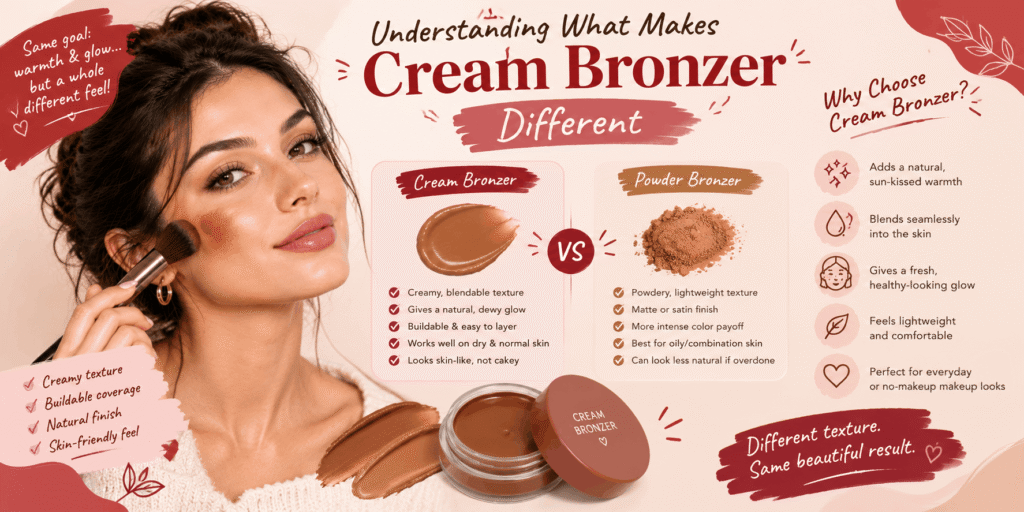
A cream bronzer is intended to add warmth to the complexion, particularly in areas where sunlight would naturally create a little extra color. It is commonly applied around the forehead, temples, upper cheeks, and jawline. A cream formula performs this role using a soft, blendable texture that can merge with other complexion products.
The main appeal is its ability to create a seamless transition between foundation and bronzer. When the texture is compatible with the products underneath, the color can look as though it belongs to the skin instead of appearing like a separate stripe of makeup. This quality makes cream formulas attractive to people who prefer fresh, softly defined makeup rather than an obviously powdered finish.
Cream bronzers also vary considerably in consistency. Some feel like whipped mousse, others resemble a thick balm, and some come in compact pots or convenient twist-up sticks. A lighter balm may spread easily across the cheeks, while a firmer stick can provide more control when applying color along the hairline or beneath the cheekbones.
It is worth remembering that creamy does not automatically mean dewy, moisturizing, or long-lasting. Ingredients, pigments, waxes, oils, and setting properties all influence how a formula behaves. One product may leave a luminous finish, while another dries down to a soft matte appearance. Understanding these differences makes shopping much easier than relying on the product name alone.
Choosing a Formula That Matches Your Makeup Style
The best starting point is to consider how you normally wear makeup. If your routine consists of sunscreen, a little concealer, and minimal complexion coverage, a sheer bronzer that blends with the fingers may be all you need. It can add dimension without making the rest of your face look unfinished.
For a more polished look, a medium-pigment formula offers greater flexibility. You can apply a small amount for daytime makeup and gradually build the color for an evening look. This approach is often easier than trying to soften an intensely pigmented product after applying too much.
People who enjoy sculpted cheeks should pay particular attention to undertones. A warm bronzer can give the face a healthy, sun-kissed appearance, but a strongly orange shade may look unnatural when used to create shadows. If you want both warmth and definition, choose a product with a balanced undertone and use a separate contour shade when necessary.
Application preferences matter as well. A stick can be practical for travel and quick touch-ups, while a pot may provide better access to the product when working with a brush. A compact cream can be convenient for people who want to keep their makeup bag small. There is no universally superior format; the most useful one is the format you can apply evenly and comfortably.
Cream Bronzer Styles Worth Considering
Rather than treating every bronzer as interchangeable, it helps to group products by the results they are designed to create. These categories can help narrow down your options before you compare individual formulas.
A Natural Finish for Everyday Makeup
A natural-looking formula adds warmth without creating a strongly reflective or completely flat appearance. It can be especially appealing when you want your skin to remain the focus of your makeup.
These products are generally easiest to work with when the pigment spreads evenly and leaves enough time for blending. Apply a small amount first, then add more only where the color looks too faint. This prevents the cheeks from becoming noticeably darker than the forehead and temples.
A Radiant Finish for Fresh-Looking Skin
Radiant formulas are designed to introduce some visible luminosity to the complexion. Depending on the product, the effect may come from a glossy balm texture, finely dispersed light-reflecting ingredients, or a naturally luminous finish.
A radiant bronzer can work beautifully on the high points of the cheeks when paired with a restrained amount of blush. However, people who prefer a shine-free appearance may find a luminous formula less suitable around the forehead or nose. Placement is just as important as the product itself.
A Soft-Matte Finish for More Definition
A soft-matte formula offers warmth without adding much visible shine. This can make it a useful option for people who prefer a more controlled finish or want to combine bronzer with other sculpting products.
Matte does not have to mean dry or difficult to blend. Some cream formulas spread smoothly before setting, leaving a finish that looks more natural than a heavily powdered complexion. The key is to choose a texture that remains workable long enough for you to blend its edges.
A Sheer Formula for Beginners
Cream bronzers are often forgiving because the color develops gradually. They allow beginners to learn where to place the product and how much warmth their complexion needs without creating an intense result immediately.
They can also be helpful for minimal makeup routines. A small amount blended around the temples and cheeks may be enough to bring balance to a complexion that looks flat after foundation application.
A Pigmented Formula for Noticeable Color
Higher-pigment options are useful when you want stronger warmth, need a product that shows up clearly on deeper skin, or prefer a more defined makeup look. However, high pigmentation requires a lighter hand.
Instead of drawing a thick stripe directly onto your face, pick up a small amount on a brush and gradually distribute the color. This gives you more control over placement and makes it easier to maintain symmetry between both sides of the face.
How to Select a Shade That Looks Natural on Your Skin
Texture is only part of the decision. Even a beautifully formulated product can look unconvincing when its shade is too orange, too red, too gray, or too dark for the intended effect.
For fair skin, lighter beige-brown shades or soft neutral tones can add warmth without overwhelming the complexion. A shade that appears only slightly deeper than your natural skin color may be enough for everyday makeup. Very dark shades can still work, but they usually require more careful application and blending.
Light-medium and medium complexions often have a wider range of suitable options, including golden brown, neutral tan, and warm caramel shades. The most flattering choice depends on the skin’s natural undertone and whether you prefer a subtle glow or a more noticeable sun-kissed effect.
For deeper complexions, rich caramel, chestnut, chocolate, and red-brown tones can provide visible warmth without creating a chalky or ashy cast. A product that looks beautifully pigmented in its packaging may appear much softer after blending, so testing the shade on the skin is more useful than judging it by appearance alone.
Undertones also deserve attention. Warm undertones may pair naturally with golden or peachy-brown bronzers, while neutral undertones can often accommodate a broader range. Cooler undertones may prefer balanced brown shades that do not lean too heavily toward orange. These are helpful starting points rather than strict rules.
Whenever possible, check the color in natural daylight. Indoor lighting can make a bronzer appear warmer or cooler than it really is. Blend a small amount into the skin and assess whether it creates believable warmth rather than an obvious band of color.
What to Check Before Buying a Cream Bronzer
Shopping becomes more straightforward when you focus on practical features instead of packaging claims. A product that looks attractive online may not be the best match for your complexion, application habits, or preferred finish.
Texture and blendability: Look for a formula that spreads without dragging across the skin. If it becomes patchy before you finish blending, applying it evenly may be difficult.
Pigment strength: Consider whether you prefer a subtle wash of color or a product that delivers noticeable warmth with a small amount. Buildable formulas can offer more control, particularly for everyday use.
Finish: Decide whether you prefer natural, luminous, or matte results. Remember that a shiny finish is not necessarily more hydrating, and a matte finish is not automatically drying.
Wear throughout the day: Think about how the product behaves after several hours, especially if you wear makeup during warm weather or spend time outdoors. Longevity can depend on the formula, skincare underneath, foundation compatibility, and application method.
Packaging: Sticks are convenient for travel, pots can be versatile for brush application, and compacts are often easy to store. Choose packaging that suits your routine and allows you to use the product hygienically.
Price and value: A higher price does not guarantee better performance. Compare the amount of product, the ease of application, and whether you can use it regularly without wasting a significant amount.
Skin compatibility: If your skin is sensitive or prone to clogged pores, review the ingredient list and test the product on a small area first. No particular texture guarantees that a formula will suit every skin type.
The most useful purchase is one that performs consistently in your actual routine. A bronzer does not need to have the most luxurious packaging or the strongest pigment to become a dependable part of your makeup collection.
How to Apply Cream Bronzer Without Leaving Harsh Lines
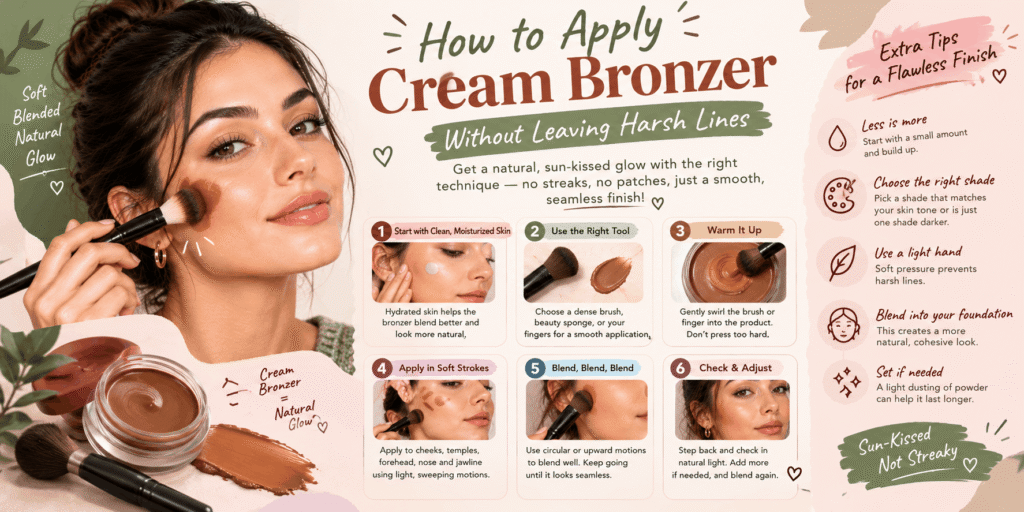
Even a well-matched bronzer can look uneven if it is applied too heavily or blended in the wrong direction. The easiest way to achieve a natural result is to start with a small amount of product and build the color gradually. This gives you more control over the final appearance and reduces the chance of disturbing your foundation.
Begin with your usual skincare and complexion products. Allow sunscreen and moisturizer to settle before applying makeup, as a slippery base can sometimes cause cream products to move around. If you wear foundation, apply it first and check whether it has dried down or remains creamy. The condition of the base can affect how easily your bronzer blends.
Pick up a little product with a brush, sponge, or clean fingertip. Place it around the temples, near the hairline, and along the upper part of the cheeks. These areas are useful starting points because they create warmth without requiring a complicated technique. Blend the edges until there are no obvious lines separating the bronzer from the surrounding complexion.
For a more lifted appearance, concentrate the color slightly higher on the cheeks and blend it toward the temples. If you prefer a traditional sun-kissed effect, distribute a small amount across the forehead and add a touch to the bridge of the nose. Keep the application light so the different areas look connected rather than like separate patches.
One of the most common mistakes is applying too much product directly from a stick onto the face. Although this can be convenient, it may deposit more pigment than necessary. Swiping the stick onto a brush first gives you greater control, especially if the formula is richly pigmented. If you do apply it directly, use a light touch and blend immediately.
Check both sides of your face in natural light before finishing. If one cheek appears darker, use a clean brush or sponge to soften the edge rather than adding more product to the other side. A little patience usually produces a more balanced result than repeatedly layering makeup.
Finding the Right Formula for Oily or Dry Skin
Skin type can influence how a bronzer looks and feels throughout the day. However, it should not be the only factor in your decision. Your preferred finish, skincare routine, climate, and the foundation you wear underneath can all change the result.
What Works Well for Oily Skin?
If your skin becomes shiny during the day, a lightweight formula with a natural or soft-matte finish may be more comfortable than a very emollient balm. These textures can provide warmth without contributing as much visible shine to areas that already produce oil.
Apply the product in thin layers rather than using a heavy amount in one application. Concentrate it where you want color and avoid unnecessarily layering it across the entire face. If your makeup tends to move around, a compatible primer and a light dusting of setting powder may help improve the overall finish.
You do not have to avoid every luminous formula simply because your skin is oily. A little glow on the cheeks can still look attractive. The important consideration is whether the formula remains comfortable and balanced in the areas where you intend to wear it.
What Works Well for Dry Skin?
Dry skin may benefit from a formula that spreads smoothly without emphasizing rough texture. Creamy products can be appealing because many blend without the powdery appearance that some people notice with dry patches.
Start with moisturized skin and allow your skincare products to absorb before applying makeup. If your foundation already feels dry or tight, a bronzer with a compatible creamy texture may blend more evenly than a product that sets almost immediately.
Avoid rubbing the product repeatedly over flaky areas. Instead, press and gently blend it with a soft brush or sponge. Too much friction can disturb the foundation underneath and make texture more noticeable.
A luminous formula may complement dry skin, but shine alone does not solve dehydration. Your skincare routine still plays an important role in maintaining a comfortable makeup base.
Can Combination Skin Use Any Cream Bronzer?
Combination skin often needs a flexible approach. The cheeks may feel dry while the forehead and nose become shiny, making one finish less suitable for every area.
A balanced, natural-finish bronzer can be a practical starting point. Apply it mainly to the cheeks and temples, then adjust your setting products according to the needs of each area. You might prefer a small amount of powder around the forehead while leaving the cheeks with their natural finish.
Instead of buying separate bronzers for different areas, experiment with placement and the amount you use. Sometimes a simple adjustment to your routine makes a greater difference than switching products.
Making Cream Bronzer Last Longer
The longevity of your makeup depends on several factors, including the formula, the products underneath it, and environmental conditions. Heat, humidity, perspiration, and frequent touching can all affect how complexion products wear.
Start with a clean, well-prepared base. Heavy skincare layers that have not absorbed may cause some formulas to slide, while an overly dry base can make blending difficult. Give each layer enough time to settle before applying the next.
Use thin applications. A thick layer may initially look more intense, but it can be harder to keep even throughout the day. Building up two light layers, when the formula allows it, often provides a more controlled result than applying a large amount at once.
If you prefer longer-wearing makeup, consider setting the bronzer with a compatible powder bronzer in a similar shade. Use a light hand so the added layer does not make the cheeks look heavy. This technique is optional; some cream formulas are designed to work beautifully without powder.
A setting spray may help bring the overall makeup together, depending on the product and your routine. However, no spray guarantees that every bronzer will stay unchanged all day. If you are attending a long event, carrying a small brush for touch-ups may be more reliable than repeatedly adding new layers.
When your complexion begins to look uneven, remove excess oil gently before reapplying makeup. Adding fresh bronzer over a combination of sweat, oil, and disturbed foundation can make the finish patchier. Small, careful corrections generally look better than completely rebuilding the product on top.
Common Cream Bronzer Mistakes to Avoid
A few simple changes can make the application process easier and help your makeup look more natural.
Choosing a shade that is too orange: Warmth should complement your complexion rather than create an obviously different color. Test the shade in daylight and look at the result after blending.
Using too much product at once: Strong pigment can spread farther than expected. Start with a small amount and add more only when necessary.
Blending too late: Some formulas set quickly. Work on one section of the face at a time instead of applying the product everywhere before blending.
Applying over a base that is still slippery: Excess skincare or sunscreen can sometimes interfere with makeup. Allow your layers to settle and check how your foundation behaves before continuing.
Using the wrong tool for the texture: A dense brush may help distribute a firmer cream, while a softer brush or sponge may be more suitable for a lightweight formula. Test different methods to see which produces the smoothest result.
Confusing bronzer with contour: Bronzer is generally used to create warmth, whereas contour is intended to mimic shadows. Some products can perform both roles, but a strongly warm bronzer may not create the most natural-looking shadow.
Ignoring the neck and hairline: If the color is concentrated in one area, the complexion can look disconnected. Blend the edges carefully without applying unnecessary product everywhere.
Assuming every cream product needs powder: Some formulas are designed to remain creamy, while others dry down. Follow the behavior of the specific product instead of automatically applying several additional layers.
Avoiding these mistakes does not require advanced makeup skills. Most improvements come from choosing a suitable shade, applying less product, and taking enough time to blend.
Final Thoughts
Finding a flattering bronzer is less about following a universal ranking and more about understanding what your complexion and makeup routine need. The right shade should provide believable warmth, the texture should be comfortable to work with, and the finish should suit the look you want to achieve.
When comparing products, pay attention to pigmentation, blendability, packaging, wear time, and how the formula performs over your usual skincare and foundation. A lightweight option may be ideal for a quick everyday routine, while a richer formula might suit someone who prefers more noticeable color and a polished finish.
Do not overlook the importance of application. Starting with a small amount, blending in manageable sections, and checking your makeup in natural light can make an ordinary product look far more flattering. Likewise, choosing an expensive formula will not necessarily guarantee better results if its shade or texture does not suit you.
Ultimately, the most useful cream bronzer is one that fits comfortably into your routine and helps you achieve your preferred look without unnecessary effort. Whether you want a soft everyday glow, a more sculpted appearance, or a radiant finish for a special occasion, understanding your options will make it easier to choose a product you enjoy using.
Neither formula is automatically better. A cream bronzer can offer a seamless, skin-like finish and may be convenient for people who prefer minimal makeup. Powder bronzers can be easier to layer over a powdered base and may appeal to those who prefer a less creamy texture.
Your skin type, preferred finish, and application habits should guide the decision. Some people enjoy using both formulas for different occasions.
Yes. A sheer or buildable formula is often a useful starting point because it allows you to control the intensity gradually. Begin with a small amount, blend it thoroughly, and check the result before adding more.
In most makeup routines, cream bronzer is applied before setting powder because creams generally blend more easily over compatible liquid or cream complexion products. Applying a creamy product over a heavily powdered base can sometimes create patchiness.

One Comment