
Have you ever created what seemed like the perfect eye makeup look, only to ruin it with one uneven eyeliner line? One eye looks sharp, the other looks slightly different, and after a few hours, the liner starts fading or smudging.
This is exactly why choosing the right liquid eyeliner and learning how to apply it properly can make such a difference.
Liquid eyeliner is one of the most popular makeup products for creating defined, dramatic, and polished eyes. With the right formula and applicator, you can create everything from a thin everyday line to a bold winged or cat-eye look. It can instantly make the eyes appear more defined and completely change the mood of your makeup.
But not every liquid eyeliner works the same way. Some formulas dry quickly, while others give you more time to correct mistakes. Some provide a deep black finish, while others offer softer shades such as brown, blue, purple, or green.
The applicator matters, too. A flexible brush tip can produce a different result from a firm felt tip, and choosing between them can make application easier depending on your experience level.
In this complete guide, you’ll learn what liquid eyeliner is, the different types available, how to choose the right formula, how to apply it, how to make it last longer, how to adapt it to different eye shapes, and how to fix common eyeliner mistakes.
What Is Liquid Eyeliner?
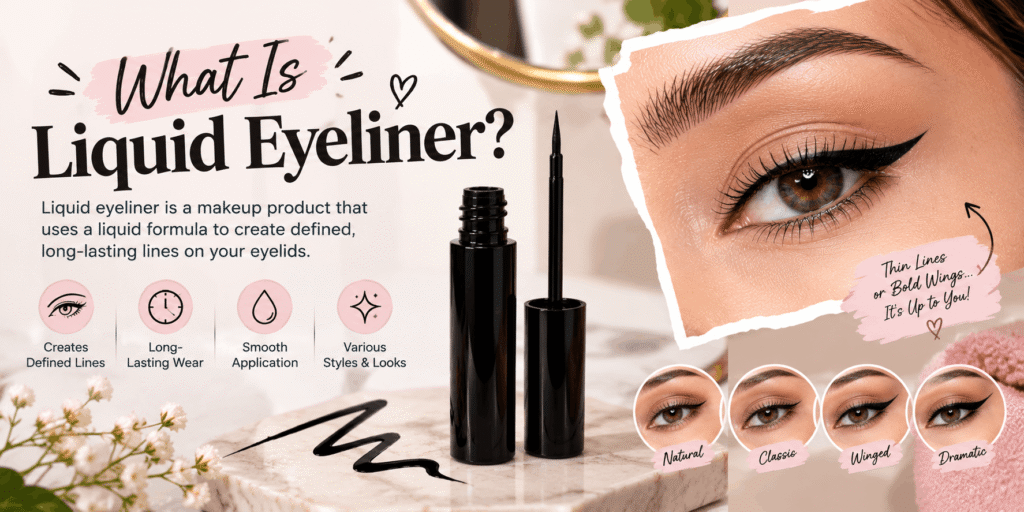
Liquid eyeliner is a makeup product designed to create a defined line along the upper or lower lash line. Unlike pencil eyeliner, which generally has a softer and drier texture, liquid eyeliner has a fluid formula that allows you to create sharp and precise lines.
It usually comes in a small tube or pen-style container with an applicator attached to the cap. Depending on the product, the applicator may have a fine brush tip, felt tip, or marker-style point.
Liquid eyeliner is particularly useful for creating precise styles such as:
- Classic eyeliner
- Winged eyeliner
- Cat-eye makeup
- Graphic eyeliner
- Double-wing eyeliner
- Thin everyday liner
- Bold dramatic liner
Liquid eyeliners can also have different finishes, including matte and glossy, giving you more options for different makeup looks.
Why Is Liquid Eyeliner So Popular?
The biggest reason people love liquid eyeliner is precision. When you want a clean, sharp line, a liquid formula can provide more control than many softer eyeliner types.
A thin line can make the lashes appear more defined without looking overly dramatic. On the other hand, extending the line outward and adding a wing can create a much bolder appearance.
Another advantage is that you can control the thickness by changing the angle and pressure of the applicator. A light touch with the tip can create a very thin line, while using more of the applicator can produce a thicker look.
Liquid eyeliner is also available in a wide range of colors and finishes. Black remains a classic choice, but brown can create a softer everyday appearance, while colorful shades allow you to experiment with more creative eye makeup.
Different Types of Liquid Eyeliner
Liquid eyeliner comes in different applicator designs and formulas, and each type can produce a slightly different result.
Brush-Tip Liquid Eyeliner
Brush-tip eyeliners use a fine brush that gives you control over the thickness of the line. They are particularly useful when you want extremely thin lines, precise wings, or detailed graphic designs.
The main drawback is that brush tips can require more practice because the applicator is flexible and may be harder for beginners to control.
Felt-Tip Liquid Eyeliner
Felt-tip liners resemble markers and are often easier for beginners to handle. They provide a firmer application point, making them useful for creating clean lines and simple wings.
They can also be convenient for quick everyday makeup because the applicator is generally easy to grip and control.
Pen-Style Liquid Eyeliner
Pen-style liquid eyeliners are designed to be portable and easy to handle. Their shape gives you a grip similar to holding a pen, which can make application feel more natural.
They are especially popular among beginners who are still learning how to control the shape and thickness of their eyeliner.
How to Choose the Best Liquid Eyeliner
Choosing a liquid eyeliner isn’t simply about picking the darkest black available. Several features can affect how easily the product applies and how long it lasts.
Consider the Applicator
If you want extremely thin lines or detailed designs, look for a fine brush or precision tip.
If you’re a beginner, a slightly firmer felt tip may provide better control and make it easier to create a simple wing.
Check the Pigmentation
Highly pigmented eyeliner can create a strong, noticeable line with fewer passes. A lighter formula may require multiple layers to achieve the desired intensity.
Applying too many layers, however, can sometimes make the liner look uneven or textured.
Pay Attention to Drying Time
Drying time is another important factor.
A fast-drying formula can reduce accidental smudging, but it may give beginners less time to correct mistakes. A slower formula may be easier to adjust, but it can transfer if you blink before it has completely set.
Consider Wear Time
If you have watery eyes, oily eyelids, or live in a hot or humid climate, wear time becomes especially important.
Look for products designed for long wear or water resistance, but always check the manufacturer’s claims rather than assuming every liquid eyeliner is completely waterproof.
Choose the Right Finish
Liquid eyeliners are available in different finishes. Matte formulas can create a sophisticated, defined appearance, while glossy finishes can produce a more dramatic or eye-catching effect.
The best finish depends on the makeup style you’re trying to create.
Black vs. Brown Liquid Eyeliner
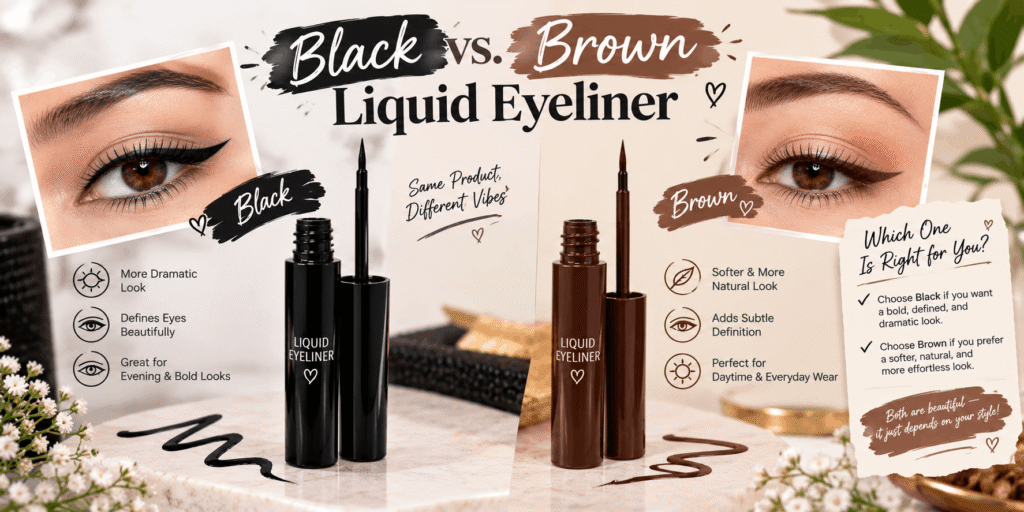
Black eyeliner is a classic choice because it creates strong definition and works with almost any makeup style.
However, brown liquid eyeliner can be an excellent alternative if you want a softer appearance. Brown creates less contrast than black and can look especially natural with everyday makeup.
You can also experiment with shades such as:
- Navy blue
- Emerald green
- Purple
- Burgundy
- Gray
- Metallic shades
Choosing an eyeliner shade that complements or contrasts with your eye color can make your eyes stand out in a different way. Color theory can be useful when selecting shades because complementary colors can create stronger visual contrast.
How to Apply Liquid Eyeliner
Applying liquid eyeliner may look difficult at first, but the process becomes much easier with practice.
Step 1: Prepare Your Eyelids
Start with clean, dry eyelids. If your eyelids tend to become oily, applying a small amount of eye primer or setting powder can help create a smoother base.
Avoid applying too much product because an overly heavy base can make eyeliner application more difficult.
Step 2: Start With the Lash Line
Instead of trying to draw one perfect line from the inner corner to the outer corner, work in small sections.
Start around the middle or outer portion of the upper lash line and gradually connect the sections.
Keep the eyeliner close to the lash roots. This helps prevent an unwanted gap between your lashes and the eyeliner.
Step 3: Create the Wing
When creating a wing, imagine a line extending from the outer corner of your eye toward the end of your eyebrow.
Make a small mark first, then connect it back toward the lash line.
For beginners, creating the wing first and then connecting it to the lash line can sometimes be easier than trying to draw the entire shape at once.
Step 4: Build the Thickness Gradually
A professional-looking approach is to keep the line thinner near the inner corner and gradually make it thicker toward the outer part of the eye.
This creates a more balanced appearance and allows you to build intensity without applying too much product at once.
Liquid Eyeliner for Different Eye Shapes
The same eyeliner style does not necessarily look the same on every eye shape. Small changes in thickness, angle, and length can make a significant difference.
Almond-Shaped Eyes
Almost any eyeliner style can work well with almond-shaped eyes.
A classic wing that gradually becomes thicker toward the outer corner can follow the natural shape of the eyes beautifully.
Round Eyes
For round eyes, extending the eyeliner slightly outward can create a more elongated appearance.
Keeping the inner portion thinner and focusing more definition on the outer corner can help balance the overall look.
Hooded Eyes
With hooded eyes, very thick eyeliner can sometimes take up too much visible eyelid space.
A thinner line placed close to the lashes often works better. When creating a wing, looking straight ahead while mapping the shape can help you see how the liner will appear when your eyes are open.
Monolid Eyes
For monolid eyes, a waterproof or long-wearing formula can be useful because the eyelid may come into contact with the liner when the eyes are open.
Depending on the amount of visible lid space, a slightly thicker line may also be necessary.
Downturned Eyes
For downturned eyes, keeping the wing slightly lifted instead of following the downward angle of the outer corner can create a more lifted-looking effect.
The goal isn’t to force every eye into the same eyeliner shape. Instead, adjust the technique to work with your natural eye structure.
Liquid Eyeliner for Everyday and Special Looks
Liquid eyeliner can be adapted for almost any occasion. You don’t always need a dramatic wing to make your eyes look defined.
Everyday Makeup
For everyday makeup, a thin line close to the upper lashes can provide subtle definition.
Brown liquid eyeliner can make this look even softer, especially when paired with neutral eyeshadow.
Office and Formal Makeup
For a polished office or formal look, a clean black line with a small outward flick can add definition without making the makeup feel too heavy.
Party and Evening Makeup
For parties, weddings, dinners, or evening events, you can make the liner thicker and add a sharper wing.
Metallic eyeshadow or shimmer can also be paired with liquid eyeliner for additional impact.
Graphic Eyeliner
Graphic eyeliner takes the concept further by moving beyond the traditional lash line.
You can experiment with:
- Floating lines
- Geometric shapes
- Double wings
- Colorful designs
- Creative graphic patterns
Colorful eyeliner is especially useful when you want to experiment with different shapes and textures.
How to Make Liquid Eyeliner Last Longer
Even a good eyeliner can fade if the eyelid is oily or if the formula isn’t allowed to set properly.
Prepare the Eyelids
Start by removing excess oil from the eyelids. If an eye primer works well for you, apply a small amount before your eyeliner.
A clean, balanced surface can help the liner adhere more effectively.
Allow the Eyeliner to Dry
After applying the eyeliner, give it enough time to dry before opening your eyes fully or applying other products directly over it.
This can help reduce transfer and smudging.
Avoid Touching Your Eyes
Rubbing or frequently touching the eye area can cause even long-wearing eyeliner to fade.
If you want your eyeliner to remain sharp throughout the day, avoid unnecessary contact with your eyelids.
Choose a Long-Wearing Formula
For watery eyes or long days, consider a formula specifically designed for long wear or water resistance.
Keep in mind that waterproof and water-resistant performance can vary between products.
What Makes a Good Liquid Eyeliner?
A good liquid eyeliner should be easy to control and match the type of look you want to create.
Some of the most useful features to consider include:
- Pigmentation
- Applicator precision
- Drying time
- Wear time
- Finish
- Water resistance
- Ease of removal
For beginners, an applicator that is firm enough to control but thin enough for precision can make the learning process easier.
More experienced users may prefer a flexible brush tip because it can provide greater control over line thickness and detailed designs.
It’s also important not to assume that a product labeled waterproof will perform perfectly in every situation. Sweat, tears, humidity, and skin oils can all affect how long an eyeliner remains in place.
Waterproof vs. Water-Resistant Liquid Eyeliner
The terms waterproof and water-resistant are often used interchangeably, but they don’t necessarily mean exactly the same thing.
A water-resistant eyeliner is designed to withstand some exposure to moisture, but it may eventually fade or move when exposed to a large amount of water.
A waterproof eyeliner is generally formulated to provide stronger resistance to water, sweat, and tears. However, even waterproof formulas have limits.
If you’re choosing eyeliner for a hot or humid day, look for a formula specifically designed for long wear and water resistance.
If you’re attending an event where you expect tears, such as a wedding, choosing a product with strong staying power may be more suitable.
How to Keep Liquid Eyeliner Looking Clean
A clean eyeliner look often depends more on preparation and technique than people realize.
Before applying eyeliner, make sure there isn’t excessive oil on your eyelids. If your eyelids become oily during the day, a suitable eye primer can provide a better surface for makeup.
It’s also helpful to apply eyeshadow before liquid eyeliner. Once the eyeshadow is finished, you can place the liner on top and keep the line crisp.
Try not to repeatedly go over the same area. If the first line is slightly uneven, make small corrections instead of continuously adding more product.
For an especially sharp wing, use a small amount of makeup remover on a fine cotton swab to clean the outer edge. You can also use a little concealer to sharpen the shape.
Tips for Beginners
If you’re new to liquid eyeliner, don’t start by trying to create an extremely dramatic cat eye.
Begin with a thin line along the upper lash line. Once you become comfortable controlling the applicator, gradually experiment with thicker lines and small wings.
Practice With Eyeshadow
You can practice your desired shape with eyeshadow first.
Use a small angled brush and dark eyeshadow to sketch the line. Once you’re happy with the shape, trace over it with liquid eyeliner.
Try the Dot Method
Another useful technique is to make several tiny dots along the lash line and then connect them.
This can feel easier than trying to draw one continuous line.
Keep Your Hand Supported
Keep your hand steady while applying eyeliner. Resting your elbow on a table or lightly placing your little finger against your cheek can reduce unnecessary movement.
Practice Both Eyes
Don’t expect both eyes to look identical immediately.
Eyeliner is a skill that improves with repetition, and small differences between the two sides are completely normal while you’re learning.
Common Liquid Eyeliner Mistakes
Even experienced makeup users can make eyeliner mistakes. Knowing the most common problems can help you avoid them.
Trying to Perfect Both Wings at Once
One common mistake is trying to create both wings perfectly in one attempt.
This often leads to repeatedly adding more product until the wings become too thick.
Instead, create the basic shape first and make small adjustments.
Pulling the Eyelid Too Tightly
Although stretching the skin can make the surface appear easier to work on, the finished eyeliner shape can look different once the skin returns to its natural position.
Try to keep the eyelid as relaxed as possible.
Using Too Much Pressure
Using excessive pressure can make it difficult to control the applicator.
A lighter touch usually provides better control, especially when working with a fine tip.
Adding Layers to Drying Eyeliner
Avoid repeatedly adding product to a line that has already started drying.
Doing so can create a rough or uneven texture.
Using Old Eyeliner
Don’t ignore the age and condition of your eye makeup.
Clean the applicator when appropriate and replace old eyeliner according to the product’s recommended usage period. Eye makeup requires careful handling because it is used very close to the eyes.
How to Fix Eyeliner Mistakes
Even experienced makeup users sometimes create uneven lines or wings.
If your wing is too short, extend it gradually rather than drawing an entirely new line.
If one side is thicker than the other, avoid making the thinner side dramatically thicker just to match it. Instead, remove a small amount from the thicker side and rebuild the shape.
For tiny mistakes, use a pointed cotton swab with makeup remover to clean the affected area without removing your entire eye makeup.
Concealer can also help sharpen the outer edge and create a more polished finish.
The best approach is to correct the smallest area possible instead of repeatedly layering more eyeliner.
How to Remove Liquid Eyeliner
Removing liquid eyeliner properly is just as important as applying it.
Avoid aggressively rubbing the delicate skin around your eyes. Instead, use an eye makeup remover designed to break down long-wearing makeup.
For stubborn waterproof formulas, an oil-based eye makeup remover can help dissolve the product.
Apply the remover to a cotton pad, gently hold it against your closed eyelid for several seconds, and then wipe without excessive rubbing.
After removing the eyeliner, gently cleanse the area and moisturize the surrounding skin if needed.
How to Store Liquid Eyeliner
Proper storage can help maintain both the formula and the applicator.
Keep It Tightly Closed
Always keep your eyeliner tightly closed when you’re not using it. Leaving the container open can allow the formula to dry out more quickly.
Avoid Excessive Heat
Store the product according to the manufacturer’s instructions and avoid exposing it to excessive heat.
High temperatures can affect the formula and its performance.
Protect the Applicator
If your eyeliner has a pen-style applicator, keeping it properly capped can help prevent the tip from drying out.
Know When to Replace It
If your eyeliner suddenly becomes unusually dry, changes in texture, develops an unusual smell, or appears contaminated, it’s better to replace it rather than continue using it near your eyes.
Final Thoughts
Liquid eyeliner can seem difficult when you’re first learning how to use it, but the right product and technique can make the process much easier.
The key is to choose an eyeliner that matches your experience level, eye shape, desired finish, and required wear time. Beginners may find a firm felt tip easier to control, while experienced users may prefer the precision of a flexible brush tip.
Start with a simple thin line, work in small sections, and build the shape gradually. As your control improves, you can experiment with wings, cat eyes, colorful eyeliner, and graphic designs.
Most importantly, don’t feel pressured to make both eyes perfectly identical on the first attempt. With practice, patience, and the right technique, liquid eyeliner can become one of the most versatile products in your makeup routine.

One Comment