A silk hair wrap can be a simple addition to your nighttime routine, especially if your hair tends to become frizzy, tangled, dry-looking, or difficult to style after sleeping. Instead of leaving your hair exposed to constant friction against a cotton pillowcase, a smooth wrap creates a gentler surface around the strands while helping keep your hairstyle contained.
The idea is simple, but not every hair wrap is made the same way. Real silk, satin, construction, size, lining, closure, and overall fit can all affect how comfortable and useful a wrap feels overnight. Some options are designed specifically for curly and textured hair, while others focus on luxury, adjustability, or keeping long hair securely covered.
If you are considering a silk hair wrap, understanding what it actually does and what to look for can make it much easier to choose an option that fits your hair rather than simply buying the first bonnet you see.
What Is a Silk Hair Wrap and Why Does It Matter?
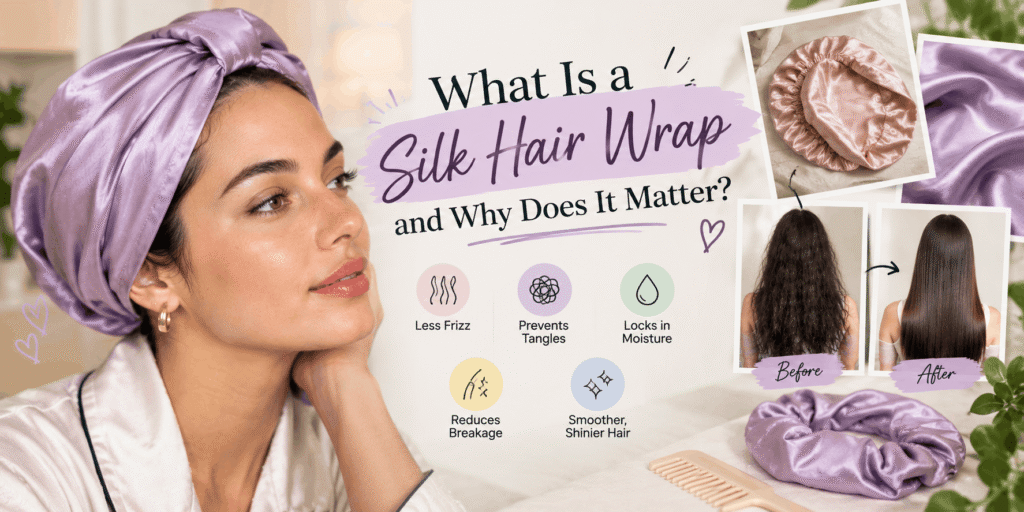
A silk hair wrap is a protective covering worn around the hair, usually while sleeping. It is designed to reduce the amount of friction and disturbance your hair experiences as you move around during the night.
Traditional cotton bedding can create considerable friction between your hair and the pillow. As strands repeatedly rub against the fabric, the movement can contribute to tangling, frizz, and a rougher-looking finish. A smooth hair wrap provides a different surface, allowing the hair to move more easily inside or against the material.
The word “silk” is important here because genuine silk and satin are not the same thing. Silk is a natural fiber, while satin describes a type of weave or finish that can be produced using several different fibers. A satin bonnet can therefore be made from polyester or other materials rather than actual silk.
That does not automatically make satin a bad choice. A well-made satin wrap can still provide a smooth surface and may be considerably more affordable than genuine silk. The right option depends on your priorities, budget, hair type, and how you want the wrap to feel while sleeping.
What Does a Silk Hair Wrap Do?
The primary purpose of a silk hair wrap is to minimize friction and keep the hair more controlled overnight. This can be particularly useful for hair that becomes easily tangled or loses its shape during sleep.
For curly and wavy hair, reducing overnight disturbance can help preserve the shape of the curls. Instead of allowing the hair to flatten against a pillow and rub against fabric for several hours, a wrap keeps the strands together in a more controlled environment.
It can also help protect carefully styled hair. If you have spent time creating waves, curls, a blowout, or another hairstyle, covering the hair can reduce the amount of movement that occurs while you sleep.
Another potential benefit is helping retain moisture and hair products. A smooth wrap does not magically moisturize the hair, but reducing friction can help prevent the hair from feeling unnecessarily rough or tangled by morning.
The biggest benefit may simply be consistency. A hair wrap does not need to transform your hair overnight to be useful. If it helps you wake up with fewer tangles and less frizz, you may spend less time manipulating your hair the next morning.
What to Look For
The best silk hair wrap is not necessarily the most expensive one. Several practical details matter more than a luxury label.
First, consider the material. If you specifically want genuine silk, check the product description carefully rather than assuming that every product called a “silk bonnet” is made entirely from silk. If you are comfortable with satin, you will have a much wider range of affordable options.
Size is another important consideration. People with long, thick, curly, or voluminous hair may need considerably more space than someone with short or fine hair. A bonnet that fits beautifully on one person’s head can feel cramped on another.
The closure also matters. Some wraps use elastic, while others rely on ties, adjustable bands, or more structured designs. A secure fit is useful, but the wrap should not feel painfully tight around your head.
Finally, think about how easy the wrap is to clean. Since it sits directly against your hair and scalp for hours, regular washing is important. A beautiful wrap that is difficult to maintain may become less practical over time.
6 Silk and Satin Hair Wraps Worth Considering
There are many silk and satin hair wraps on the market, and they are not all designed for exactly the same person. Some prioritize luxury materials, some focus on affordability, and others are designed around particular hair textures.
The options below represent different approaches to overnight hair protection, so the most suitable one will depend on what matters most to you.
1. Silke Hair Wrap
Silke is known for silk-based hair accessories designed with overnight hair protection in mind. Its hair wraps appeal to people who specifically want a more luxurious alternative to standard satin caps.
A genuine silk wrap can feel exceptionally smooth against the hair and scalp. For someone who already follows a detailed hair-care routine, the material can make the nighttime routine feel more refined rather than simply functional.
The design is also important. A good wrap needs to remain on the head while you sleep without creating unnecessary pressure. If it slips off during the night, even an excellent material becomes less useful.
For people who prioritize genuine silk and are willing to spend more for it, Silke can be an attractive option.
Pros
Uses a luxury silk-focused approach.
Smooth surface can help reduce overnight friction.
Suitable for people who want a premium hair-care accessory.
Can work well for protecting styled hair.
Available in designs intended for different preferences.
Cons
Usually costs more than basic satin alternatives.
Genuine silk requires more careful maintenance.
The fit may not be ideal for every hair length or volume.
A premium material does not guarantee that everyone will find the design comfortable.
2. Slip Pure Silk Turban
Slip has become well known for incorporating pure silk into sleep and beauty accessories. Its silk turban is aimed at people who want a polished, comfortable option that combines hair protection with a more luxurious feel.
One of the strongest reasons people choose a pure silk turban is the material itself. The smooth surface is designed to minimize friction between the hair and the covering, which can be useful for people who regularly wake up with frizz or tangles.
The turban format can also provide a more structured alternative to very loose bonnets. This can be helpful if you want your hair to remain covered rather than spilling out during the night.
As with any premium hair accessory, however, the price may be considerably higher than simple satin alternatives. Someone who mainly wants friction reduction may decide that a less expensive option provides enough of the same practical benefit.
Pros
Made with a premium silk material.
Smooth texture is suitable for overnight hair protection.
Turban-style design can provide secure coverage.
Attractive option for people who prioritize luxury.
Can be useful for protecting different hairstyles overnight.
Cons
Premium pricing may not suit every budget.
Care requirements can be more demanding than inexpensive synthetic options.
The fit may feel different depending on head size and hair volume.
Some people may prefer the flexibility of a larger bonnet.
3. Bonnet Queen Silk Bonnet
Bonnet Queen focuses on protective hair accessories with designs intended to accommodate different hair types and styling needs. A silk bonnet can be particularly appealing to people who need more room than a close-fitting sleep cap provides.
For textured, curly, or longer hair, space is often just as important as the fabric. If the hair has to be tightly compressed into a small bonnet, the protective purpose can become less practical because the hairstyle may be flattened or the bonnet may simply become uncomfortable.
A roomier design can allow curls or longer hair to sit more naturally while remaining covered. This makes the bonnet format especially interesting for people whose main concern is keeping their hair contained without squeezing it into a small space.
The exact fit and material composition should still be checked before buying, since product designs and versions can vary.
Pros
Bonnet-style construction can provide generous hair coverage.
Potentially useful for longer or fuller hairstyles.
Designed with protective hair care in mind.
Can be a practical alternative to tighter sleep caps.
Suitable for people who prefer more room around their hair.
Cons
A larger design may feel bulky for people with short hair.
Fit can vary depending on head size.
Not every product labeled as silk will necessarily be made entirely from silk.
A roomier bonnet may require a more secure closure to stay in place.
4. Kitsch Satin Sleep Cap
A satin sleep cap can be a practical alternative for people who want the smooth feel of satin without paying the price of a genuine silk wrap. Kitsch is known for beauty accessories that focus on making everyday routines simple, and its satin sleep cap follows that approach.
The main appeal is the combination of a smooth fabric surface and a sleep-friendly design. Satin can help reduce the rough friction that hair may experience against traditional bedding, making it useful for people who wake up with frizz, tangles, or flattened styles.
Because this is a satin option rather than a pure silk wrap, it may also appeal to shoppers who want a more accessible price point. It can be especially useful as an introduction to the idea of sleeping with a hair covering before investing in a premium silk option.
Pros
More accessible than many genuine silk alternatives.
Smooth satin surface can reduce overnight friction.
Simple design makes it easy to incorporate into a nighttime routine.
Useful for protecting curls and other hairstyles.
Good option for people who want to try a sleep cap without a luxury price tag.
Cons
Satin is not the same material as genuine silk.
The fit may not work equally well for every hair volume.
Some people may prefer a larger bonnet for thick or long hair.
Synthetic satin can feel different from natural silk.
5. Only Curls Satin Sleep Turban
Only Curls is particularly associated with curly-hair care, making its satin sleep turban an interesting choice for people who want to protect waves, curls, and textured hairstyles overnight.
Curly hair can be especially vulnerable to overnight friction because the natural bends and twists of the strands can make tangling and frizz more noticeable. A smooth covering can help reduce unnecessary movement while allowing the curls to remain gathered.
The turban-style format can also provide a balance between coverage and structure. Instead of simply placing the hair inside a loose cap, the design is intended to keep the hair contained while sleeping.
This type of product may be especially appealing if your nighttime routine already focuses on preserving curl definition rather than completely restyling your hair every morning.
Pros
Designed with curly and textured hair routines in mind.
Satin surface can help reduce friction.
Turban design can keep curls more contained overnight.
Useful for preserving hairstyles between wash days.
Can be a practical addition to a curl-focused nighttime routine.
Cons
People with very long or extremely voluminous hair may need additional space.
Satin does not provide the same material experience as genuine silk.
The fit may take some adjustment.
Not everyone prefers wearing a turban-style covering to bed.
6. Cantu Satin Bonnet
Cantu is widely associated with textured-hair care, and a satin bonnet can be a straightforward option for people who want to add overnight protection without making their routine complicated.
A bonnet is particularly useful when you want enough space to gather your hair without compressing it tightly. This can be helpful for curls, coils, twists, protective styles, and other looks that need room.
The satin construction offers a smoother surface than many traditional fabrics, making it a practical choice for reducing overnight friction. It can also be easier to justify as an everyday accessory because satin options are generally more affordable than luxury silk designs.
The key is finding a fit that covers the hair securely without being uncomfortably tight.
Pros
Affordable and practical option.
Satin surface helps reduce friction during sleep.
Suitable for many textured and curly hairstyles.
Bonnet design can provide useful hair coverage.
Easy choice for people who want a simple nighttime routine.
Cons
Not made from genuine silk.
Fit and durability can vary depending on the specific design.
May not feel as luxurious as a premium silk wrap.
Some hairstyles may require a larger bonnet.
What Makes One Hair Wrap Better Than Another?
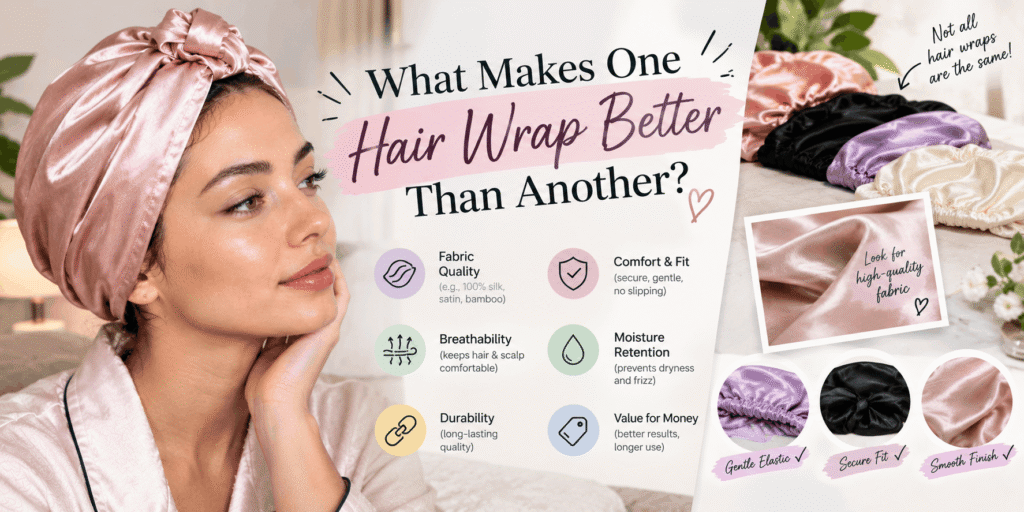
At first glance, most hair wraps can look almost identical. The difference becomes much clearer once you consider how they behave during an entire night.
A wrap that slides off after an hour is not particularly useful, regardless of how expensive the fabric is. Likewise, a bonnet that stays perfectly secure but compresses your hairstyle too tightly may not be the right choice.
Comfort should therefore be treated as part of performance. You should be able to sleep naturally without constantly noticing the wrap around your head.
Hair volume is another major factor. Fine or short hair generally needs less space, while thick curls, long hair, braids, extensions, or voluminous styles may require a much larger interior.
The material should also match your expectations. If the luxury feel of real silk is important to you, paying attention to fiber composition makes sense. If your priority is simply a smooth sleeping surface at a lower price, a quality satin design may be perfectly reasonable.
Ultimately, the “best” hair wrap is the one you can comfortably wear consistently and that suits the way your hair behaves overnight.
How to Choose the Right Hair Wrap
Choosing a silk or satin hair wrap becomes much easier when you start with your hair rather than the product’s appearance.
If you have short or fine hair, a compact sleep cap may be enough. You may not need a large bonnet with significant interior space, and a smaller design can feel less noticeable while sleeping.
For long, thick, curly, or highly textured hair, space becomes much more important. A roomy bonnet or turban can allow the hair to sit comfortably without excessive compression.
Match the Wrap to Your Hair Type
Curly and wavy hair often benefits from a design that allows the natural shape of the hair to remain relatively undisturbed. If the wrap is too tight, it may flatten the areas you are trying to preserve.
Straight hair can also benefit from a smooth wrap, particularly if the main concerns are tangling, frizz, or protecting a blowout. In this case, the priority may be minimizing movement rather than maintaining curl shape.
Long hair may need a larger interior, especially if you want to gather it loosely inside the wrap. If the hair constantly spills out, the product may not provide the coverage you need.
Silk vs. Satin: Which Should You Choose?
The choice between silk and satin largely comes down to material preference and budget.
Silk is a natural fiber and is often chosen for its smooth, lightweight, luxurious feel. High-quality silk products can be expensive, but they may appeal to people who want a premium material specifically for nighttime hair care.
Satin, on the other hand, describes a smooth fabric construction rather than one specific fiber. Many satin products use synthetic materials, which can make them considerably more affordable.
There is no requirement to buy genuine silk to protect your hair overnight. A well-fitting satin wrap can still provide a smooth surface and reduce friction. If your main goal is simply to minimize overnight rubbing, satin can be a perfectly practical choice.
Does a Silk Hair Wrap Actually Make Hair Healthier?
A hair wrap should not be viewed as a treatment that repairs damaged hair or changes the biological health of the strands. Its potential benefit is mainly protective.
By reducing friction and unnecessary movement, a smooth wrap can help minimize some of the everyday mechanical stress that hair experiences while sleeping. This may make the hair appear less frizzy and easier to manage in the morning.
The effect is especially useful when combined with other sensible hair-care habits. Gentle detangling, appropriate conditioning, avoiding excessive heat, and handling wet hair carefully can all have a much larger impact on the overall condition of your hair.
Think of a silk or satin wrap as a protective accessory rather than a miracle product.
Final Thoughts
A silk hair wrap can be a surprisingly simple way to make your nighttime hair routine more protective and manageable. By creating a smooth barrier between your hair and rougher bedding surfaces, it can help reduce friction, tangling, and some of the morning frizz associated with overnight movement.
The right choice depends less on which product looks most luxurious and more on how well it fits your hair. Genuine silk may appeal to shoppers who want a premium natural material, while satin can offer many of the practical advantages at a lower price.
For short or fine hair, a compact sleep cap may be enough. Long, thick, curly, or textured hair may benefit from a roomier bonnet or turban that does not compress the hairstyle.
The six options discussed here represent different approaches rather than one universal winner. Silke and Slip appeal to those looking for a premium silk experience, while satin-focused choices such as Kitsch, Only Curls, and Cantu can offer more accessible alternatives. Bonnet-style designs can also be useful when coverage and space are the priority.
Ultimately, the best silk hair wrap is one that stays comfortably in place, gives your hair enough room, suits your texture and hairstyle, and is easy enough to maintain that you will actually use it consistently.
A hair wrap will not repair damaged strands overnight, but as part of a thoughtful hair-care routine, it can be a useful tool for protecting the work you put into your hair before you go to sleep.
A silk or satin wrap can be useful for many hair types, including straight, wavy, curly, and coily hair. However, the ideal design can differ considerably depending on hair length, thickness, texture, and hairstyle.
Not necessarily for everyone. Genuine silk offers a smooth natural-fiber experience and a luxurious feel, but quality satin can also provide a smooth surface while usually costing less.
The most important factors are material quality, fit, comfort, and whether you can wear the wrap consistently.
Many people use silk or satin wraps as part of their regular nighttime routine. If the wrap is comfortable and properly maintained, it can be used regularly.
However, it should not be so tight that it causes discomfort or leaves excessive pressure around the head.
One Comment