
If you have ever looked at your hair and wondered why some sections form loose waves while others create defined curls or tighter coils, you are not alone. Curly hair types can vary significantly, even on the same head, and understanding your natural pattern can make it easier to choose styling techniques and products that actually suit your hair.
The commonly used curl-pattern system divides hair into four broad groups, from Type 1 straight hair through Type 4 tightly coiled hair. Within the wavy, curly, and coily categories, the patterns are further divided into A, B, and C. These labels describe the shape and tightness of the pattern, not the overall health, thickness, softness, or moisture level of your hair.
That distinction matters. Two people can have the same curl type but completely different hair needs. One person may have fine strands that become weighed down easily, while another may have thicker strands that need more conditioning. Your curl pattern is simply one piece of the bigger picture.
The 9 Types of Curls
The nine commonly discussed curly hair types range from loose Type 2 waves to the tightest Type 4 coils. The letters A, B, and C generally describe how loose or compact the pattern appears within each major category.
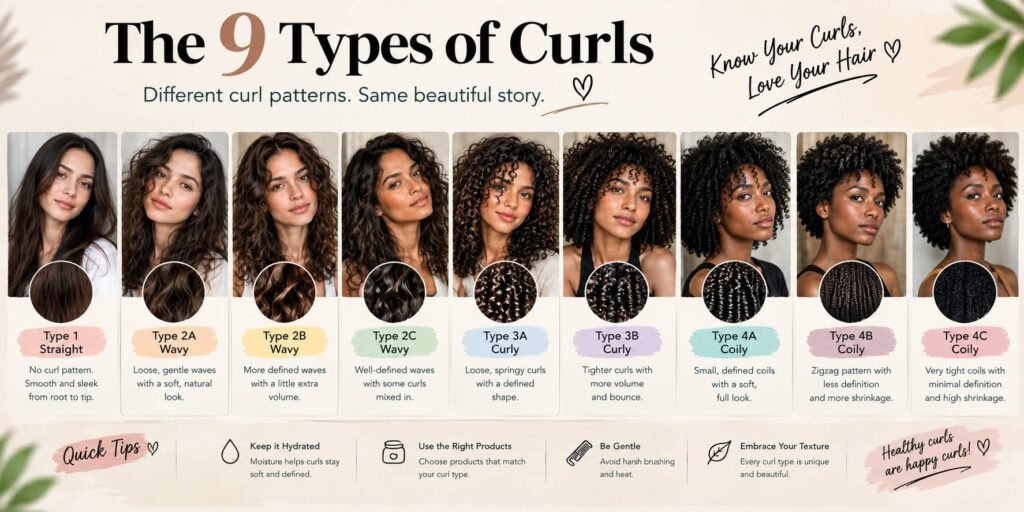
Your hair may also display more than one pattern. You might notice loose waves around the front, stronger curls underneath, and tighter sections near the back. This is completely possible and does not mean you are choosing the wrong category.
The best way to understand your pattern is to look at your hair when it is clean, conditioned, and allowed to form its natural shape without heavy styling products or excessive manipulation. The pattern can become much harder to recognize when the hair is brushed dry, stretched, chemically altered, or weighed down by buildup.
Type 2a: Loose, Soft Waves
Type 2a is the loosest pattern within the wavy category. The hair usually appears mostly straight near the roots before developing a gentle wave farther down the strand. Instead of forming a defined curl, the pattern tends to create soft bends that may be easy to stretch out.
Because the wave is relatively subtle, Type 2a hair can sometimes look straight depending on the weather, styling routine, or products being used. Humidity may make the wave more noticeable, while brushing or using heavier products can make it appear flatter.
The challenge with this pattern is often finding enough definition without weighing the hair down. Very rich creams, oils, or multiple layers of styling products may make loose waves lose their shape. Lightweight conditioners and styling products are often easier to work with when the goal is to encourage the natural wave.
Type 2a hair can also respond well to simple styling techniques. Instead of repeatedly brushing the hair after washing, gently scrunching damp lengths can help encourage the existing pattern. Allowing the hair to dry without constantly disturbing it may also help the waves remain visible.
Type 2b: Defined S-Shaped Waves
Type 2b has a more noticeable wave pattern than Type 2a. The hair commonly forms an S-shaped wave through the lengths, while the roots may remain relatively flat or less defined.
This pattern can create a beautiful combination of movement and volume, but it may also be more prone to frizz because the strands do not always lie completely flat. The wave can become more obvious when the hair is wet and may lose definition if it is brushed after drying.
One of the easiest ways to recognize Type 2b is to look for repeated S shapes rather than random bends. The pattern does not usually form a complete spiral. Instead, the hair moves from one direction to another in a relatively loose rhythm.
When caring for Type 2b hair, the goal is often to support the wave without making it heavy. Applying a lightweight styling product to damp hair and scrunching gently can help encourage definition. A soft drying method can also reduce unnecessary disruption to the wave pattern.
Type 2b hair may have sections that behave differently. The hair around the crown can appear straighter while the lower layers develop stronger waves. This does not necessarily mean the hair belongs to a completely different category; mixed patterns are common.
Type 2c: Strong Waves With a Curl-Like Shape
Type 2c sits close to the curly end of the wavy spectrum. The waves are usually more pronounced, and some sections may begin forming loose curls or spirals. Compared with Type 2a and Type 2b, this pattern often has more natural volume and stronger texture.
Type 2c hair can look dramatically different depending on how it is styled. When brushed or stretched, it may appear much less textured. When left to dry naturally with the pattern supported, the waves can become highly defined and may even resemble loose curls.
Frizz can also be more visible with this pattern, particularly when the hair is dry or exposed to humid conditions. Instead of repeatedly brushing the hair to control it, a gentler approach can help preserve the natural shape.
A useful technique is to apply styling products while the hair is damp, then scrunch upward from the ends. This encourages the wave to gather rather than pulling the strands straight. Once the hair has dried, avoid excessive manipulation if you want to maintain definition.
Type 2c is also a good reminder that curl categories are not strict boxes. Some sections may look clearly wavy while others form actual ringlets. Looking at the overall pattern rather than one isolated section gives you a better idea of where your hair fits.
Type 3a: Loose, Springy Curls
Type 3a moves into the curly category, with curls that commonly form loose, springy loops. The curls are more defined than Type 2c waves and tend to maintain a recognizable spiral or ringlet shape when the hair is left undisturbed.
The amount of definition can vary depending on moisture, styling, and the natural structure of the individual strands. Some Type 3a hair forms large, open curls, while other hair within the same category may have slightly smaller spirals.
One of the biggest differences between strong waves and Type 3a curls is how the strand behaves when it dries naturally. Rather than simply bending from side to side, the hair tends to wrap around itself and create a more obvious curl formation.
Type 3a hair often benefits from styling techniques that preserve this shape. Applying product to wet or damp hair and gently scrunching can encourage curls to group together. Separating the curls too much while they are drying may increase frizz and reduce definition.
That does not mean Type 3a hair needs a complicated routine. In fact, using too many products can make the curls heavy or leave unwanted buildup. Finding a manageable combination of cleansing, conditioning, and styling products is usually more useful than following a long routine simply because the hair is curly.
Type 3b: Tighter, More Springy Curls
Type 3b curls are generally tighter than Type 3a curls and tend to form smaller, more defined spirals. The pattern can have significant spring and volume, especially when the curls are allowed to expand naturally.
A Type 3b curl can look compact when the hair is dry but appear longer when stretched. This difference is sometimes called shrinkage, although the amount can vary greatly from person to person. Hair density, strand characteristics, moisture, and styling methods can all influence how much the hair appears to contract.
The tighter curl formation also means that the strands can experience more friction as they move against one another. Gentle handling becomes particularly useful when detangling or styling.
Rather than aggressively brushing through dry curls, many people with Type 3b hair find it easier to work through sections when the hair has sufficient slip from conditioner or a suitable detangling product. Working gradually from the ends upward can also make the process more manageable.
Definition does not have to be the only goal, however. Some people prefer their Type 3b curls stretched, fluffy, or more voluminous. The same curl pattern can be styled in different ways, so the category should not dictate one particular appearance.
Type 3c: Dense, Tight Curls
Type 3c generally features tighter curls that form compact spirals. The curls may appear dense and highly textured, with less space between individual curl formations than Type 3a or Type 3b.
Because the pattern is tighter, the hair may appear significantly shorter than its actual stretched length. This is another example of why visual length does not always tell you how long curly hair really is.
Type 3c hair can also have considerable volume. When the curls are separated or allowed to expand, the overall shape can become much fuller. Some people prefer highly defined curls, while others enjoy a softer, more voluminous finish.
Moisture and gentle handling can become particularly important as the curl becomes tighter. Detangling should be approached carefully rather than rushed. Pulling through knots too aggressively can create unnecessary tension and lead to breakage.
A good routine does not need to eliminate the natural texture. Instead, it should support the way the hair already behaves. Conditioning, gentle detangling, and avoiding excessive manipulation can help maintain the appearance and feel of the curls.
Type 4a: Defined Coils With a Small Pattern
Type 4a is the first of the tightly coiled Type 4 patterns. The hair usually forms small, clearly visible coils that can have a spring-like appearance. When the hair is moisturized and allowed to form naturally, the pattern can be quite defined.
The coils may look compact, but that does not mean every strand behaves exactly the same way. Different sections can have different levels of definition, density, and shrinkage.
Type 4a hair can also be particularly sensitive to excessive manipulation. The repeated bends in the strand can make it important to handle the hair carefully during washing, detangling, and styling.
Protective styling may be part of some people’s routines, but it should never be treated as mandatory. Loose, natural styles can work just as well when they suit the person’s preferences and hair needs. The most useful approach is one that allows the hair to be handled gently and maintained consistently.
When styling Type 4a hair, water and conditioner can make detangling more manageable. Working in sections rather than trying to handle the entire head at once can also make the process easier.
Type 4b: Z-Shaped Coils and Bends
Type 4b has a tighter, less uniform pattern than Type 4a. Rather than forming clearly rounded coils throughout, the hair may create sharper bends that are often described as having a Z-like or zigzag appearance.
The pattern can be difficult to identify when the hair is stretched, brushed, or heavily manipulated because its natural shape becomes less obvious. Looking at freshly washed hair after it has had a chance to form naturally can provide a clearer picture.
Type 4b hair can also experience significant shrinkage, meaning the visible length may be considerably shorter than the hair’s stretched length. This is a normal characteristic of tightly textured hair rather than a sign that the hair is not growing.
Because of the bends in the strands, gentle handling remains important. Detangling slowly and keeping sections organized can reduce unnecessary pulling. Many people also find that keeping the hair adequately conditioned makes routine maintenance more comfortable.
It is worth remembering that Type 4b does not have to look perfectly uniform. One section may form tighter bends while another creates a pattern closer to Type 4a or Type 4c. Natural hair rarely follows a perfectly consistent template from root to tip.
Type 4c: The Tightest Curl Pattern
Type 4c is generally described as the tightest and least visibly defined of the commonly used curl patterns. Instead of forming obvious spiral shapes, the hair may create very small bends, coils, and angles that are difficult to see without closely examining individual sections.
Shrinkage can be especially noticeable with Type 4c hair. The hair may appear much shorter in its natural state than when gently stretched. This is a characteristic of the curl structure and does not indicate a lack of length.
Because the pattern can be extremely compact, Type 4c hair may require thoughtful handling during detangling and styling. Rushing through knots or repeatedly manipulating the hair can place unnecessary stress on the strands.
Moisture, conditioning, and gentle techniques can all play a role in maintaining the hair. However, there is no single routine that every person with Type 4c hair needs to follow. Strand thickness, density, scalp condition, lifestyle, and styling preferences can all affect what works.
Type 4c hair can also be incredibly versatile. It can be worn in its natural shape, stretched, twisted, braided, or styled in many different ways. The curl-pattern label describes the structure of the hair; it does not determine how the hair should be worn.
Looking Beyond the Curl Chart
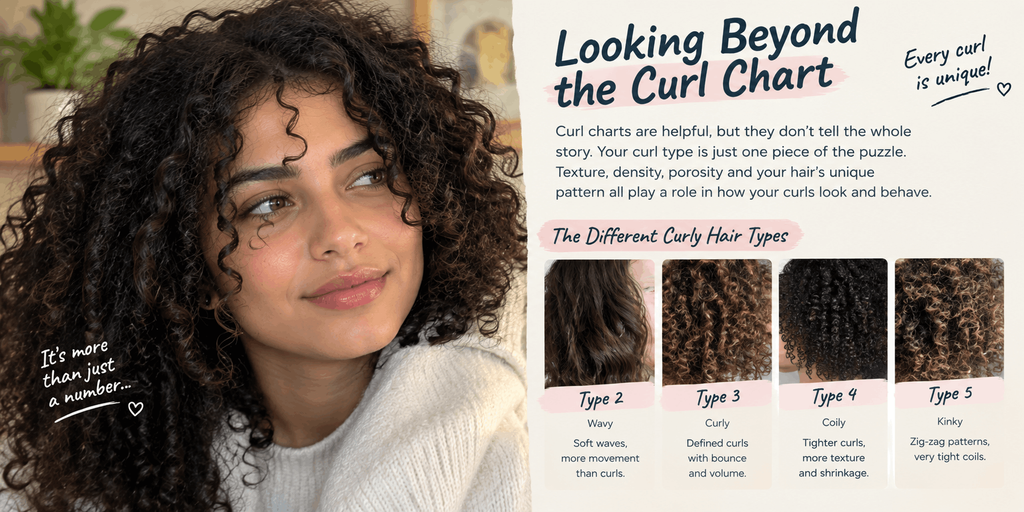
Curl typing can be useful when you are trying to understand why your hair behaves a certain way, but it should not become the only thing you consider. Two people with Type 3c hair, for example, may need completely different routines because one has fine strands and the other has thicker strands.
Hair density is another important factor. Density describes how much hair you have overall, while curl pattern describes the shape that the strands form. A person can have a tight curl pattern with lower density or a looser pattern with very dense hair.
Porosity is also frequently discussed in curly-hair routines. It relates to how the hair interacts with moisture and how easily water and products move into and out of the strand. It is separate from curl type, so knowing your pattern does not automatically tell you your porosity.
This is why the best curly hair routine is usually based on observation rather than a label alone. Pay attention to how your hair responds after washing, how quickly it becomes dry, how easily it tangles, how much product it needs, and which techniques make the natural pattern easier to manage.
Your curl pattern can also change over time. Hair can behave differently after chemical processing, heat styling, major changes in length, or changes in the condition of the strands. Even without those factors, different sections can naturally behave differently.
The goal of learning your curly hair type is therefore not to find a perfect label. It is to understand your hair well enough to make better choices about cleansing, conditioning, styling, detangling, and everyday maintenance.
A Quick Comparison of the 9 Curl Types
| Curl Type | General Pattern | What It Usually Looks Like |
|---|---|---|
| 2A | Loose waves | Soft, gentle bends with minimal definition |
| 2B | Defined waves | Noticeable S-shaped waves |
| 2C | Strong waves | Deep waves with some loose curls |
| 3A | Loose curls | Large, springy ringlets |
| 3B | Medium curls | Smaller, well-defined spirals |
| 3C | Tight curls | Dense, compact ringlets |
| 4A | Coils | Small, clearly defined coils |
| 4B | Tight bends | More angular or Z-shaped pattern |
| 4C | Very tight coils | Compact bends with less visible definition |
Types 2A through 2C are generally considered wavy, 3A through 3C fall into the curly category, and 4A through 4C describe tightly coiled patterns. These labels describe the shape of the hair rather than its thickness, density, porosity, or overall condition.
How to Identify Your Curl Type
The easiest time to identify your natural pattern is after washing your hair and allowing it to form its shape with minimal manipulation. Heavy styling products, straightening, brushing, or stretching can temporarily change the way the pattern appears.
Start by cleansing your hair according to your normal routine and conditioning it so the strands are comfortable to handle. After rinsing, gently remove excess water without aggressively rubbing the hair. Then allow the strands to form naturally.
Look closely at the shape that develops as your hair dries.
If your hair mostly forms gentle bends without creating complete spirals, you are likely somewhere in the Type 2 range. If you see recognizable loops or ringlets, Type 3 may be a better match. If the strands create compact coils, sharp bends, or very small patterns, you may fall within Type 4.
The A, B, and C categories can then help you describe the degree of tightness within that broader group.
Look at the Overall Pattern, Not One Curl
One isolated strand should not determine your curl type. Natural hair often contains several patterns, so examine different sections across your head.
For example, the hair near the front may form Type 2c waves while the underneath layers create Type 3a curls. Another person may have a mixture of Type 3b and Type 3c curls. These differences can happen naturally and do not mean anything is wrong with the hair.
Instead of asking whether every strand matches a particular picture, consider which pattern describes the majority of your hair when it is in its natural state.
It can also help to look at your hair on more than one wash day. One day’s results may be affected by buildup, humidity, product application, or how much the hair was manipulated. Observing the pattern repeatedly gives you a more realistic picture.
Avoid Brushing the Pattern Away Before You Assess It
Dry brushing can stretch waves and curls, making the natural pattern harder to see. If your goal is to identify your curl type, allow the hair to form naturally before brushing it into a different shape.
This does not mean you can never brush curly hair. It simply means that brushing immediately before assessing the pattern can give you an inaccurate impression of the texture.
Likewise, using a straightening tool or repeatedly stretching the hair before examining it will not tell you what the natural pattern looks like. The goal is to observe the hair rather than change it first.
Consider Your Hair When It Is Wet and Dry
Your hair can look dramatically different when wet compared with when it is completely dry. Wet curls often appear longer and more defined, while dry hair may become fuller and show more shrinkage.
This is particularly noticeable with tightly coiled curly hair types. A Type 4 pattern may look relatively elongated when wet but much more compact once dry. That change is part of the natural behavior of the curl pattern.
For identification, observe both stages. The wet pattern can help you see how the strands group together, while the dry pattern shows how the hair naturally contracts and expands.
Do Not Use Shrinkage as the Only Test
Shrinkage can provide a clue about how tightly the hair curls, but it should not be used by itself to determine curl type.
Two people can have similar curl patterns but very different amounts of visible shrinkage. Hair length, strand structure, moisture, density, and styling methods can all influence how much the hair contracts.
Instead of measuring shrinkage and assigning a category from that alone, combine it with the actual shape of the curls, coils, waves, or bends.
Is It Possible to Be Between Curl Types?
Yes. Hair does not always fit perfectly into a single category.
The curl chart is a useful descriptive system, but natural hair is more complicated than nine neat boxes. You might have Type 2b waves in one area and Type 2c waves or Type 3a curls somewhere else. Similarly, someone may have a combination of Type 3b and Type 3c curls.
This can happen because different follicles can produce strands with different shapes. Hair density, length, previous damage, styling habits, and environmental conditions can also affect how individual sections appear.
Being between curl types is not something that needs to be corrected. In fact, mixed patterns can give hair a distinctive combination of volume, movement, and texture.
Why Your Curl Pattern Can Look Different From Day to Day
Even if your natural pattern stays the same, its appearance can change.
Humidity may cause some curls to expand or become less defined. Product buildup can make waves or curls appear heavier. Lack of moisture can affect how smoothly the strands group together. A different styling technique can also produce a completely different shape from the same hair.
This is why comparing your hair to a single photograph is not always helpful. A curl chart shows general patterns, while real hair changes according to its environment and routine.
Length can make a difference as well. Longer hair is pulled downward by its own weight, which can make curls appear looser. After a haircut, the same hair may spring up and appear more tightly curled.
Your Hair Can Have Multiple Curl Patterns
Mixed curl hair are especially common. You might notice that your crown is wavier while the lower sections are curlier. The front may have looser curls because of styling or everyday manipulation, while less-handled sections maintain a tighter pattern.
Rather than creating an entirely separate routine for every section, start with a routine that works for most of your hair. You can then adjust individual areas if they need something different.
For example, a looser section may need less styling product, while a tighter section may benefit from more careful conditioning and detangling. This allows you to work with the differences instead of trying to make every part of the hair behave identically.
How to Care for Your Curls and Prevent Breakage
Understanding curly hair types can help you choose techniques, but healthy-looking curls depend on more than curl classification. Gentle handling, appropriate conditioning, careful detangling, and reducing unnecessary stress on the strands are all important parts of a practical routine.
Curly and coily hair can bend repeatedly along the length of each strand. Because of that structure, rough handling can sometimes create more stress than it would on straighter hair. A gentle routine can help reduce unnecessary pulling and friction.
Start With Gentle Cleansing
Cleansing removes sweat, oils, styling products, and buildup from the scalp and hair. However, how often you need to cleanse depends on your individual scalp and routine.
There is no universal schedule that every curly-haired person needs to follow. Some people may prefer more frequent washing, while others may go longer between washes. Consider how your scalp feels and whether you are dealing with noticeable buildup or product residue.
When cleansing, focus on the scalp rather than aggressively scrubbing the lengths. Let the cleanser move through the hair as you rinse. Excessive rubbing of the lengths can create unnecessary tangling.
Give Conditioning an Important Role
Conditioner can make curly hair easier to detangle and can help the strands feel smoother. Apply it through the lengths according to the product instructions, giving extra attention to areas that tend to become tangled.
The amount you need can depend on your hair density, strand characteristics, length, and the formula being used. Very fine curls may become weighed down by heavy products, while thicker or denser hair may tolerate richer conditioning products.
Rather than choosing products solely because they are marketed for a particular curl type, pay attention to how your own hair responds.
If your hair feels coated, heavy, or difficult to style after using a product, you may be using more than necessary. If it feels rough or becomes difficult to detangle, you may need a routine that provides more conditioning.
Detangle Slowly and in Sections
Detangling is one of the moments when curly hair can experience considerable mechanical stress. Trying to force a brush or comb through a tangled section can create unnecessary pulling.
Working in manageable sections can make the process easier. Start at the ends and gradually move upward instead of pulling from the roots through the entire length.
Many people prefer detangling while the hair is damp and conditioned because the strands can have more slip. A wide-tooth comb or suitable detangling tool may also make the process easier, depending on your hair.
The goal is not to remove every single knot instantly. Slow, controlled movements can be more practical than trying to finish as quickly as possible.
Be Careful With Heat
Heat styling can change the appearance of curls temporarily, and repeated high heat can contribute to dryness or damage. If you use heat, follow the instructions for your styling tools and use appropriate heat protection.
You do not have to avoid heat forever simply because you have curly hair. The important point is to avoid unnecessary or excessive exposure and to pay attention to how your hair responds.
If your curls suddenly look less defined after frequent heat styling, feel unusually dry, or become harder to manage, reducing heat exposure may be worth considering.
Avoid Constant Manipulation
Repeatedly touching, brushing, separating, or restyling curls throughout the day can disturb their shape and create additional friction.
Once your curls have been styled, try to let them settle instead of continually rearranging them. If a section loses definition, you can refresh it with a small amount of water or a suitable styling product rather than completely restyling the entire head.
This is particularly useful for tightly coiled hair, where repeated manipulation can make maintenance more demanding.
Choose Hairstyles That Do Not Create Excessive Tension
Braids, ponytails, buns, twists, and other hairstyles can all be part of a curly-hair routine. The important consideration is how tightly the hair is being pulled.
A hairstyle that feels painful, causes persistent scalp discomfort, or puts strong tension on the hairline is worth reconsidering. Comfortable styling is generally more practical than keeping a hairstyle extremely tight.
Changing your hairstyle periodically can also reduce repeated stress on exactly the same areas. This can be especially relevant around the edges and other sections that are frequently pulled or manipulated.
Protect Curls While You Sleep
Friction between the hair and bedding can contribute to tangling and disturbance of the curl pattern. Some people choose a satin or silk-style pillowcase, bonnet, or similar method to reduce friction.
You do not need a complicated nighttime routine. The goal is simply to find a comfortable way to reduce excessive rubbing and preserve your hairstyle.
If your hair is longer, loosely gathering it in a comfortable style can also make it easier to manage overnight. Avoid creating unnecessary tension when securing it.
Pay Attention to Your Ends
The ends are the oldest part of your hair and can experience more wear from brushing, styling, clothing, and environmental exposure.
If the ends become noticeably rough, tangled, or difficult to manage, adjusting your routine may help. Gentle conditioning and careful detangling can reduce unnecessary stress.
Regular trims are another option when you want to remove visibly damaged ends, although how frequently you trim is a personal choice. A haircut does not change your underlying curl type; it simply changes the length and shape of the hair.
Build a Routine Around Your Hair, Not Just Its Label
The most useful lesson from learning about curly hair types is that the number or letter is only a starting point. Your routine should be based on how your actual hair behaves.
For example, two people with Type 3a curls might use completely different amounts of styling product. One may have fine, easily weighed-down hair, while the other may have dense hair that needs more product for definition. Treating them identically simply because they share a curl category would not necessarily make sense.
The same applies to Type 4 hair. Curl pattern alone does not tell you how much conditioner someone needs, how frequently they should wash, or which hairstyle they should wear.
Instead, observe your hair over time. Notice what happens after cleansing, how quickly your scalp becomes oily or uncomfortable, how your curls respond to different amounts of product, and whether certain styling methods create unnecessary tangles.
Your routine can then become much simpler because you are responding to your hair instead of following a rigid checklist.
Final Thoughts
Learning about curly hair types can make your natural texture easier to understand, but the curl chart should be viewed as a guide rather than a strict rule. Type 2 patterns generally move from loose waves toward stronger, curl-like waves, Type 3 patterns progress through increasingly defined curls, and Type 4 patterns include tighter coils and bends.
You may fit clearly into one category, or your hair may contain several patterns. Both situations are completely normal. Your curl pattern can also look different depending on length, humidity, moisture, styling, and how much the hair has been manipulated.
Once you have a general idea of your pattern, focus on the things that actually affect your daily routine: how your hair responds to cleansing, conditioning, detangling, styling, and heat. Gentle handling is particularly useful when you want to reduce unnecessary breakage and maintain the natural shape of your curls.
Most importantly, there is no single “correct” way for curly hair to look. Whether your hair forms loose waves, springy ringlets, compact coils, or several patterns at once, understanding its behavior gives you more options for caring for and styling it on your own terms.


One Comment