Mineral sunscreen has become a popular choice for people who want daily sun protection without relying on chemical UV filters. Also called physical sunscreen, it typically uses zinc oxide, titanium dioxide, or both as its active sunscreen ingredients.
The challenge is finding a formula that provides reliable protection while also feeling comfortable on the skin. Some mineral formulas can leave a noticeable white cast, while newer tinted and lightweight options are designed to blend more easily. The right choice also depends on whether your skin tends to be oily, dry, sensitive, acne-prone, or somewhere in between.
Mineral vs. Chemical Sunscreen
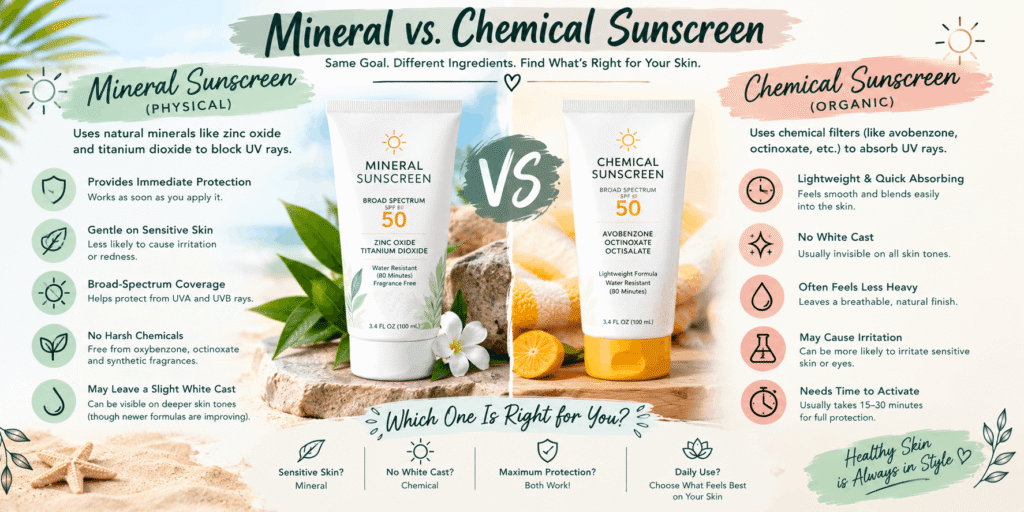
The main difference between chemical and mineral sunscreen is the type of active ingredients used. Mineral sunscreens use zinc oxide, titanium dioxide, or both, while chemical sunscreens use other UV-filtering ingredients. Hybrid formulas can contain ingredients from both categories.
Mineral sunscreen is often recommended for people with sensitive skin because formulas containing only zinc oxide and titanium dioxide may be less irritating for some individuals. However, “mineral” does not automatically mean every formula will work for every person. Fragrance, preservatives, texture, and other inactive ingredients can still affect how a product feels on the skin.
Whatever type you choose, the label matters more than the marketing language. Dermatologists recommend choosing a sunscreen that offers broad-spectrum protection, SPF 30 or higher, and water resistance. Broad-spectrum protection covers both UVA and UVB rays, while SPF primarily indicates protection against sunburn-causing UVB radiation.
How We Evaluated Mineral Sunscreens
A useful mineral sunscreen needs to do more than simply contain a mineral active ingredient. Texture, finish, ease of application, skin type, and how comfortably the formula fits into a daily routine all matter.
We also considered the different needs people may have when choosing sunscreen. Someone with oily skin may prefer a lighter or more matte finish, while someone with dry skin may appreciate a more moisturizing formula. Sensitive skin can benefit from a simpler formula, while tinted options can help minimize the visible residue that some mineral sunscreens leave behind.
Because sunscreen is only useful when applied consistently, comfort matters. A formula that feels unpleasant, pills under other products, or leaves an obvious cast may be harder to use regularly. Tinted mineral sunscreens can be particularly helpful for reducing the appearance of a white residue.
Best Mineral Sunscreens for Different Skin Needs
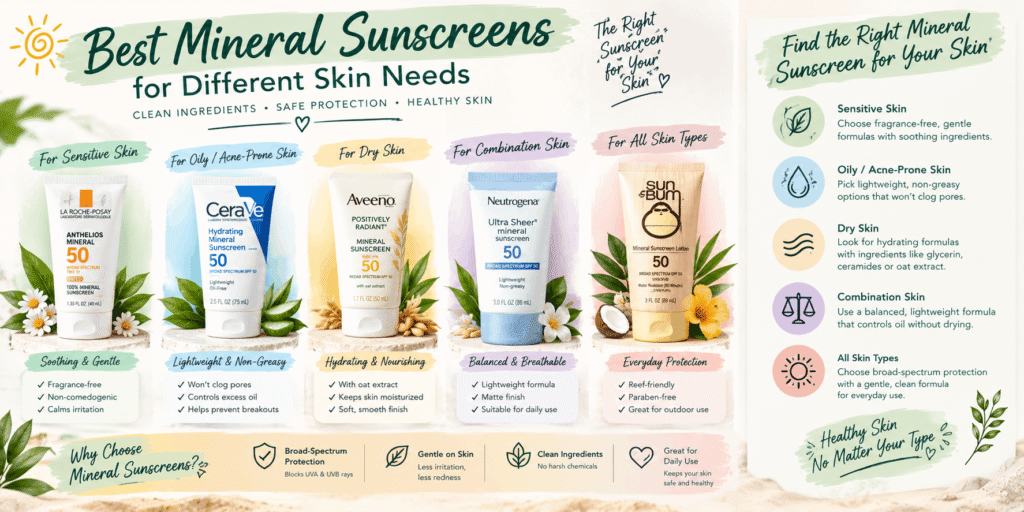
Instead of looking for one universal winner, it makes more sense to choose a mineral sunscreen according to your skin type and preferences. The following options represent different categories, from lightweight everyday formulas to products aimed at specific skin concerns.
Best Overall: EltaMD UV Clear Face Sunscreen
A good everyday mineral sunscreen should fit easily into a normal morning routine. EltaMD UV Clear Face Sunscreen is often considered for facial use because it is designed with everyday wear in mind and can work well underneath other skincare and makeup.
When choosing a face sunscreen, pay attention to how the formula behaves after application. A sunscreen can have excellent protection on paper but still be difficult to wear if it feels heavy or leaves noticeable residue.
For anyone comparing facial sunscreens, the most important question is whether the product provides broad-spectrum SPF 30 or higher protection and whether its texture encourages consistent use.
Best for Acne-Prone Skin: Bubble Skincare Solar Mate Mineral Sunscreen
For acne-prone skin, sunscreen selection is often about balancing protection with a comfortable finish. A heavy or greasy-feeling formula may be less appealing when the skin already tends to become oily.
Bubble Skincare Solar Mate Mineral Sunscreen is positioned as a facial mineral option for everyday use. When looking for sunscreen for acne-prone skin, checking the label for terms such as “non-comedogenic” can be useful because the AAD recommends this type of labeling for oily skin and pores that clog easily.
It is also worth remembering that sunscreen does not need to be harsh or drying simply because the skin is acne-prone. A comfortable formula can make daily sun protection much easier to maintain.
Best Drugstore: CeraVe Sensitive Skin Mineral Sunscreen
CeraVe Sensitive Skin Mineral Sunscreen is a practical option for people who want a widely available mineral sunscreen without necessarily choosing a luxury product.
Sensitive skin can react to more than just sunscreen filters, so it is useful to examine the complete ingredient list rather than assuming that every mineral product will feel identical. The AAD recommends sunscreen labeled for sensitive skin and suggests avoiding fragrance and certain ingredients when they cause irritation.
The best drugstore sunscreen is ultimately one that you can apply comfortably and consistently while meeting the basic protection requirements.
Best for Oily Skin: Isdin Eryfotona Ageless Tinted Sunscreen
Oily skin often feels more comfortable with a sunscreen that does not leave an excessively greasy finish. Isdin Eryfotona Ageless Tinted Sunscreen provides a tinted approach, which can also help reduce the visible white residue associated with some mineral formulas.
Tint can be particularly useful because mineral sunscreen may appear more noticeable on certain skin tones. The AAD specifically recommends tinted sunscreen as one way to help prevent visible white residue.
When choosing a sunscreen for oily skin, look for language such as “non-comedogenic” or “won’t clog pores,” while still considering the actual feel of the product on your own skin.
Best Lightweight: La Roche-Posay Anthelios Ultra-Light Mineral Sunscreen
A lightweight texture can make a major difference when sunscreen is being worn every day. La Roche-Posay Anthelios Ultra-Light Mineral Sunscreen is aimed at people who prefer a less noticeable sunscreen experience.
Lightweight does not mean you should use less product. Applying too little sunscreen reduces the protection you receive, so the goal is to find a formula that feels comfortable while still allowing you to apply an adequate layer.
For outdoor use, water resistance is another useful feature to check because sweating and water exposure can reduce how long sunscreen remains effective. Dermatologists recommend reapplying sunscreen every two hours when outdoors and after swimming or sweating.
Best Budget: Neutrogena Ultra Sheer Mineral Sunscreen
Budget-friendly sunscreen can still provide meaningful protection when it meets the essential label requirements. Neutrogena Ultra Sheer Mineral Sunscreen is an option for shoppers who want to keep the cost of daily sun protection more manageable.
Price should not be the only deciding factor. Check that the sunscreen provides broad-spectrum protection, SPF 30 or higher, and water resistance when needed. These are the qualities dermatologists emphasize when selecting sunscreen.
A less expensive sunscreen that you use consistently can be a more practical choice than an expensive product that you rarely enjoy wearing.
Best Matte Finish: Supergoop! Mineral Mattescreen
A matte finish can appeal to people who dislike the shiny appearance some sunscreens leave behind. Supergoop! Mineral Mattescreen is designed around a more matte-looking finish, making this category particularly relevant for those who prefer a less dewy appearance.
A matte sunscreen can also work well as part of a makeup routine, although compatibility varies between products. If you notice pilling, try simplifying the layers underneath rather than immediately assuming the sunscreen itself is unsuitable.
Best for Sensitive Skin: Tower 28 SOS FaceGuard Mineral Sunscreen
Sensitive skin often benefits from a straightforward approach to sun protection. Tower 28 SOS FaceGuard Mineral Sunscreen is another mineral-focused option for people who prioritize a gentle-feeling facial sunscreen.
The important point is that “sensitive skin” is individual. If a sunscreen repeatedly causes stinging, burning, itching, or irritation, stop using it and consider discussing the reaction with a healthcare professional.
For sensitive skin, the AAD recommends looking for products labeled for sensitive skin and avoiding fragrance when it causes irritation.
Best Mineral Sunscreens for Dry, Tinted, and Body Use
Best for Dry Skin: Ranavat Radiant Rani Mineral Sunscreen
Dry skin often feels more comfortable with a sunscreen that does not leave the skin feeling tight after application. Ranavat Radiant Rani Mineral Sunscreen is a mineral option aimed at people who prefer a more nourishing-feeling finish.
When choosing mineral sunscreen for dry skin, the sunscreen itself is only one part of the routine. Applying moisturizer beforehand can make the finish more comfortable, especially when the skin is prone to dryness. However, adding too many layers can sometimes cause pilling, so it is worth testing how the products work together.
The ideal formula should provide broad-spectrum protection while fitting naturally into the rest of your skincare routine. If a sunscreen feels comfortable enough to use every morning, you are more likely to apply it consistently.
Best Tinted: InnBeauty Project Mineral Sun Glow
Tinted mineral sunscreen is one of the easiest ways to address the white-cast problem. Instead of leaving an obvious pale layer, the tint can help the sunscreen blend more naturally with the appearance of the skin.
InnBeauty Project Mineral Sun Glow is a tinted option for people who want sun protection with a more cosmetic-looking finish. Tinted formulas can be especially useful for everyday facial wear because they can look more natural than an untinted mineral formula.
A tint does not mean you can apply less sunscreen. You still need enough product to obtain the protection indicated on the label. If the shade does not match well, look for another tinted formula rather than reducing the amount you apply.
Best for Body: Coppertone SPORT Mineral Sunscreen Spray
Facial sunscreen gets most of the attention, but exposed areas of the body also need protection. A body sunscreen can be more convenient when you are covering larger areas such as the arms and legs.
Coppertone SPORT Mineral Sunscreen Spray is designed for body use and can be convenient when you want a spray format. When using a spray sunscreen, make sure the product is applied thoroughly rather than relying on a quick mist over the skin.
For outdoor activities, water resistance can be particularly useful. Remember that water-resistant sunscreen is not waterproof, and sunscreen needs to be reapplied after swimming or sweating and approximately every two hours while outdoors.
What to Look For in a Mineral Sunscreen
The first thing to check is the active ingredient. Mineral sunscreens generally rely on zinc oxide, titanium dioxide, or both. Zinc oxide is particularly useful because it provides broad-spectrum protection, while titanium dioxide is also used as a mineral UV filter.
Next, look for broad-spectrum SPF 30 or higher. This is more important than choosing a product simply because it is labeled “natural,” “clean,” or “mineral.” Marketing terms do not replace the sunscreen’s actual protection information.
Water resistance is another useful feature if you are exercising, swimming, or spending extended time outside. Even water-resistant sunscreen needs to be reapplied because no sunscreen remains fully effective indefinitely.
Texture is also worth considering. If you have oily skin, you may prefer a lighter or matte formula. Dry skin may feel better with a more moisturizing finish, while sensitive skin may benefit from a simpler formula without fragrance if fragrance tends to cause irritation.
Tint is another option worth considering. Some mineral formulas can leave a visible white residue, particularly on deeper skin tones. Tinted formulas can help reduce this effect and may also provide a more natural-looking finish.
How to Apply Mineral Sunscreen Properly
Application technique matters just as much as choosing the product. Apply sunscreen generously to exposed skin rather than using only a thin layer. For the face, remember areas that are easy to overlook, including the ears, hairline, neck, and around the eyes while avoiding direct contact with the eyes.
Apply sunscreen before going outdoors. If you are spending time outside, reapply about every two hours and after swimming or sweating.
Sunscreen should also be part of a broader sun-protection routine. Seeking shade, wearing protective clothing, and using a wide-brimmed hat can reduce direct sun exposure, particularly during strong midday sunlight.
Final Thoughts
The best mineral sunscreen is not necessarily the most expensive or the one with the most impressive marketing claims. It should provide broad-spectrum SPF 30 or higher protection, feel comfortable enough for regular use, and suit your skin’s needs.
If white cast is your biggest concern, a tinted formula may be worth considering. Oily skin may prefer a lightweight or matte finish, while dry or sensitive skin may do better with a more comfortable moisturizing formula. For outdoor activities, water resistance and convenient reapplication become especially important.
Most importantly, sunscreen works best when it becomes a consistent part of your sun-protection routine. Choosing a formula you genuinely like using can make that habit much easier to maintain.