Buying skincare has never been easier, but choosing products that won’t trigger breakouts has become more confusing than ever. A moisturizer may promise deep hydration, a sunscreen may advertise a lightweight finish, and a cleanser may claim to be “non-comedogenic”—yet many people still experience clogged pores, whiteheads, or acne after using them.
That’s where a pore clogging checker becomes incredibly useful. Instead of relying only on marketing claims, these tools analyze the ingredient list of your skincare products and help identify ingredients that may contribute to clogged pores.
Whether you’re dealing with stubborn acne, tiny forehead bumps, blackheads, or closed comedones, learning how to check ingredients before buying can save you time, money, and frustration.
In this complete guide, you’ll discover how pore clogging checker work, how to understand comedogenic ratings, which ingredients deserve attention, and how to build a skincare routine that’s better suited to your skin.
What Is a Pore Clogging Checker?
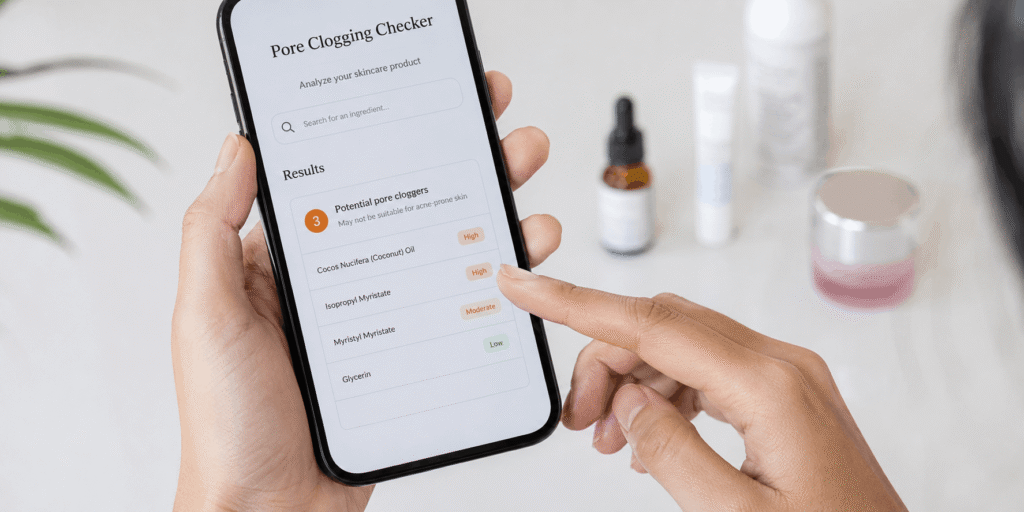
A pore clogging checker is an online ingredient analysis tool designed to review the ingredient list (INCI list) of skincare and cosmetic products.
Instead of trusting labels like “oil-free” or “non-comedogenic,” these tools examine every ingredient individually and compare it with databases containing information about comedogenicity, ingredient functions, and skin compatibility.
Most pore clogging checkers can analyze products including:
- Moisturizers
- Cleansers
- Sunscreens
- Face oils
- Serums
- Toners
- Foundations
- Primers
- Concealers
- Sleeping masks
Although they’re especially popular among people with acne-prone skin, anyone interested in understanding skincare ingredients can benefit from using them.
Why More People Are Using Pore Clogging Checkers
Today’s skincare formulas often contain 20–50 different ingredients. While many of them hydrate, repair, or protect your skin, others may increase the chance of clogged pores depending on your skin type.
Rather than buying products based on attractive packaging or influencer recommendations, ingredient checkers allow you to make informed decisions backed by ingredient research.
Spot Hidden Acne Triggers
Some ingredients associated with clogged pores aren’t immediately obvious because they’re included for texture, moisture, or product stability.
Commonly discussed ingredients include:
- Coconut Oil
- Wheat Germ Oil
- Isopropyl Myristate
- Isopropyl Palmitate
- Lanolin
- Certain Algae Extracts
That doesn’t automatically mean these ingredients will cause acne, but they may be worth paying attention to if your skin is highly acne-prone.
Don’t Depend Only on “Non-Comedogenic” Labels
Many products proudly display “non-comedogenic” on their packaging, but there isn’t a single global testing standard that every brand follows.
A pore clogging checker allows you to:
- Review ingredient lists yourself
- Compare multiple products
- Learn which ingredients may not suit your skin
- Build a more personalized skincare routine
Instead of replacing dermatologists, these tools simply provide another layer of useful information.
How Does a Pore Clogging Checker Work?
Most ingredient checkers work in just a few simple steps.
Step 1: Copy the Ingredient List
Visit the product page or look at the packaging and copy the complete ingredient list (also known as the INCI list).
Many skincare brands publish the full list online, making it easy to copy and paste.
Step 2: Paste It Into the Checker
After pasting the ingredients, the tool compares each ingredient with established cosmetic databases.
Most checkers evaluate:
- Comedogenic ratings
- Ingredient purpose
- Skin-conditioning properties
- Potential irritants
- Acne-related concerns
Within seconds, you’ll receive an ingredient breakdown highlighting substances that may deserve closer attention.
Step 3: Review Individual Ingredients
Instead of simply labeling a product as “good” or “bad,” quality pore clogging checkers evaluate ingredients individually.
For example, a moisturizer may contain one moderately comedogenic ingredient, but because it’s used in a very low concentration, the product may still perform perfectly well for many users.
Learning to interpret the results is more valuable than focusing on a single number.
Understanding the Comedogenic Rating Scale
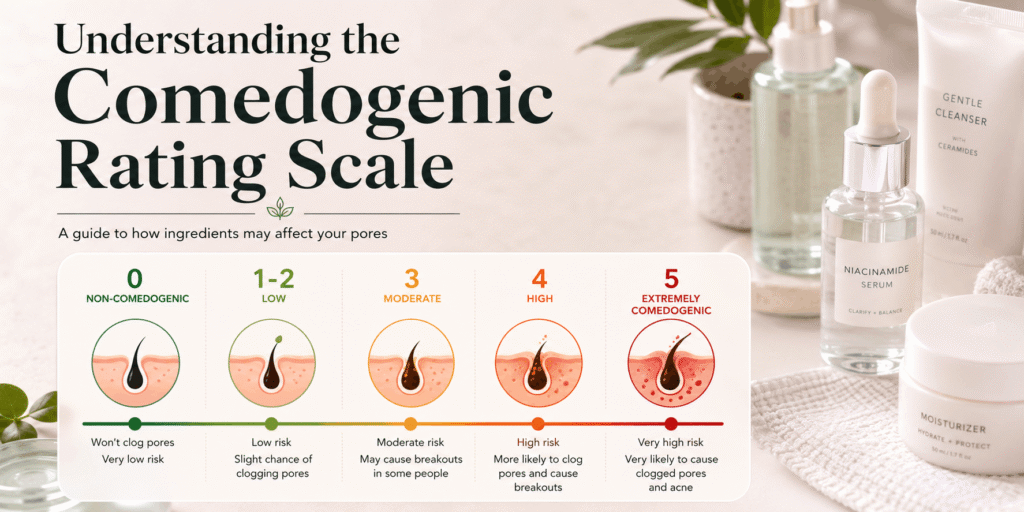
Most pore clogging checkers rely on a 0–5 comedogenic scale.
| Rating | Meaning |
| 0 | Very unlikely to clog pores |
| 1 | Minimal risk |
| 2 | Low risk |
| 3 | Moderate possibility |
| 4 | High likelihood |
| 5 | Very high pore-clogging potential |
It’s important to remember that these ratings serve only as guidelines.
Real-life performance depends on several factors, including:
- Ingredient concentration
- Overall formulation
- Your skin type
- Climate
- Frequency of use
- Other products in your routine
Two people can use the exact same moisturizer and have completely different experiences.
Ingredients Frequently Linked to Clogged Pores
While no ingredient guarantees acne, some ingredients appear more often in discussions surrounding pore clogging.
Coconut Oil
Coconut oil is famous for its moisturizing benefits but is considered too rich for many acne-prone skin types.
It often works better as:
- Body moisturizer
- Hair treatment
- Dry elbow treatment
- Foot cream
Many people with facial acne prefer lighter oils such as squalane.
Isopropyl Myristate
This ingredient improves product texture and spreadability.
Benefits include:
- Smooth application
- Lightweight feel
- Better absorption
However, because it has a relatively high comedogenic rating in some databases, acne-prone users often monitor products containing it.
Wheat Germ Oil
Rich in vitamin E and nourishing fatty acids, Wheat Germ Oil provides excellent hydration.
It’s commonly found in:
- Night creams
- Facial oils
- Anti-aging products
- Body lotions
Because it’s a heavier oil, people with oily skin sometimes choose lighter alternatives.
Lanolin
Lanolin creates an excellent moisture barrier and helps repair very dry skin.
You’ll commonly find it in:
- Lip balms
- Healing ointments
- Barrier creams
- Dry skin treatments
Although it’s highly effective for dry skin, some acne-prone individuals prefer lighter moisturizing ingredients.
Algae Extract
Algae extracts are valued for antioxidants, minerals, and hydration.
Different algae ingredients behave differently, so experiences vary considerably between individuals.
Some users tolerate algae perfectly, while others monitor products containing algae if they’re prone to clogged pores.
Why Ingredient Concentration Matters
One mistake many beginners make is assuming every flagged ingredient automatically makes a product unsuitable.
That’s not how cosmetic formulations work.
Ingredient lists are arranged in descending order by concentration.
If a potentially comedogenic ingredient appears among the first five ingredients, it’s usually present in a much larger amount than one listed near the end.
This is why understanding the complete formula is much more valuable than judging a product based on one ingredient alone.
How to Use a Pore Clogging Checker Effectively
A pore clogging checker is only as useful as your ability to interpret its results. Rather than treating every flagged ingredient as a deal-breaker, use the checker as a smart filtering tool when shopping for skincare.
Step 1: Find the Complete Ingredient List
Every skincare and makeup product includes an ingredient list, also called the INCI list.
You can usually find it:
- On the product packaging
- On the brand’s official website
- On online retailer pages
- In skincare ingredient databases
Always copy the entire ingredient list to get the most accurate analysis.
Step 2: Analyze the Ingredients
Paste the ingredient list into your preferred pore clogging checker.
Most tools will identify:
- Ingredients with higher comedogenic ratings
- Heavy oils and waxes
- Fatty acids and esters
- Potential acne triggers
- Barrier-supporting ingredients
Some advanced ingredient analyzers even explain what each ingredient does and why it appears in the formula.
Step 3: Look Beyond the Numbers
Seeing one ingredient with a moderate comedogenic rating doesn’t automatically mean the product will break you out.
Instead, ask yourself:
- Is the ingredient near the top of the ingredient list?
- Have you reacted to it before?
- Is your skin naturally oily or acne-prone?
- Is the product designed for your skin type?
Remember that ingredient concentration matters just as much as the ingredient itself.
Choose Products Based on Your Skin Type
For Oily & Acne-Prone Skin
People with oily skin generally benefit from products that are:
- Lightweight
- Oil-free
- Gel-based
- Non-comedogenic
- Easy to absorb
Avoid heavy creams if they consistently trigger breakouts.
For Dry Skin
Dry skin usually tolerates richer moisturizers much better.
Even ingredients with moderate comedogenic ratings may work perfectly if your skin rarely develops acne.
Look for products containing:
- Ceramides
- Squalane
- Hyaluronic Acid
- Glycerin
- Panthenol
For Combination Skin
Combination skin often requires balance.
A lightweight moisturizer may work best for the T-zone, while richer creams can be used on dry cheeks.
For Sensitive Skin
Besides pore-clogging ingredients, sensitive skin should also watch for:
- Strong fragrance
- Essential oils
- Drying alcohols
- Harsh preservatives
Sometimes irritation—not clogged pores—is actually causing breakouts.
Ingredients Often Considered More Acne-Friendly
If you’re building an acne-friendly skincare routine, look for ingredients such as:
- Niacinamide
- Hyaluronic Acid
- Ceramides
- Squalane
- Glycerin
- Panthenol
- Zinc PCA
- Green Tea Extract
- Centella Asiatica
- Allantoin
These ingredients are widely used to support hydration, calm irritation, and strengthen the skin barrier while generally being considered less likely to clog pores.
Pore Clogging Checker vs. Ingredient Analyzer
Although the two tools seem similar, they focus on different things.
| Feature | Pore Clogging Checker | Ingredient Analyzer |
| Detects pore-clogging ingredients | ✔ | ✔ |
| Shows comedogenic ratings | ✔ | ✔ |
| Explains ingredient functions | Limited | ✔ |
| Identifies irritants | Sometimes | ✔ |
| Highlights allergens | Sometimes | ✔ |
| Reviews the complete formulation | Limited | ✔ |
| Best for beginners | ✔ | Moderate |
If your primary concern is acne, a pore clogging checker is usually enough. If you want a deeper understanding of the formula, an ingredient analyzer provides much more detailed information.
Common Mistakes to Avoid
Many people misinterpret the results from ingredient checkers.
Avoid these common mistakes:
- Assuming every flagged ingredient will cause acne.
- Ignoring ingredient concentration.
- Introducing several new products at the same time.
- Depending entirely on online tools.
- Skipping patch tests.
- Ignoring your own skin’s history.
- Believing that “natural” automatically means acne-safe.
Remember that skincare is highly personal, and no online checker can perfectly predict how your skin will respond.
Expert Tips for Building an Acne-Friendly Routine
To reduce clogged pores and unnecessary breakouts:
- Read ingredient lists before purchasing products.
- Use a pore clogging checker before trying new skincare.
- Introduce only one new product at a time.
- Patch test products whenever possible.
- Keep your cleansing routine gentle.
- Moisturize consistently to protect your skin barrier.
- Choose products labeled “non-comedogenic” while still reviewing their ingredients.
- Give new products several weeks before judging their performance.
Consistency is often more important than constantly switching products.
Final Thoughts
A pore clogging checker is one of the most valuable tools for anyone trying to reduce breakouts and make smarter skincare purchases. While it can’t predict exactly how your skin will react, it helps you understand ingredient lists, compare products more confidently, and identify ingredients that may not suit your skin.
The best skincare decisions come from combining ingredient knowledge with your own experience. Instead of focusing on a single ingredient, evaluate the entire formulation, consider your skin type, and introduce new products gradually. Over time, you’ll develop a routine that keeps your skin healthier, clearer, and more balanced.