A medusa piercing is a facial piercing positioned in the center of the upper lip, directly through the philtrum—the small vertical area between the nose and upper lip. Its central placement gives it a distinctive look, while the relatively small jewelry used for it can make the piercing appear subtle or bold depending on the style chosen.
Like any piercing, getting one involves more than simply choosing a piece of jewelry. Placement, professional technique, jewelry quality, healing, daily habits, and aftercare can all affect the experience. Understanding these details beforehand can make it easier to decide whether this piercing fits your preferences and lifestyle.
What Is a Medusa Piercing and Where Is It Placed?
A medusa piercing passes through the philtrum, which is the groove located between the base of the nose and the center of the upper lip. Because the piercing sits exactly in the middle of the face, even a tiny piece of jewelry can become a noticeable feature.
The usual jewelry is a small flat-back labret stud. The decorative front may be a simple ball, gemstone, opal, or another small design, while the flat backing sits inside the mouth. A professional piercer chooses jewelry with enough room to accommodate normal swelling during the early healing period.
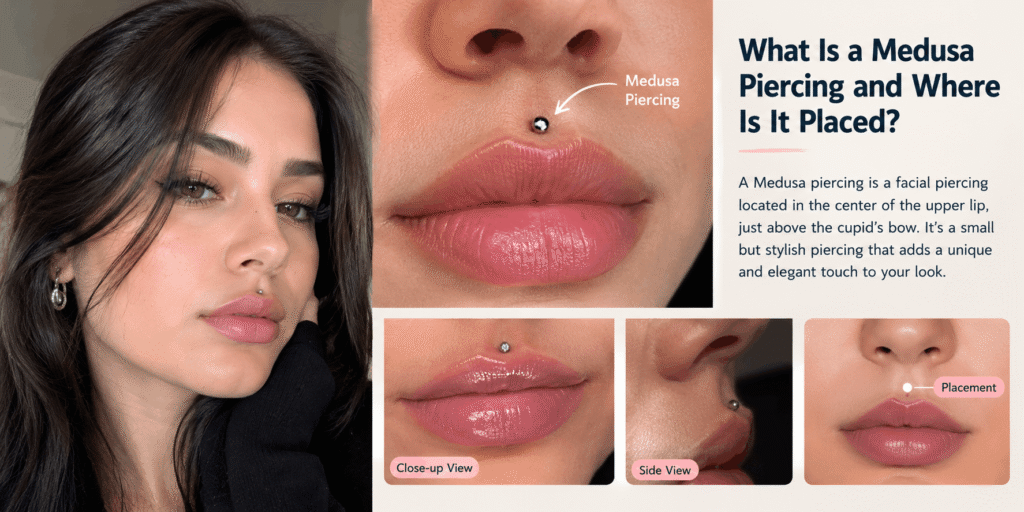
The Philtrum Piercing Explained
The term “philtrum piercing” describes the anatomical location, while “Medusa piercing” is the popular name commonly used for the same placement. Unlike many lip piercings positioned toward one side, this one is centered.
Its central position also means that placement needs to be particularly precise. A professional piercer will normally examine the shape of the philtrum, the tissue available for piercing, and the relationship between the jewelry and surrounding structures before proceeding.
A good placement should look balanced from the front without putting unnecessary pressure on the surrounding tissue.
Why Is It Called a Medusa Piercing?
The name is generally associated with the area between the nose and upper lip and became popular as a modern name for this particular facial piercing. It does not mean that the piercing has a special connection to the mythological Medusa.
The nickname simply became widely recognized within piercing and alternative fashion communities, while “philtrum piercing” remains the more anatomical description.
How It Looks With Different Jewelry
The jewelry can significantly change the overall appearance of a medusa piercing. A tiny metallic bead can create a very understated result, while a gemstone or decorative top can make the center of the face more noticeable.
For a first piercing, practicality is generally more important than choosing the most elaborate design. The jewelry needs to be appropriate for the healing stage, comfortable, and made from a suitable material.
Once the piercing has healed and a professional confirms that changing the jewelry is appropriate, there is more freedom to experiment with different tops, finishes, and styles.
What to Know Before Getting a Medusa Piercing
Before getting a medusa piercing, it is worth considering the cost, discomfort, healing requirements, and the commitment involved in caring for a fresh facial piercing.
Because the location is close to the mouth, everyday activities such as eating, drinking, brushing your teeth, and applying skincare around the area can require extra care while the piercing heals.
How Much Does a Medusa Piercing Cost?
The price can vary considerably depending on the studio, location, piercer’s experience, and jewelry selected. A basic piercing may cost less than one performed with premium jewelry, but price should not be the only factor when choosing a studio.
A reputable professional piercer should use appropriate sterile equipment, explain the procedure, discuss jewelry options, and provide clear aftercare instructions.
It is better to compare studios based on hygiene, professionalism, experience, and jewelry quality rather than simply choosing the cheapest option.
The initial price may also exclude upgraded jewelry or additional services, so asking for the complete cost beforehand can prevent surprises.
Does a Medusa Piercing Hurt?
Pain is highly individual, so there is no single experience that applies to everyone. A professional piercing is generally very quick, but the area can feel sensitive during and shortly after the procedure.
Some people describe the sensation as a brief sharp pressure followed by tenderness. Others may experience more sensitivity around the upper lip during the first part of healing.
Anxiety can also make the experience feel more intense. Eating appropriately beforehand, staying hydrated, and choosing an experienced professional may help make the appointment more comfortable.
The piercing itself is only one part of the experience. Temporary swelling, tenderness, and sensitivity can occur afterward as the body begins its normal healing response.
What Can Affect the Healing Process?
Healing can vary from person to person. Your body’s individual healing response, jewelry fit, placement, aftercare, accidental irritation, and everyday habits can all influence how the area settles.
Because this is a facial piercing near the mouth, frequent touching, playing with the jewelry, or repeatedly bumping it can create unnecessary irritation.
Following the piercer’s instructions and avoiding unnecessary interference gives the area a better environment for healing.
Medusa Piercing Aftercare: The Habits That Matter Most
Aftercare is one of the most important parts of having a new medusa piercing. A fresh piercing should be treated gently rather than constantly adjusted or inspected.
Your piercer should provide specific instructions based on the jewelry and placement. In general, keeping the area clean, minimizing irritation, and avoiding unnecessary contact are important habits during healing.
Keep the Piercing Clean
Cleanliness matters because a fresh piercing is vulnerable to irritation and contamination. Follow your professional piercer’s recommended cleaning routine rather than repeatedly applying harsh products.
Avoid using strong household disinfectants or aggressive chemicals on the piercing. Products that are too harsh can irritate healing tissue instead of helping it.
When cleaning around the outside of the piercing, gentle handling is preferable to scrubbing. Inside the mouth, maintaining good oral hygiene is also important because the jewelry is located near the oral environment.
Be Careful While Eating
Eating can feel slightly different during the early healing period because the jewelry may be sensitive or swollen.
Take smaller bites when necessary and pay attention to foods that seem to irritate the area. Extremely spicy, acidic, or otherwise irritating foods may feel uncomfortable for some people shortly after getting the piercing.
You should also be careful not to accidentally bite or pull the jewelry while eating.
Avoid Touching or Playing With the Jewelry
One of the easiest mistakes is repeatedly moving the jewelry simply because you are curious about how it feels.
Touching the piercing unnecessarily can transfer dirt and bacteria from your hands and can also irritate the healing tissue. Twisting or pulling the jewelry is not a useful way to help a piercing heal.
Try to leave the jewelry alone unless you are following your cleaning routine.
Keep Makeup and Skincare Products Away
Foundation, concealer, lipstick, lip liner, creams, and other cosmetic products can come into contact with the piercing.
During the early healing period, it is sensible to avoid putting makeup directly around the piercing unless your professional piercer has given different guidance.
Skincare products can also cause irritation if they enter the piercing channel. Keep the area as simple as possible while it heals.
Protect the Area During Healing
Accidental bumps are another common source of irritation. Be mindful when changing clothes, washing your face, sleeping, exercising, or doing anything that could catch the jewelry.
Avoid unnecessary pressure on the area and do not remove the jewelry simply because it feels better for a short time. If there is a concern about swelling, jewelry fit, or irritation, contact your piercer rather than attempting to solve the problem yourself.
A healing piercing generally benefits from consistency. The less unnecessary disturbance it receives, the easier it can be to monitor its progress.
How Long Does a Medusa Piercing Take to Heal?
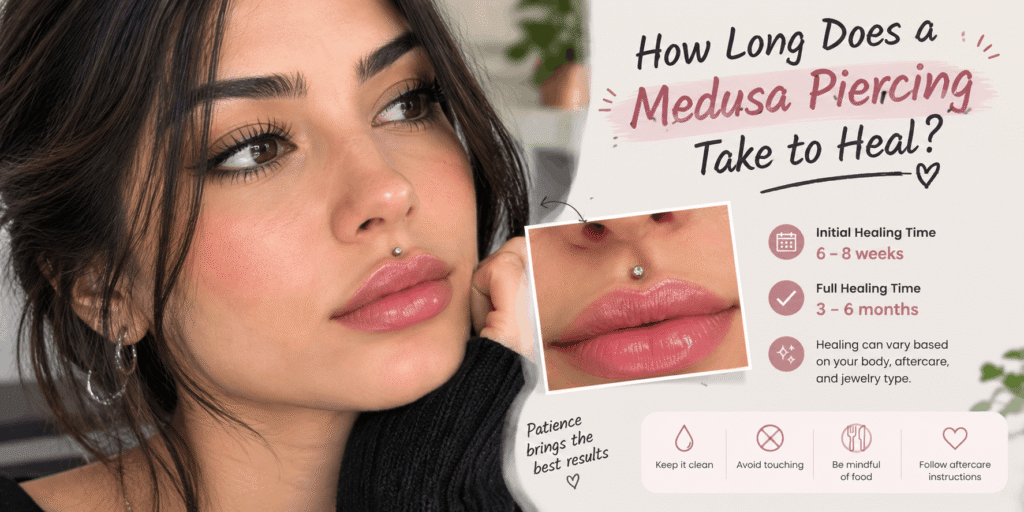
Healing times differ between individuals, and a piercing can look fine on the outside before the internal tissue has completely healed.
During the early stages, mild tenderness, swelling, or sensitivity can occur. These symptoms should gradually settle rather than continuously become more intense.
What Normal Healing Can Look Like
A fresh piercing may be somewhat tender and can have minor swelling during the initial stage. The surrounding skin may also feel different while the body forms new tissue around the jewelry.
As healing progresses, the piercing should generally become more comfortable and less reactive.
However, healing does not happen at exactly the same speed for everyone. Avoid assuming that the piercing is fully healed just because it looks normal from the outside.
Signs the Piercing May Need Attention
Persistent or worsening discomfort, significant swelling, unusual discharge, excessive warmth, or other concerning changes deserve attention.
If something seems wrong, do not repeatedly remove, twist, or replace the jewelry yourself. A qualified piercer can assess jewelry-related issues, while a healthcare professional can evaluate symptoms that may indicate a medical problem.
What Can Delay Healing?
Repeated irritation is one of the biggest practical concerns. Playing with the jewelry, catching it on clothing, applying irritating products, or failing to follow aftercare instructions can all make the healing period more difficult.
Poorly fitted jewelry can also cause problems. This is why professional assessment is useful if the jewelry seems too tight, constantly moves, or is causing unusual pressure.
Patience is important. A piercing is not a temporary accessory that can be treated casually during the healing stage; it requires consistent care until the tissue has recovered.
Choosing Jewelry for a Medusa Piercing
Jewelry is an important part of the overall medusa piercing experience because the piece sits in a highly visible area of the face. The right jewelry should not only complement the look but also be appropriate for the stage of healing.
For a new piercing, comfort and suitability should come before decorative details. A professional piercer can help determine the appropriate size, style, and material based on the anatomy and expected swelling.
Once the piercing has completely healed, there is usually more flexibility when choosing different decorative tops and styles.
Best Jewelry Styles for the Initial Piercing
A flat-back labret is commonly used for a medusa piercing because the backing sits inside the mouth while the decorative end remains visible from the front.
A simple bead or small gemstone can create a clean appearance without making the jewelry unnecessarily bulky. The initial piece may also have additional room to accommodate swelling during the early stage of healing.
The exact jewelry choice should be made with the piercer rather than based solely on appearance. Jewelry that looks attractive but does not fit correctly can create unnecessary pressure or irritation.
Materials to Consider
Jewelry material matters, particularly for a fresh piercing. Professional piercing studios commonly offer implant-grade materials designed for body jewelry.
Titanium is one material often considered because it is lightweight and generally well tolerated by many people. Other materials may also be appropriate depending on their quality and the individual’s needs.
If you have previously reacted to certain metals, mention that to your piercer before choosing jewelry. Avoid selecting unknown or poorly made jewelry simply because it is inexpensive.
When You Can Change the Jewelry
Changing jewelry too early can interfere with the healing process. Even when the outside appears settled, the inside of the piercing may still be healing.
Rather than deciding based only on appearance, ask your professional piercer when the jewelry can safely be changed. They can assess the piercing and determine whether it has progressed enough for a jewelry change.
If the initial jewelry needs to be downsized because swelling has gone down, have a professional perform the change when possible.
Can a Medusa Piercing Leave a Scar?
Any piercing can potentially leave some type of mark after the jewelry is removed. How noticeable that mark becomes can depend on individual healing, placement, jewelry, irritation, and how the piercing was treated during healing.
Some people may be left with a tiny spot that becomes difficult to notice over time, while others may have a more visible mark.
There is no reliable way to guarantee that a medusa piercing will leave absolutely no trace.
What Can Increase the Chance of a Mark
Repeated irritation can make healing more difficult and may contribute to prolonged inflammation or changes in the surrounding tissue.
Pulling the jewelry, repeatedly catching it, changing it too soon, or wearing jewelry that does not fit properly can all create unnecessary stress.
Individual skin characteristics also matter. Some people naturally develop more noticeable marks after injuries or piercings than others.
If you are particularly concerned about scarring, discuss the possibility with an experienced piercer before getting the piercing. They can explain how your anatomy and the planned placement may affect the result.
Possible Medusa Piercing Side Effects
Temporary tenderness and swelling can occur after getting a new piercing. The area may also feel sensitive while the tissue begins to heal.
Other problems can occur if the piercing becomes excessively irritated or if there is an issue with the jewelry or aftercare. Persistent swelling, worsening pain, unusual discharge, or other concerning changes should not simply be ignored.
A professional piercer can help identify jewelry or placement problems, while a healthcare professional can evaluate symptoms that may indicate an infection or another medical concern.
Avoid attempting to diagnose a serious problem yourself based only on pictures or online descriptions.
Is a Medusa Piercing Right for You?
A medusa piercing can be a distinctive choice for someone who likes centered facial jewelry, but it is still worth considering the practical side before making the decision.
Because of its location, the piercing can be noticeable in everyday situations. It may also require some patience during healing and extra awareness when eating, cleaning your face, or using products around the mouth.
Thinking about these factors beforehand can help you decide whether the piercing fits comfortably into your routine.
Questions to Ask Your Piercer
Before the appointment, consider asking the piercer about their experience with philtrum piercings, the jewelry they use, expected healing, aftercare, and what to do if swelling or irritation develops.
You can also ask how they assess anatomy and how they determine the appropriate initial jewelry size.
A professional should be willing to explain the procedure and answer reasonable questions rather than rushing you into a decision.
The studio environment matters as well. Look for a professional setting where hygiene, sterile equipment, and appropriate jewelry are treated seriously.
Things to Consider Before Making Your Decision
Think about whether you are comfortable with a visible facial piercing and whether you can consistently follow aftercare instructions during the healing period.
Consider your daily routine too. If you frequently play with jewelry, participate in activities where facial jewelry could easily get caught, or have difficulty avoiding makeup around the area, the healing period may require more attention.
You should also consider whether you are willing to wait before changing the jewelry or experimenting with different styles.
A good decision is not simply about whether the piercing looks appealing. It is also about whether you are prepared to care for it properly.
Final Thoughts
A medusa piercing offers a distinctive way to add jewelry to the center of the face, with its placement through the philtrum giving it a recognizable appearance. Its final look can range from extremely subtle to more noticeable depending on the jewelry chosen.
Before getting one, focus on the practical details as much as the style. Choose an experienced professional, use appropriate jewelry, understand the healing process, and follow the aftercare guidance you receive.
The healing period is not something to rush. Avoid unnecessary touching, protect the area from repeated irritation, and wait for professional confirmation before changing the jewelry.
Most importantly, remember that every person’s anatomy and healing response is different. If you are unsure whether a medusa piercing is suitable for you, a qualified piercer can assess your anatomy and explain what to expect before you make the decision.
With proper planning and responsible aftercare, you can approach the process with a much clearer understanding of what the piercing involves and what caring for it will require.