
Frizz, dryness, and hair that refuses to stay in place can make everyday styling frustrating. A keratin hair treatment is one option people consider when they want smoother-looking strands, improved shine, and hair that feels easier to manage. Depending on the formula, these treatments may help reduce the appearance of frizz and make blow-drying or styling less time-consuming.
Salon keratin services and at-home smoothing products are not all the same. Some products are designed to condition the hair and temporarily improve its surface, while professional treatments may use stronger chemical processes and heat to produce a longer-lasting change in texture. Understanding this difference is essential before choosing a treatment.
If you are considering a keratin hair treatment at home, you should look beyond promises of perfectly straight hair. Your hair’s current condition, natural texture, color history, and the ingredients in the product all influence which approach may be suitable. The goal is to choose a method that improves manageability without putting unnecessary stress on your hair or scalp.
What Is a Keratin Hair Treatment?
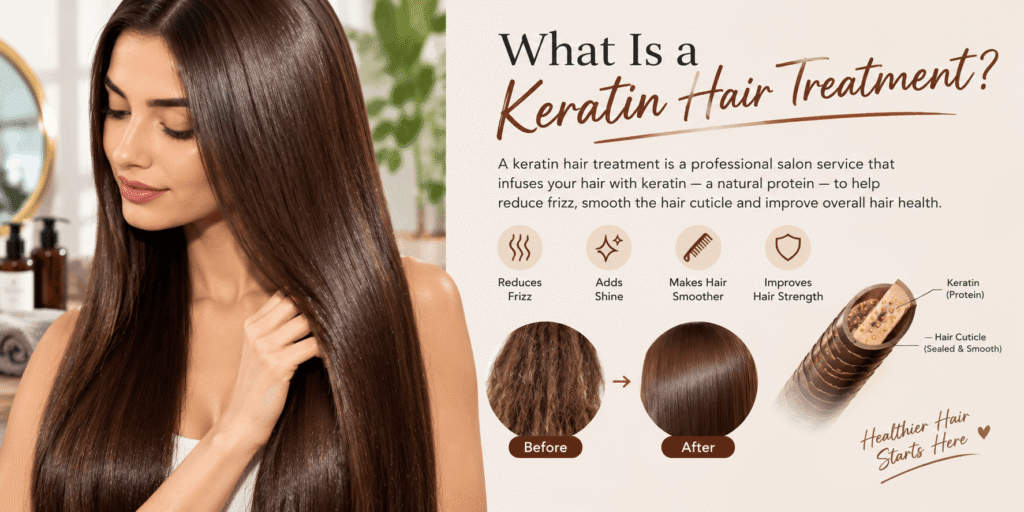
Keratin is a structural protein found naturally in hair, skin, and nails. Hair fibers contain keratin proteins that contribute to their strength and structure. Over time, everyday styling, chemical processing, ultraviolet exposure, and friction can leave the hair feeling rough, dry, or less manageable.
A keratin hair treatment is a broad term used for products and salon services intended to improve the hair’s smoothness, shine, and manageability. The results depend on the treatment’s formulation and how it works.
Some at-home products contain conditioning agents, hydrolyzed proteins, or other ingredients that coat or condition the hair fiber. These products may temporarily make strands feel softer, reduce friction, and improve the appearance of frizz.
Professional smoothing treatments can work differently. Some use chemical ingredients combined with heat to change how the hair behaves. The results may last longer, but these services can also involve greater risks, particularly when products are used incorrectly or expose the user to irritating fumes.
One important point is that a cosmetic treatment does not necessarily rebuild hair that has already broken or permanently repair every type of damage. It may improve the hair’s feel and appearance, but damaged strands still require careful handling as they grow out.
Keratin Treatments vs. Ordinary Smoothing Products
A conventional smoothing shampoo, conditioner, or mask generally works through cleansing and conditioning. These products may help reduce static, soften rough strands, and make hair easier to detangle.
An at-home keratin treatment may offer similar conditioning benefits, depending on its ingredients. Some are designed to be rinsed out, while others are leave-in products intended to remain on the hair.
Salon smoothing services may produce a more noticeable change in texture, but the exact process varies. Certain treatments require blow-drying and flat-ironing, while others follow different application instructions. Their results and potential risks depend on the active ingredients and the procedure used.
Do not assume that every product labeled keratin will straighten your hair or deliver salon-like results. Read the product description carefully and determine whether it is a rinse-out conditioner, a temporary smoothing treatment, or a chemical service intended to alter the hair’s texture.
Who Can Benefit From an At-Home Keratin Treatment?
At-home smoothing products may suit people who want to improve the feel and appearance of their hair without booking a salon appointment. However, the right option depends on your hair’s condition and the result you expect.
Frizzy or difficult-to-manage hair: If your hair becomes puffy in humid weather or develops flyaways after drying, a conditioning treatment may help make it easier to style. The amount of improvement depends on the formula and your hair’s natural texture.
Dry, rough-feeling strands: Hair that feels coarse or tangles easily may benefit from a treatment containing suitable conditioning ingredients. These products can improve softness and reduce friction during detangling.
Wavy or curly hair: People with waves or curls may use smoothing products to reduce frizz and create a more controlled finish. However, a conditioning mask will not necessarily remove the natural curl pattern. If preserving your curls is important, select a product specifically intended for your desired result.
Hair that takes a long time to style: A suitable smoothing product may help reduce the effort needed to manage your hair. Some formulas improve slip and reduce tangling, making blow-drying easier. They do not guarantee a shorter styling time for everyone.
When You Should Be More Careful
At-home keratin hair treatment is not automatically suitable for every hair type. If your hair is heavily bleached, breaking easily, or already weakened by chemical services, an intensive treatment involving high heat may increase the risk of further damage.
Color-treated hair may also need special consideration. Some smoothing processes can affect color, while frequent high-temperature styling may contribute to fading or dryness. Check whether the product is compatible with your hair color and any previous chemical services.
If your scalp is irritated, scratched, or unusually sensitive, avoid applying chemical smoothing products until the area has recovered. People with a history of allergic reactions should examine ingredient lists and follow appropriate product-testing instructions.
Pregnant or breastfeeding individuals, people with respiratory sensitivities, and anyone concerned about chemical exposure should be particularly cautious with salon-style smoothing products. Some formulations can release irritating or hazardous fumes when heated. Seek advice from a qualified healthcare professional or experienced hair professional when the product’s safety is uncertain.
Your Hair Preparation Routine Before Treatment
Preparation is an important part of achieving an even result. Applying a product to hair covered in styling residue can affect how it spreads, while using excessive heat on already fragile strands may increase damage.
Before starting, identify the result you want. Are you trying to soften frizz while retaining your natural waves, or do you want a straighter finish? Your answer will help you decide whether a conditioning treatment is sufficient or whether you are considering a more intensive process.
Check your hair’s current condition, too. Look for excessive breakage, rough ends, tangling, or areas that feel significantly weaker than the rest. If your hair is compromised, a gentle conditioning routine may be a better choice than an intensive smoothing service.
Step 1: Cleanse and Prepare Your Hair
Begin by reading the treatment’s instructions. Some products require freshly washed hair, while others have different preparation requirements. Avoid assuming that every keratin treatment needs a clarifying shampoo.
If the product calls for cleansing, use the recommended shampoo and rinse thoroughly. A clarifying shampoo may remove more residue than an ordinary cleanser, but frequent or unnecessary use can leave some hair types feeling dry.
Do not apply a treatment immediately over heavy oils, styling waxes, or layers of product unless the instructions specifically allow it. Residue may interfere with even application.
After cleansing, follow the label’s directions regarding towel-drying or blow-drying. Some products are intended for damp hair, while others require dry hair. Applying a treatment at the wrong moisture level can affect its performance.
Gently detangle your hair using a suitable comb or brush, beginning at the ends and working upward. Avoid pulling forcefully through knots, particularly when your hair is wet and more vulnerable to mechanical damage.
Understanding the Ingredients and Technology
The word keratin can make a product sound as though it directly restores every damaged area of the hair. In reality, its performance depends on the entire formula, not simply the presence of one ingredient.
Hydrolyzed keratin and other hydrolyzed proteins may be included in conditioning products to improve the feel of the hair. Conditioning agents can help strands slide past one another more easily, reducing friction and making detangling more manageable.
Silicones, fatty alcohols, and other emollient ingredients may also contribute to smoothness and shine. Their role varies by formula, and their presence does not automatically indicate that a product is good or bad for your hair.
Some smoothing treatments rely on chemical ingredients and heat to produce more persistent changes in how the hair behaves. These formulas deserve additional scrutiny because certain heated hair-smoothing products can release formaldehyde or related compounds. The exact risk depends on the ingredients, product formulation, and application conditions.
Read the full ingredient list rather than relying on marketing phrases such as professional strength, natural keratin, or formaldehyde-free. If a product’s instructions are unclear, its ingredients are not adequately disclosed, or it requires a procedure you cannot perform safely, do not proceed.
A good treatment should match your hair’s needs and provide clear instructions for use. More intense does not necessarily mean more effective or safer.
Choosing the Right Keratin Hair Treatment for Your Hair Type
Selecting a product becomes easier when you consider your hair’s natural texture, thickness, and current condition. Instead of choosing solely by popularity, look for a formula intended to deliver the type of result you want.
Fine hair: Lightweight conditioning products may be preferable because heavy formulas can leave fine strands looking flat or greasy. Use only the recommended amount and avoid layering multiple rich products unnecessarily.
Thick hair: Thicker strands may benefit from products that provide sufficient conditioning and slip. However, hair density and individual strand thickness are different characteristics, so the amount of product needed can vary.
Curly hair: If you want to maintain your curl pattern, choose a conditioning treatment designed to improve softness and reduce frizz without claiming to permanently straighten the hair. A traditional smoothing service may change the appearance of your curls more noticeably.
Color-treated hair: Look for products labeled as compatible with color-treated hair. Even then, check the instructions and consider professional advice before combining a smoothing service with bleaching, permanent color, or other chemical processes.
Dry or damaged hair: Focus on gentle cleansing, conditioning, and reduced heat exposure. An intensive chemical treatment is not necessarily the best way to improve fragile hair, particularly if breakage is already occurring.
Remember that two people with the same hair type may respond differently to the same product. The most useful choice is one that suits your current hair condition, offers clear directions, and does not require you to compromise scalp comfort or hair health.
How to Apply a Keratin Hair Treatment at Home
Once you have selected a suitable product and prepared your hair, the next step is to follow the application process carefully. There is no single method that works for every keratin hair treatment, so the instructions on your chosen product should always take priority over general advice.
Some at-home products are simple conditioning treatments that can be rinsed out after a short period. Others are designed to create a stronger smoothing effect and may involve drying, heat styling, or additional precautions. Never use the instructions for a rinse-out mask to apply a chemical smoothing formula, or vice versa.
Step 1: Divide Your Hair Into Manageable Sections
If the product requires sectioning, gently separate your hair into manageable parts using clips. Smaller sections can make it easier to distribute a product evenly without repeatedly applying it to the same area.
Avoid pulling the hair tightly or using clips that snag fragile strands. If your hair is long or thick, take your time rather than rushing through the application. Uneven distribution may leave some areas feeling coated while other sections receive too little product.
Step 2: Apply the Product as Directed
Follow the manufacturer’s directions regarding the amount to use, where to apply it, and how far from the scalp the product should begin. Do not assume that applying extra product will create smoother hair. Excess product may cause buildup, weigh down the strands, or increase exposure to irritating ingredients.
Use the protective equipment recommended on the label, and avoid contact with the eyes and skin. Never apply a product to the scalp unless the instructions specifically allow it. If you experience burning, itching, or unusual irritation, stop the application and follow the product’s rinsing and safety instructions.
Step 3: Follow the Required Processing Time
Different formulas have different processing requirements. Some need only a brief application, while others have specific waiting periods. Follow the exact timing provided by the manufacturer and never leave the product on longer in the hope of improving the outcome.
Do not combine multiple smoothing products during the same session unless their instructions explicitly confirm compatibility. Mixing formulas can produce unpredictable results and may increase the risk of irritation or hair damage.
Step 4: Rinse, Dry, or Style According to the Instructions
Some treatments must be rinsed out before styling, while others may have different requirements. Read the instructions before you begin so you know which tools and steps are necessary.
If the product requires blow-drying or flat ironing, use only the recommended method and temperature. Do not improvise with higher heat or additional passes. If the instructions are unclear about heat application, ask the manufacturer or a qualified stylist before proceeding.
For a product intended only to condition the hair, there is generally no reason to add intensive heat styling unless the directions specifically recommend it. Gentle drying and careful detangling can help limit unnecessary stress on the strands.
Heat Styling and Safety Precautions
Heat can make certain smoothing treatments more effective, but it also introduces additional risks. Excessive temperatures may weaken hair, increase breakage, and make already damaged strands feel rougher. The risk can be greater for hair that has been bleached, relaxed, or repeatedly colored.
Use heated tools only when the product instructions require or permit them. Select an appropriate temperature for your hair condition, and avoid repeatedly passing a flat iron over the same section. If your hair begins to smoke, smell scorched, or feel unusually brittle, stop the process.
Ventilation is particularly important with chemical smoothing treatments. Some products may release formaldehyde or related compounds when heated. A pleasant fragrance, a salon-style label, or the word keratin does not establish that a formula is free from these substances.
Check the ingredient information and safety warnings before purchasing. Be cautious of products with incomplete ingredient disclosures or instructions that encourage use despite eye, nose, throat, or breathing irritation. Do not continue using a product that causes these symptoms. Move away from the exposure and seek medical advice if symptoms are severe or do not resolve.
If you cannot safely meet the product’s application requirements, choose a simpler conditioning treatment or consult a trained professional. The aim is to improve manageability, not to expose your hair or yourself to unnecessary risk.
Building an Aftercare Routine for Smoother Hair
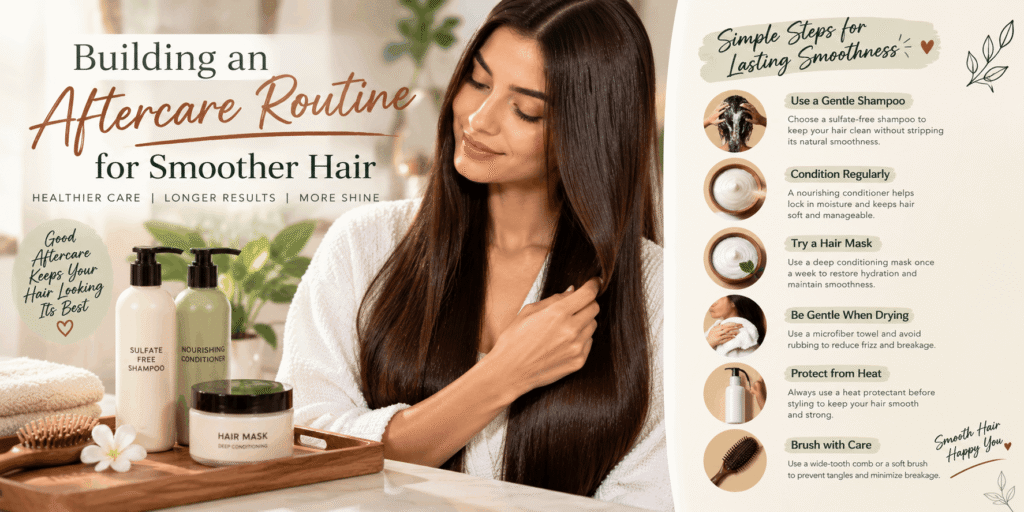
The way you care for your hair after treatment can influence how long it looks smooth and how healthy it feels. However, aftercare recommendations vary considerably. Some products have specific washing restrictions, while others can be rinsed out immediately and followed by your normal routine.
Choose a Suitable Shampoo and Conditioner
Use a shampoo and conditioner that suit your scalp and hair type. If the manufacturer recommends particular products or washing instructions, follow those directions. Some smoothing treatments are marketed as compatible with sulfate-free shampoos, but sulfate-free products are not automatically better for every person or every formula.
If your scalp becomes oily, choose a cleansing routine that removes excess oil without causing unnecessary dryness. If your lengths feel dry, apply conditioner mainly to the mid-lengths and ends. The goal is to balance scalp cleanliness with enough conditioning to keep the hair manageable.
Avoid changing several products at once. Introducing a new shampoo, mask, oil, and styling cream immediately after treatment can make it difficult to determine which product is helping or causing buildup.
Keep Heat Styling Under Control
You may find that treated hair requires less styling effort, so take advantage of that opportunity. Allow the hair to air-dry when practical, or use a blow-dryer on a moderate setting. When additional heat styling is necessary, use a suitable heat protectant if it is compatible with your treatment.
A heat protectant can help reduce some heat-related stress, but it does not eliminate the risk of damage. Avoid repeated high-temperature styling, particularly if the hair already feels dry or weak.
Protect Your Hair While Sleeping
Friction from pillowcases, rough fabrics, and restless movement can contribute to tangling and frizz. Detangle gently before bed and avoid sleeping with hair tied in a tight style that places tension on the roots.
A smooth pillowcase or a loose, comfortable hairstyle may help reduce friction for some people. These measures will not extend every treatment’s lifespan, but they can support easier day-to-day hair management.
Use Conditioning Products Without Overloading Your Hair
A lightweight leave-in conditioner may help with detangling, while a suitable hair mask can improve softness when used according to its instructions. Apply products sparingly and focus on areas that need additional moisture or slip.
More products do not necessarily produce better results. Heavy oils, creams, and silicone-rich styling products can accumulate on some hair types, making the strands appear flat or greasy. Clarify your hair when appropriate for your routine, but avoid aggressive cleansing that leaves it uncomfortable or excessively dry.
How Long Does a Keratin Hair Treatment Last?
The duration depends on the type of treatment, the hair’s condition, how frequently you wash it, and the products used afterward. A conditioning treatment may provide benefits until the next wash or for a few washes, whereas some longer-lasting smoothing formulas are designed to maintain their effect for weeks or months.
It is not accurate to promise the same duration for every keratin hair treatment. Results can also look different from person to person. Naturally curly hair may retain some of its pattern, and frizz reduction does not always mean that the hair will become completely straight.
Frequent washing, swimming, heat styling, and environmental conditions may influence how the finish changes over time. Rather than trying to preserve the result at any cost, focus on keeping the hair comfortable, manageable, and in good condition.
Avoid repeating a strong smoothing treatment simply because the effect appears to be fading. Review the manufacturer’s recommended interval and consider the condition of your hair before applying another treatment. If the strands are breaking or becoming unusually dry, pause intensive processing and seek advice from a professional stylist.
Common Keratin Hair Treatment Mistakes to Avoid
Even a well-chosen product may produce disappointing results if it is used incorrectly. A few simple precautions can help you avoid unnecessary damage.
Choosing a product based only on its name: Keratin is not a guarantee of a particular result. Check what the product is designed to do, how it should be used, and which ingredients it contains.
Ignoring the instructions: Processing time, rinsing requirements, and heat settings can vary. Never substitute another brand’s method or extend the recommended time.
Applying too much product: Excess product can cause buildup and may increase exposure to potentially irritating ingredients. Use the amount specified on the label.
Skipping patch and strand tests: Testing is especially useful when your hair is fragile, colored, or chemically treated. A test cannot guarantee complete safety, but it may reveal problems before you treat your entire head.
Using excessive heat: Higher temperatures and repeated flat-iron passes can contribute to breakage. Follow the product’s heat instructions and stop if you notice scorching or unusual fumes.
Expecting permanent repair: A smoothing treatment may improve appearance and manageability, but it cannot permanently reverse all structural damage. Split ends and severely damaged hair may require trimming and a gentler care routine.
Repeating treatments too frequently: Repeated chemical processing and heat exposure can accumulate stress. Follow the product’s guidance and assess the condition of your hair before considering another application.
Final Thoughts
A keratin hair treatment can be a useful option for people who want smoother-looking hair, less frizz, and easier styling. The key is understanding that different products provide different results, from temporary conditioning to more intensive smoothing.
Start by identifying your hair’s needs and choosing a formula that matches your goals. Read the ingredients and instructions carefully, perform the recommended tests, and avoid improvising with processing times or heat settings. If a product requires professional equipment or precautions that you cannot provide, seek help from a trained stylist.
After treatment, maintain a balanced routine with gentle cleansing, appropriate conditioning, and less unnecessary heat styling. Most importantly, pay attention to how your hair responds. Smoothness and shine are valuable, but they should never come at the expense of your hair’s condition or your personal safety.
A keratin hair treatment is designed to improve the appearance and manageability of hair. Depending on the formula, it may reduce frizz, increase softness, improve shine, or create a smoother finish. The results vary by product and hair type.
Some products are specifically formulated for home use, while others are intended for professional application. Choose a product with clear instructions and complete safety information. Do not attempt a professional-style chemical process at home if you cannot safely follow its requirements.
It can be, depending on your goal and the product. A conditioning treatment may help reduce frizz while preserving natural curls. Stronger smoothing formulas may loosen the curl pattern or change how the hair behaves, so review the expected results before applying one.

3 Comments