
The Norwood Scale is a classification system used to describe common patterns of male pattern hair loss. It helps organize the progression of hairline recession and thinning into several stages, making it easier for professionals to describe the general pattern of hair loss. You may also see it called the Norwood-Hamilton Scale.
Understanding the Norwood Scale can help you learn the terminology used when discussing hair loss. However, a stage number alone does not provide a complete assessment of someone’s hair or predict exactly how their hair may change in the future. Hair-loss patterns can vary considerably from person to person.
What Is the Norwood Scale? 📊
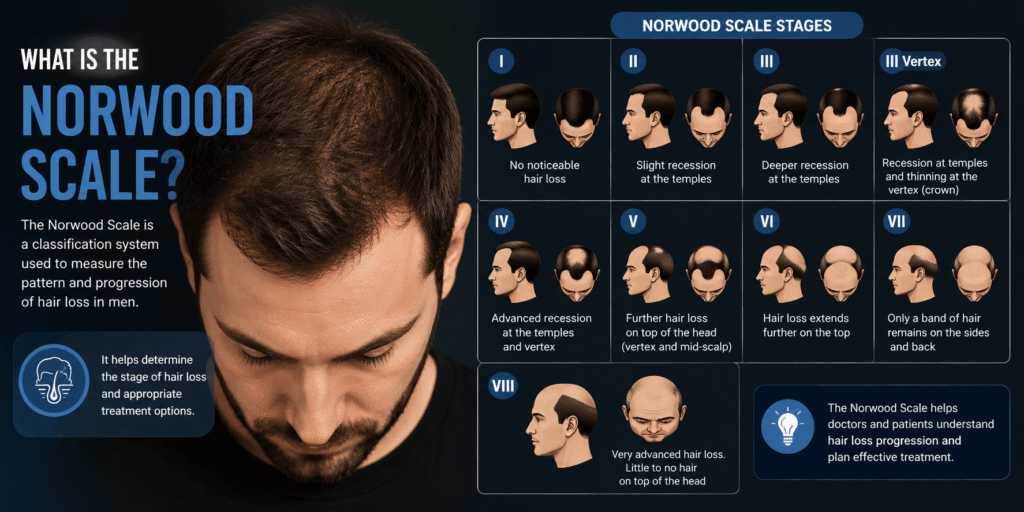
The Norwood Scale is a visual classification system that divides common male pattern hair-loss patterns into stages.
Who Developed the Norwood Scale? 👨⚕️
The system is associated with dermatologist James Hamilton’s earlier classification work and was later modified and expanded by Dr. O’Tar Norwood.
The resulting classification became widely used for describing androgenetic alopecia, commonly known as male pattern hair loss.
What Does the Scale Measure? 📏
The Norwood Scale primarily focuses on changes such as:
- Receding temples
- Changes in the frontal hairline
- Thinning around the crown
- Progression of hair loss across the top of the scalp
It does not measure every possible type of hair loss.
Why Is the Norwood Scale Used? 🔍
The scale provides a common language for describing the general pattern of hair loss.
Easier Communication
Instead of giving a long description of a hairline, a professional may use a Norwood stage to communicate the general pattern.
Tracking Changes
A stage can also provide a simple reference point when comparing hair-loss progression over time.
Discussing Treatment Options
Healthcare professionals may consider the pattern and extent of hair loss when discussing possible treatment approaches.
However, treatment decisions should not be based on the Norwood number alone.
Understanding the Norwood Stages 🧑🦱
The classic Norwood classification is commonly described using stages from I through VII.
Norwood Stage I 1️⃣
Stage I generally represents little or no significant hairline recession.
The frontal hairline remains relatively youthful in appearance, although natural differences in hairline shape can occur.
Stage I is often considered the starting point of the scale rather than a clear indication of progressive hair loss.
Norwood Stage II 2️⃣
At Stage II, there may be mild recession around the temples.
The front of the hairline begins to take on a more mature shape.
Temple Recession
The changes are usually most noticeable around the front corners of the hairline.
A person’s natural hairline can sometimes resemble Stage II without necessarily progressing to more advanced hair loss.
Norwood Stage III 3️⃣
Stage III represents more noticeable recession.
The temples may recede farther backward, creating a more defined M-shaped or similar hairline pattern.
Crown Variant
Some classifications also recognize a Stage III vertex pattern, where thinning is more noticeable around the crown.
This highlights why looking only at the front hairline may not provide the complete picture.
Norwood Stage IV 4️⃣
At Stage IV, recession and thinning become more pronounced.
The frontal hairline may be significantly farther back, and the crown can also show noticeable thinning.
Front and Crown Changes
The frontal and crown areas may still be separated by an area of relatively denser hair.
The exact appearance varies between individuals.
Norwood Stage V 5️⃣
Stage V represents more advanced hair loss.
The areas of frontal recession and crown thinning become larger, and the band of hair separating them becomes narrower.
Reduced Density
Hair density across the top of the scalp may be noticeably reduced.
The remaining hair pattern becomes increasingly concentrated around the sides and back.
Norwood Stage VI 6️⃣
At Stage VI, the areas of hair loss at the front and crown have generally connected or become much more extensive.
There is significantly less hair remaining across the top of the scalp.
Side and Back Hair
Hair around the sides and back of the scalp generally remains more resistant to typical androgenetic hair loss.
This area is sometimes referred to as the donor region in the context of hair transplantation.
Norwood Stage VII 7️⃣
Stage VII represents the most advanced stage in the traditional Norwood classification.
Hair loss extends across most of the top of the scalp, leaving a relatively narrow band of hair around the sides and back.
The exact pattern can still differ from one individual to another.
Norwood Scale vs. Normal Hairline Changes 🔄
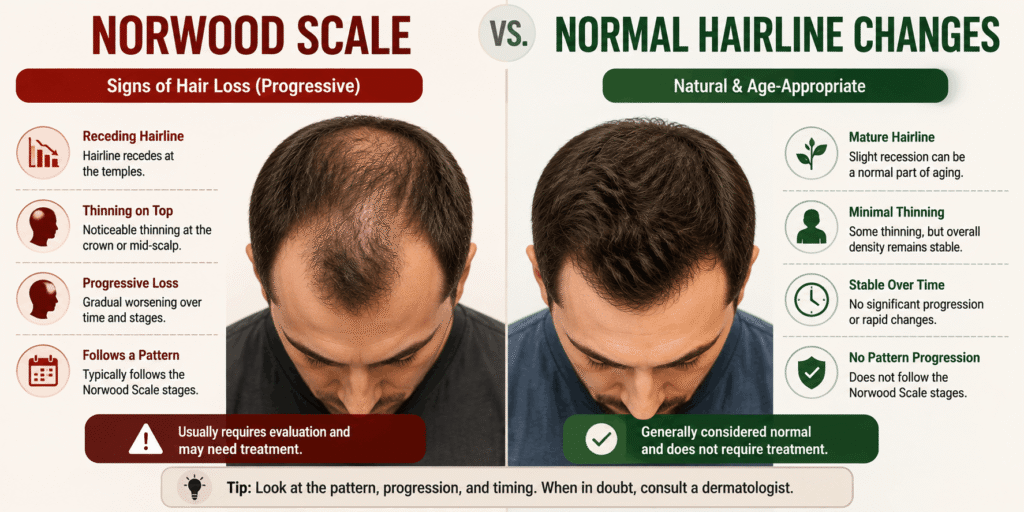
Not every change in the hairline means progressive hair loss.
Mature Hairline
Many people experience some natural change in their hairline as they move from adolescence into adulthood.
A mature hairline can have some recession without progressing to extensive hair loss.
Natural Variation
Hairlines naturally differ in shape, density, and position.
For this reason, comparing your hairline with another person’s is not a reliable way to determine whether hair loss is occurring.
What Causes Male Pattern Hair Loss? 🧬
Male pattern hair loss is primarily associated with genetic and hormonal factors.
Genetics
Family history can play an important role.
Hair-loss susceptibility can involve genetic factors inherited from different sides of the family, so looking only at one relative does not provide a complete prediction.
DHT and Hair Follicles
Androgenetic alopecia is associated with sensitivity of certain hair follicles to dihydrotestosterone, commonly called DHT.
In susceptible follicles, this process can gradually cause miniaturization, meaning the affected hairs become finer and shorter over time.
Does Everyone Progress Through Every Norwood Stage? ❓
No.
People do not necessarily progress through every stage in a predictable sequence.
Different Progression Patterns
Some people may experience mild recession that remains relatively stable, while others may develop more extensive thinning.
The speed and extent of progression can vary significantly.
Age Does Not Determine the Stage
People of different ages can have different Norwood patterns.
A younger person can have noticeable hair loss, while an older person may retain substantial hair density.
How Is the Norwood Stage Determined? 🔎
A professional can assess the overall pattern of hair loss by examining the scalp and hairline.
Looking at the Front
The frontal hairline and temples are assessed for recession.
Checking the Crown
The crown or vertex is also important because thinning in this area may not be obvious from a front-facing view.
Evaluating Overall Density
Hair density and the distribution of remaining hair can provide additional information.
Why Photos Can Be Useful 📸
Consistent photographs can help document changes over time.
Take Similar Photos
If you are monitoring your hair, photographs taken under similar lighting and from similar angles can make comparisons easier.
Avoid Drawing Conclusions From One Photo
A single photograph can be misleading because hair direction, lighting, styling, and camera angle can change how dense the hair appears.
Can the Norwood Scale Be Used for Women? 👩
The Norwood Scale was developed primarily for male pattern hair loss and is not generally the standard classification system for female pattern hair loss.
Women can experience different patterns of hair thinning, and other classification systems may be more appropriate.
Why This Matters
Using the wrong classification system can make it harder to accurately describe the pattern of hair loss.
A healthcare professional can determine what type of hair-loss assessment is appropriate.
Other Causes of Hair Loss 🩺
Not all hair loss is androgenetic alopecia.
Temporary Shedding
Some conditions can cause increased shedding for a period of time.
Medical Conditions
Certain medical conditions can contribute to hair loss.
Nutritional Factors
Nutritional deficiencies can sometimes be associated with hair shedding.
Scalp Conditions
Some scalp disorders can affect hair growth.
Because these causes can require different approaches, a professional evaluation can be important when hair loss is sudden, unusual, or concerning.
When Should You Talk to a Professional? 👨⚕️
Consider seeking professional advice if you notice:
- Sudden or rapid hair loss
- Significant scalp changes
- Patchy areas of hair loss
- Persistent excessive shedding
- Hair loss accompanied by other symptoms
- Uncertainty about the cause of thinning
A dermatologist or other qualified healthcare professional can help determine whether the pattern resembles androgenetic alopecia or another type of hair loss.
Norwood Stage 2 vs. Stage 3 🧑🦱
The difference between Stage 2 and Stage 3 is generally the degree of recession around the temples.
Norwood 2
At Stage 2, the hairline may show relatively mild temple recession.
The overall density across the top of the scalp can remain fairly strong.
Norwood 3
At Stage 3, the recession is usually more pronounced.
The temples move farther backward, creating a more obvious change in the shape of the frontal hairline.
A professional assessment can help distinguish a naturally mature hairline from progressive hair loss.
Norwood Stage 3 vs. Stage 4 🔍
The main difference is often the extent of frontal recession and whether noticeable crown thinning is present.
Stage 3
The primary change is usually concentrated around the frontal hairline and temples.
Stage 4
The frontal recession is more advanced, and the crown may also show visible thinning.
The areas of hair loss are generally still separated by an area of hair across the top.
Norwood Stage 5 vs. Stage 6 📊
These stages represent more advanced patterns.
Norwood 5
The frontal and crown areas have become larger, and the strip of hair separating them becomes narrower.
Norwood 6
The frontal and crown areas have generally joined or become substantially connected.
Hair across the top is significantly reduced compared with earlier stages.
Norwood Stage 7 🧑🦲
Stage 7 is the most advanced category in the traditional Norwood classification.
Hair loss extends across most of the top of the scalp, while a relatively narrow band of hair typically remains around the sides and back.
The exact appearance can still vary between individuals.
Does Norwood Stage Predict Future Hair Loss? 🔮
Not exactly.
The Norwood Scale describes the current or observed pattern rather than guaranteeing what will happen next.
Genetic Factors
Family history can provide some context, but it cannot precisely predict an individual’s future hair-loss pattern.
Age
Hair loss can develop at different ages and at different rates.
Individual Variation
Two people with a similar Norwood stage may experience very different progression over the following years.
For this reason, a stage should be viewed as a description rather than a guaranteed forecast.
Can Hair Loss Be Treated? 💡
Depending on the cause, there may be professional treatment options for hair loss.
Medical Evaluation
Before choosing a treatment, it is useful to determine why the hair is thinning.
A dermatologist or other qualified healthcare professional can evaluate the scalp, hair pattern, medical history, and other relevant factors.
Treatment Options
For androgenetic alopecia, healthcare professionals may discuss evidence-based treatments that are appropriate for the individual.
The suitable option depends on factors such as age, health history, stage, pattern, and personal circumstances.
Do not start prescription or medicated treatments without appropriate professional guidance.
Norwood Scale and Hair Transplants 💇
The Norwood Scale is sometimes discussed in relation to hair transplantation.
Donor Area
Hair around the sides and back of the scalp can be less affected by typical androgenetic hair loss.
This area may be considered when evaluating whether someone could be a candidate for transplantation.
Available Hair Matters
A transplant cannot simply restore unlimited amounts of hair.
The amount and quality of available donor hair, the size of the thinning area, and the individual’s goals all matter.
Professional Assessment
A qualified hair-restoration professional can determine whether transplantation is appropriate and discuss realistic expectations.
Norwood Scale and Hair Density 📈
The scale primarily describes the pattern of recession and thinning, but density is also important.
Similar Stage, Different Density
Two people can appear to have a similar Norwood stage while having noticeably different hair density.
One person may have finer hair throughout the affected area, while another may retain relatively strong density around certain regions.
Why Density Matters
Density can influence how noticeable thinning appears and may be relevant when discussing treatment options.
How to Monitor Hair Changes 📸
If you are concerned about gradual hair loss, tracking changes over time can be useful.
Take Consistent Photos
Take photos from the front, both sides, and the top or crown.
Try to use similar lighting, camera distance, and hair positioning each time.
Avoid Daily Comparisons
Hair naturally looks different depending on styling, washing, lighting, and moisture.
Comparing photographs over a longer period can provide more useful information than checking the mirror repeatedly.
Haircuts and the Norwood Scale ✂️
A haircut does not change the underlying Norwood stage, but styling can influence how hair loss appears.
Short Hair
A shorter hairstyle can create a cleaner overall appearance and may make differences in hair length less noticeable.
Textured Styles
Texture and appropriate styling can add visual movement.
Avoid Extreme Comparisons
A hairstyle that looks good on one person may not produce the same appearance on someone with a different hair texture or density.
Hair Care for Thinning Hair 🧴
General hair care can help maintain the condition of the hair and scalp.
Handle Hair Gently
Avoid unnecessarily rough brushing, pulling, or styling.
Use Suitable Products
Choose hair-care products appropriate for your hair and scalp.
Protect Hair From Excessive Heat
If you use heat-styling tools, follow safe instructions and avoid unnecessary high heat.
These habits do not reverse genetic hair loss, but they can support general hair and scalp care.
Common Misunderstandings About the Norwood Scale ⚠️
Myth: Stage 2 Always Becomes Stage 7
This is not necessarily true.
Hair-loss progression varies considerably between individuals.
Myth: The Scale Diagnoses Every Type of Hair Loss
It does not.
The Norwood Scale is mainly designed to classify common male pattern hair-loss patterns.
Myth: Your Hairline Can Be Diagnosed From One Photograph
A single photograph cannot reliably determine the cause or progression of hair loss.
Lighting, hairstyle, camera angle, and hair length can all affect appearance.
Myth: A Higher Norwood Stage Means Treatment Is Impossible
Treatment possibilities depend on many factors, including the cause and extent of hair loss.
A qualified professional can discuss appropriate options.
When Hair Loss Needs Professional Attention 🩺
Not every change in hair density is a sign of male pattern hair loss.
Professional evaluation can be particularly important when hair loss is:
- Sudden
- Patchy
- Rapidly progressing
- Associated with scalp irritation
- Accompanied by other unusual symptoms
- Significantly different from your usual pattern
A professional can determine whether additional evaluation is needed.
Final Thoughts 📝
The Norwood Scale is a useful way to understand and describe the general progression patterns associated with male pattern hair loss. From minimal recession in Stage 1 to more extensive loss in Stage 7, the classification provides a common framework for discussing changes to the frontal hairline, temples, and crown.
However, it is important not to treat the scale as a prediction or diagnosis. People can have naturally different hairlines, and hair loss can result from many different causes. A similar-looking hairline does not necessarily mean that two people will experience the same progression.
If you are concerned about changes in your hair, documenting the pattern over time and discussing it with a qualified healthcare professional can provide more useful information than relying on online comparisons alone. A professional can assess whether the pattern is consistent with androgenetic alopecia and whether further evaluation or treatment may be appropriate.
Ultimately, understanding the Norwood Scale can help you communicate more clearly about hair-loss patterns, but your individual hair, scalp, genetics, and overall circumstances matter much more than a single stage number.






One Comment