
Quick answer: Silver hair color is a cool, light gray shade. You get it by enhancing hair that is already gray, or by lightening other hair to a very pale base and toning it. Your starting point decides the route. Natural gray is easiest, blonde is moderate, and dark hair needs repeated lightening, which carries the most damage risk.
Table of Contents
- What Is Silver Hair Color?
- Which Route to Silver Fits Your Starting Point?
- How Do You Make Silver Hair, Step by Step?
- Is Silver Hair Color Bad for Your Hair?
- What Safety Steps Come Before Dyeing?
- Why Does Silver Hair Turn Yellow?
- How Do You Use Purple Shampoo Without Overdoing It?
- Weekly Silver Hair Care Checklist
- Two Real-World Scenarios
- Common Mistakes
- Can You Go Silver Gradually?
- FAQs
- Conclusion
Key Takeaways
- Silver is a result of pigment loss. Natural gray hair gets there by itself, and everyone else has to lighten first.
- A true silver needs a very pale, even base. Dye over a yellow or orange base looks dull or off-tone.
- Dermatologists advise keeping color changes within three shades of your natural color. Silver from dark hair goes far beyond that, so weigh the trade-off.
- Always do a patch test before using a dye, and repeat it each time you color.
- Yellowing has several causes. Match the fix to the cause instead of reaching for purple shampoo every time.
- Use purple shampoo only when you see yellow. Stop when hair starts to look lavender.
What Is Silver Hair Color?
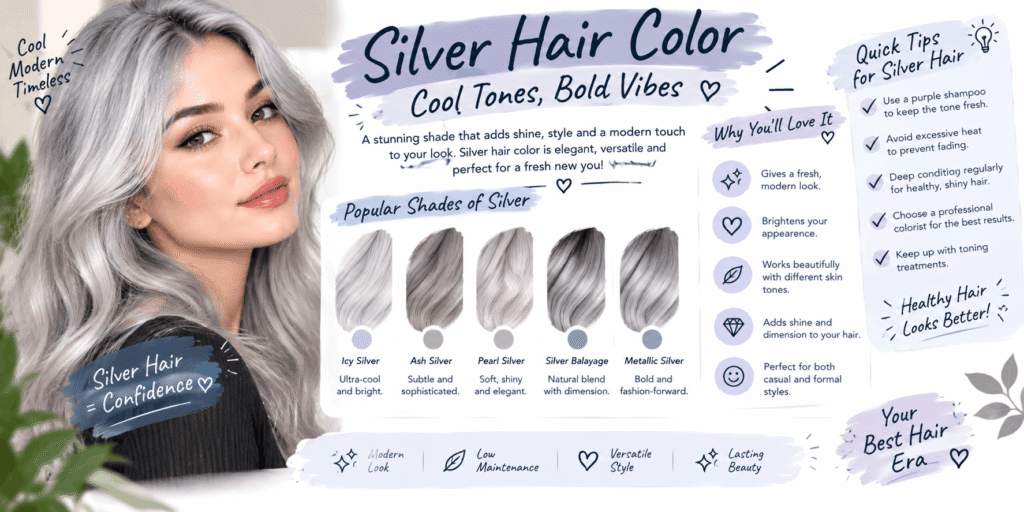
Silver hair color is a cool, light gray tone with very little yellow. It appears naturally when hair loses pigment, and it can be created by lightening and toning hair that still has color.
Natural graying starts in the follicle. Each follicle holds pigment-producing cells called melanocytes. According to the University of Miami Health System, these cells gradually make less melanin, and the stem cells that replace them may run down with age. Stress has also been linked to faster graying. The American Academy of Dermatology, as reported by the UC Irvine Beckman Laser Institute, says most people begin to notice more gray in their 30s or 40s.
People use “gray,” “white” and “silver” loosely. In practice, white hair has no melanin, and gray hair keeps a little. Silver usually describes the cool, bright end of that range.
Gray hair also behaves differently. The University of Miami reports that it often becomes thicker, coarser and more brittle. Britannica notes that gray hair is stiffer and wirier than pigmented hair, and that the exact reason is not fully understood. Reduced scalp oil with age likely plays a part, so gray and silver hair usually need more moisture.
Which Route to Silver Fits Your Starting Point?
Your starting silver hair color decides your route, your effort and your risk. Hair professionals describe color on a scale from level 1 (black) to level 10 (pale blonde), with medium brown near level 5. Bleach works by breaking down melanin, and the darker you start, the more warm pigment shows up along the way. A violet-based toner cancels yellow. Darker hair shows orange or red-orange, which needs bluer toners. This is described in lightening patents filed with the U.S. Patent and Trademark Office.
| Starting point | What you do | Typical effort | Damage risk | Upkeep |
|---|---|---|---|---|
| Mostly natural gray or white | Tone or gloss to cancel yellow; blend with salon color if some pigment remains | Low | Low | Low to moderate |
| Light blonde (about levels 8 to 10) | Tone toward silver, sometimes lighten slightly first | One toning visit | Low to moderate | Moderate |
| Medium blonde to light brown (about levels 6 to 7) | Lighten to a pale base, then tone | Often one lightening session plus toning | Moderate to high | Moderate to high |
| Dark brown to black | Lighten in several stages, then tone | More than one session is typical | Highest | Highest |
The 4-Question Readiness Check
Answer these before you book anything.
- Is more than half your hair already gray? If yes, you are on the easiest path. Start with toning, not bleach.
- Is your hair already colored or bleached? Previous dye and lightener change how new color takes. Tell your colorist everything you have used.
- Can you accept slower, gentler results? Gradual routes protect your hair but take longer.
- Will you maintain it? Silver fades. Without a care routine it drifts toward yellow or blonde.
How Do You Make Silver Hair, Step by Step?
You make silver in two stages: build a very pale base, then deposit cool pigment on top. Skipping the first stage is the most common reason silver comes out dull.
- Assess your level in daylight. Roots, mid-lengths and ends are often different levels. Note any previous color.
- Test first. Do a patch test and a strand test (see the safety section).
- Lighten to a pale base. L’Oréal Paris Canada says the base should be very light, ideally platinum, because without it the silver can look indistinct or turn yellowish. Aim for hair that is near-white with only a trace of pale yellow. Process by checking the hair, not just the clock.
- Tone. A violet or silver toner cancels yellow and leaves a cool finish. Professional toners are generally semi-permanent or demi-permanent, and they work best on pre-lightened hair.
- Gloss and seal. A gloss adds shine, which matters because silver pigment alone can look flat.
- Start aftercare right away. Use a moisturizing conditioner and gentle shampoo. Limit heat.
If your hair is already naturally gray, you can often skip steps 3 and 4 and use a toning shampoo, mask or salon gloss. Follow your product’s label for timing. Processing times vary by brand and formula. L’Oréal Paris Canada, for example, cites 10 to 45 minutes on naturally gray roots for one product line.
Is Silver Hair Color Bad for Your Hair?
Getting silver from non-gray hair is hard on hair, and dermatologists say so plainly. Bleach lifts pigment by chemical reaction, and coloring and bleaching are described by dermatologists as damaging, according to a press release from the American Academy of Dermatology.
The Academy’s color guidance gives a useful benchmark: stay within three shades of your natural color. Lightening further needs stronger peroxide, which causes more damage. Going darker is usually gentler than going lighter. Silver from dark hair sits far outside that range. That does not make it forbidden. It means you are choosing a high-maintenance look knowingly.
A practical damage budget:
- Count your lightening sessions. Each one adds to the total.
- Space sessions out and ask your colorist how long your hair needs between them.
- Cut back on heat styling.
- Wear a hat in strong sun. The Academy notes that sun makes dyed or bleached hair weaker, rougher and more faded.
- Expect to trim damaged ends.
The Academy also states that no hairstyle or procedure reverses hair damage. Care can improve how hair looks and feels, but it cannot rebuild a broken strand.
What Safety Steps Come Before Dyeing?
Do a patch test every time you use a hair dye, because allergic reactions can appear without warning. The U.S. Food and Drug Administration says some hair dyes can cause allergic reactions or sensitization, which may lead to skin irritation and hair loss. Health Canada advises repeating the patch test before every use, since sensitivity can develop after several uses.
How to do it:
- Follow the instructions on your product. Most label tests use a small spot behind the ear or on the inner forearm.
- Leave it for the time the label states. Guidance commonly ranges from 24 to 48 hours.
- Watch for redness, itching, burning, swelling or blisters.
- If any appear, do not use the product and speak to a dermatologist or doctor.
A negative test lowers risk but does not remove it, according to the FDA. Never dye eyelashes or eyebrows. The FDA prohibits hair dye for that use. Also avoid mixing different dye products.
This article is general information, not medical advice. If you have a history of dye allergy, scalp conditions or hair loss, see a doctor or dermatologist first.
Why Does Silver Hair Turn Yellow?
Silver turns yellow because the cool pigment fades, the hair oxidizes, residue builds up, or warm pigment remains underneath. Naming the cause tells you which fix to use.
| Cause | What it looks like | Best response |
|---|---|---|
| Toner fading | Silver shifts toward blonde over weeks | Refresh with a toning mask or salon gloss |
| Sun and UV exposure | Brassy, dry, faded lengths | Hat, UV-protective hair products, gentle care |
| Product residue | Dull, slightly yellow film | Clarifying wash first, then purple product |
| Leftover warm pigment | Persistent yellow on white or very light hair | Salon gloss or toner; purple shampoo helps slowly |
| Mineral buildup from water | Dulling, uneven tone | [VERIFY: confirm with a primary source or hair-science reference before stating as fact] |
Sources behind the table: Matrix explains that residue from styling products can leave a yellowish deposit, that white hair can keep a yellow undertone after losing melanin, and that a clarifying wash should come before purple shampoo when residue is the problem. Redken’s product education notes that without melanin’s protective role, gray hair is more exposed to UV, which can weaken the fiber and cause yellowing. The American Academy of Dermatology confirms that sun weakens and fades color-treated hair.
How Do You Use Purple Shampoo Without Overdoing It?
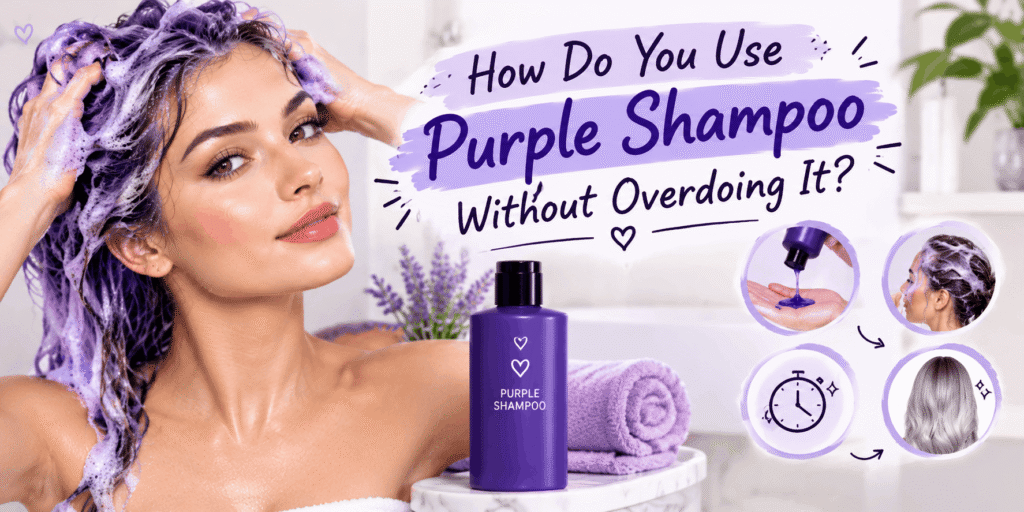
Use purple shampoo when you notice yellow, not on autopilot. Purple sits opposite yellow on the color wheel, so purple pigment cancels yellow tones. Matrix suggests keeping use to about once a week or less, and if your hair takes on a purple tint, stop and use a clarifying shampoo to remove it.
A simple routine:
- Wash with a gentle, sulfate-free shampoo most days. L’Oréal Paris Canada recommends sulfate-free formulas for silver hair.
- When yellow appears, swap in purple shampoo and leave it on for the time the label states.
- Follow with a moisturizing conditioner. L’Oréal Paris Canada also suggests a purple mask several times a month to revive color.
- If hair looks lavender or gray-purple, pause the purple product and clarify.
A note on strength: more pigment neutralizes more yellow, but also raises the risk of a purple cast on very pale hair. Start gently and adjust. [AUTHOR EXPERIENCE: describe how you adjusted frequency for your own hair or for clients, and which products you tested.]
Weekly Silver Hair Care Checklist
- Wash with a gentle, sulfate-free shampoo; avoid washing more than you need to
- Use purple shampoo or mask only if yellow is visible
- Deep condition once weekly or as your hair needs
- Air-dry when you can; use heat protection when you cannot
- Cover hair with a hat or use UV protection in strong sun
- Clarify if hair feels coated or looks dull
- Check color in daylight and book a gloss before it fades too far
- Trim split ends on a regular schedule
Two Real-World Scenarios
These are illustrative scenarios, not case studies of real people.
Scenario 1: Mostly gray hair with a yellow cast. A reader’s hair is about two-thirds gray, with brown strands mixed in, and the gray looks yellowish in sunlight. Bleach is unnecessary. The sensible plan is a clarifying wash to remove residue, a weekly violet shampoo trial, a hat in strong sun, and a salon gloss if tone is still uneven. The remaining brown strands will not turn silver, so a stylist may suggest subtle highlights to blend them. [AUTHOR EXPERIENCE: add a real example if you have one.]
Scenario 2: Medium brown hair, wants platinum-silver. The reader starts near level 5. Per the lightening principles above, brown hair shows orange as it lifts, and each stage adds stress. A colorist plans two or more sessions, tones with a blue-leaning product at the right stage, then switches to a gloss and sulfate-free routine. The reader accepts shorter hair and a monthly upkeep budget. The trade-off is explicit: high impact look, high upkeep, and some damage risk.
Common Mistakes
- Applying silver dye over yellow or orange hair. The dye mixes with the warm base and looks dull or off-tone.
- Treating silver like a one-step color. Lightening and toning are separate jobs.
- Skipping the patch test because you used the product before.
- Overusing purple shampoo, which can leave a lavender tint.
- Ignoring sun. UV fades color and weakens bleached hair.
- Chasing speed. Rushing lightening raises the damage risk.
- Buying products for the shade, not the hair. Porous, bleached hair absorbs color differently from natural gray.
Can You Go Silver Gradually?
Yes. Gradual routes are gentler and let you decide as you go. Stylists quoted by AOL suggest doing fewer and fewer color lowlights over time so gray becomes more visible, and going about half a shade lighter at each salon visit if you want to soften a hard line at the roots. Gradual blending also avoids a dramatic, high-damage bleach session.
If you are already graying, you can decide how much to enhance. Some readers add only a gloss. Others keep a few lowlights while the silver grows in.
Conclusion
Silver hair color rewards a clear plan. Start by naming your starting point: natural gray, light blonde, or darker hair. Then choose the route that matches it, accept the damage trade-off if you are lightening, and build a care routine around yellow, sun and moisture. Do a patch test every time, tone instead of guessing, and use purple shampoo only when yellow shows up.
Yes, but results depend on lifting your hair to a very pale base first. Dark hair usually needs more than one lightening session, and silver dye over a yellow or orange base looks dull or off-tone. Home attempts carry more risk of uneven color and damage, so many people book a colorist for the lightening stage.
If your hair is naturally dark or already colored, yes. Lightening to a very pale blonde is needed for a true silver. If your hair is already naturally gray or very light, you may only need toner or gloss. The paler and more even your base, the cleaner the silver looks.
Silver is a fading shade, and toner deposits wash out gradually. Exact timing depends on the product, your hair’s porosity, how often you wash and how much sun you get, so there is no single number. Expect a slow shift toward yellow or blonde and plan for periodic toning or gloss. Ask your colorist for a schedule based on your hair.

One Comment