
Some makeup days call for a full-coverage foundation, while others need only a little help controlling shine and making the complexion look more even. That is where a pressed powder can become one of the most useful products in your makeup bag. Its compact packaging, convenient application, and ability to refine the appearance of makeup make it a practical choice for everyday routines, quick touch-ups, and special occasions.
The right formula can soften the appearance of excess shine without making your skin look overly matte. It can also help foundation feel more settled, reduce the appearance of minor unevenness, and make your overall makeup look more polished. However, different formulas produce different results. Some provide barely noticeable coverage, while others offer enough pigment to even out the complexion on their own.
Choosing between them requires more than picking an attractive compact. Your skin type, undertone, preferred coverage, and the products you already use all influence the final result. A formula that looks smooth on one person may emphasize dry patches on another, so understanding the details before buying can save you time and money.
This guide explains how to compare powder formulas, choose a suitable shade, and apply your product without creating a thick or cakey finish. It also explores the differences between pressed and loose formulas, helping you decide which option makes the most sense for your makeup habits.
Finding the Right Powder for Your Everyday Routine
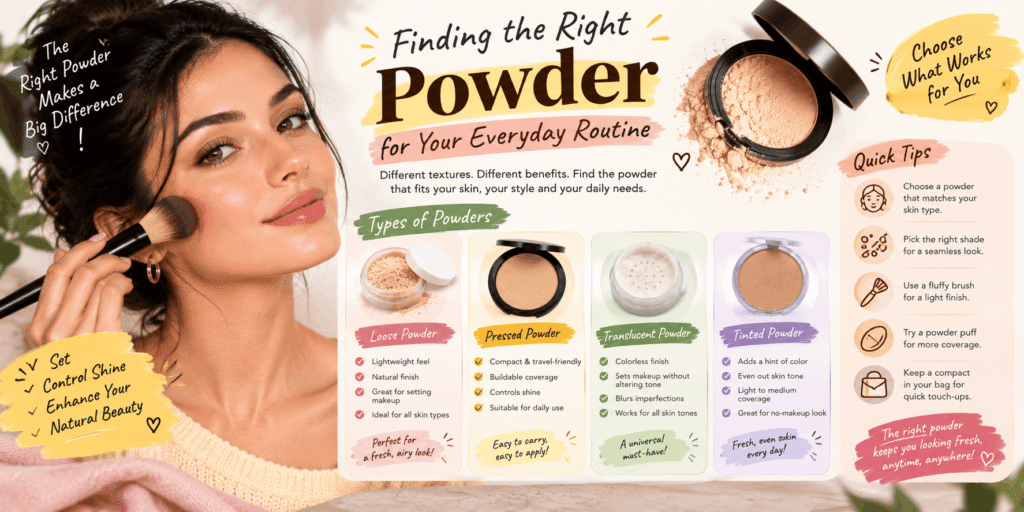
Not everyone needs the same result from complexion makeup. Some people want to reduce forehead shine before leaving the house, while others need light coverage that makes their skin look more even without wearing foundation. Identifying your main goal is the easiest way to narrow down your choices.
If you wear foundation every day, look for a formula that sits comfortably over your usual base. A lightweight option may be enough to reduce unwanted shine, while a more pigmented compact can help even out areas where your foundation looks slightly uneven. The important thing is to avoid adding unnecessary coverage simply because a product offers it.
For minimal makeup routines, a tinted formula can be especially convenient. Applied with a soft brush, it may provide a subtle improvement in the appearance of redness or discoloration. A sponge can deposit more pigment, making it useful when you want greater coverage in particular areas.
People who frequently travel or carry makeup throughout the day may appreciate the portability of a pressed powder. The compact format usually makes it easier to apply makeup without dealing with loose particles or carrying a separate container of powder. A mirror and built-in applicator, when included, can make touch-ups even more convenient.
Consider how often you will use the product, too. A compact that works well for quick daytime corrections may be more valuable to you than a highly pigmented formula designed for elaborate makeup looks. The best purchase is one that solves a real problem in your routine.
What Makes Pressed Formulas Different?
Pressed powder are made by compressing powder ingredients into a solid cake inside a compact. Depending on the product, the formula may include pigments, absorbent ingredients, binders, and components that affect how smoothly the powder spreads across the skin.
This compressed format offers several practical advantages. It is easy to store, simple to carry, and generally less messy to use than loose powder. You can pick up a small amount with a brush or applicator, apply it where needed, and close the compact without worrying about loose powder spilling inside your bag.
The finish depends on the formulation rather than the packaging alone. Some products are designed to absorb excess oil and leave a matte appearance. Others contain light-reflecting ingredients or have a more natural finish that allows some of the skin’s natural luminosity to remain visible.
Coverage also varies. Translucent formulas are intended to add little visible color, although they can still affect the appearance of the skin. Tinted products contain pigments that may help even out the complexion, while fuller-coverage options can function as a light foundation alternative for some people.
A compact format does not automatically mean a product is heavier, more durable, or better for a particular skin type. Those characteristics depend on its ingredients, pigment concentration, and performance on the skin.
Understanding Coverage, Finish, and Texture
These three characteristics often determine whether a product becomes an everyday favorite or sits unused in a drawer.
Coverage That Matches Your Needs
Sheer coverage is useful when your foundation already provides the appearance you want and you simply need to finish your makeup. It adds little extra color, making it a practical choice for people who prefer a natural look.
Medium coverage can help create a more even appearance without necessarily requiring another layer of foundation. It may be useful for quick makeup routines, although the result depends on the product and how much you apply.
Higher coverage is better suited to people who want more visible correction. However, using a dense applicator and repeatedly layering pigment can make the finish look heavier. Build the coverage gradually and concentrate it on areas that need it rather than covering the entire face unnecessarily.
Matte, Natural, or Radiant?
A matte finish can be helpful when you prefer less visible shine, particularly around the forehead, nose, and chin. It is also a popular choice for people who want their foundation to look more settled.
A natural finish offers a middle ground. It can reduce excessive shine while preserving some dimension in the complexion. This may be particularly appealing for everyday makeup, where a completely flat finish is not always the desired result.
Radiant formulas are designed to maintain or introduce a subtle glow. They may work well on the cheeks, especially when paired with a natural blush. However, if your primary concern is controlling oil, check whether the product offers the level of shine reduction you need.
Why Texture Matters More Than Packaging
A finely milled texture can help powder spread evenly, while a formula that feels coarse or difficult to distribute may require more effort to blend. The way a product sits on your skin is more important than whether its compact looks luxurious.
If you have noticeable dry patches, apply a small amount and observe whether the formula settles into them. For oily areas, check how well it controls shine without creating a visibly thick layer. Testing the product in your usual makeup routine is often more informative than judging it from a quick swatch.
Choosing a Shade That Blends Seamlessly
Shade selection becomes especially important when a product contains enough pigment to alter your complexion’s color. Even a formula with excellent texture can look unnatural if it is too light, too dark, or noticeably different from the skin underneath.
For sheer or translucent formulas, consider how the product appears after blending rather than relying entirely on the shade name. Some products marketed as translucent can still leave a visible cast, depending on their ingredients and how much is applied.
If you want additional coverage, choose a shade that works with your foundation and natural skin tone. Applying a noticeably lighter powder across the whole face can make the complexion appear flat or create a contrast with the neck. A darker shade may add warmth, but it can also make the face look uneven if the difference is too pronounced.
Undertones matter as well. Some complexions lean golden, peachy, or olive, while others have cooler or more neutral undertones. A close match can help the product blend into the skin instead of creating a separate layer of color.
Whenever possible, test a small amount in natural daylight. Blend it over the area where you intend to use it and give yourself a moment to assess the result. Look at the finish from different angles, especially if the formula contains ingredients that reflect light.
Pressed Powder or Loose Powder: Which Should You Choose?
Both formats can help finish makeup, but they serve slightly different practical preferences. Neither is automatically superior, and the better option depends on how you apply makeup and where you use it.
A pressed powder is convenient for everyday use because it stays contained in its compact. It is easy to carry, works well for small corrections, and allows you to apply product without preparing a separate container. This can make it especially useful for commuting, travel, and keeping makeup fresh throughout a busy day.
Loose powder consists of fine particles stored in a container rather than compressed into a solid cake. Depending on its formulation, it can be useful for applying a light, even layer across larger areas or setting makeup with a fluffy brush. However, it can be messier to transport and use, particularly when you are away from home.
Your preferred application technique also matters. A compact applicator can place more product in a concentrated area, while a large fluffy brush can distribute a softer layer. Loose powder can also be applied with different tools, so there is no single application method that defines either format.
For someone who prioritizes convenience, portability, and easy touch-ups, a compact may be the more practical choice. For someone who prefers applying a fine layer at home and rarely needs to carry makeup around, loose powder may work just as well.
Ultimately, consider the result you want rather than assuming one format will always perform better. Both can create a polished finish when the formula, shade, and application method suit your needs.
How to Choose a Formula for Your Skin Type
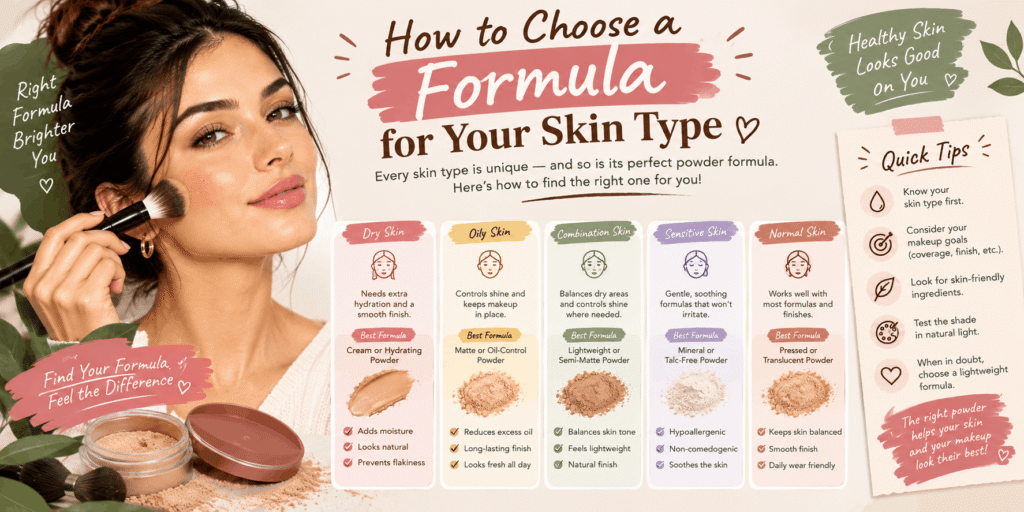
Your skin’s behavior throughout the day can help you determine which powder formula is likely to work best. Instead of relying entirely on labels such as oil-control or hydrating, think about the areas where your makeup usually changes. Does your forehead become shiny after a few hours? Do your cheeks feel tight after applying foundation? These details can guide you toward a more suitable option.
For Oily Skin
If your complexion tends to become shiny, look for a formula designed to reduce excess oil and help makeup maintain a balanced appearance. A matte finish may be particularly useful around the forehead, nose, and chin, where shine often becomes noticeable first.
Apply a thin layer to these areas instead of automatically covering your entire face. Concentrating the product where it is needed can help maintain a more natural appearance on the cheeks. If you apply foundation, allow it to settle before adding powder so that the layers do not become patchy.
A pressed powder can also be useful for midday touch-ups. Before reapplying, gently blot away excess oil with a clean tissue or blotting paper. Applying more product directly over accumulated oil may create a heavier finish rather than improving your makeup.
For Dry Skin
Dry skin generally benefits from a lighter application and a formula that does not emphasize rough patches. Even products marketed as finely milled can appear noticeable when the skin underneath is dehydrated or flaky.
Begin with skincare that leaves your complexion comfortable, then allow moisturizer and sunscreen to settle. If you wear foundation, check whether it has blended evenly before applying a small amount of powder to areas that genuinely need it.
You may find that a natural or softly radiant finish suits your routine better than an intensely matte one. However, the ingredients and application method matter more than the finish label alone. If a product repeatedly highlights dry patches, try using less or limiting it to selected areas.
For Combination Skin
Combination skin may require different levels of powder across the face. The forehead and nose might become shiny while the cheeks remain comfortable or even slightly dry.
A targeted approach usually makes more sense than applying the same amount everywhere. Use a small brush around the center of the face and leave the outer cheeks with minimal product if they do not need additional setting.
This method allows you to manage shine without sacrificing the natural appearance of the rest of your complexion. It can also help reduce product buildup, particularly when you already use foundation and concealer.
For Sensitive or Blemish-Prone Skin
If your skin reacts easily to cosmetics, review the ingredient list before purchasing a new formula. Fragrance, certain preservatives, or other ingredients may not agree with every person, although sensitivity varies considerably.
Look for products that suit your individual skin needs, and consider testing a small amount on a limited area before incorporating the formula into your full makeup routine. A non-comedogenic claim may be useful information, but it does not guarantee that a product will work for everyone.
Keep applicators clean, avoid sharing makeup, and replace products according to their packaging instructions. If a cosmetic repeatedly causes irritation, discontinue use rather than trying to cover the reaction with additional makeup.
The Correct Way to Apply Pressed Powder
Good application can make a noticeable difference in how your complexion looks. The aim is to distribute enough product to achieve your desired finish without creating an unnecessary layer over the skin.
Start by preparing your complexion as usual. Apply moisturizer and sunscreen, then allow them to settle before moving to foundation or concealer. If you prefer minimal makeup, you can apply powder directly to prepared skin, provided the formula is intended for that use.
Choose an applicator according to your goal. A fluffy brush generally provides a lighter, more diffused finish, while a sponge or compact puff can deposit more product in a smaller area. Neither tool is universally better; the important thing is to use a method that gives you control.
Pick up a small amount and tap away any obvious excess. Gently press or sweep the product over the desired area, following the instructions appropriate for your formula. Avoid repeatedly rubbing the applicator across the same spot, as this may disturb the foundation underneath.
If you need additional coverage, build it gradually. Applying several thin layers gives you a better opportunity to assess the result than depositing a large amount immediately. Pay particular attention to areas around the nose and mouth, where excess product can become more noticeable.
After application, examine your makeup in natural light. If your complexion looks overly matte, a clean brush can help remove loose excess product from the surface. If some areas still appear shiny, add a small amount only where necessary rather than repeating the entire application.
The best result should look balanced from different angles. You want your complexion to appear refined without making the makeup itself the most noticeable part of your appearance.
Common Mistakes That Can Ruin Your Finish
Even a suitable formula can look disappointing when it is applied incorrectly. Recognizing a few common problems can help you improve your routine without buying additional products.
Applying too much at once: Heavy application can make the skin look flat and emphasize texture. Begin with less than you think you need and build up only when necessary.
Ignoring your skin’s condition: Powder cannot replace skincare. If your complexion is flaky or uncomfortable, adding more product may make those areas more visible.
Using an unsuitable shade: A noticeable color mismatch can create a line between the face and neck. For tinted formulas, check the shade in natural daylight before deciding whether it works.
Layering without checking the base: If foundation has separated or moved, applying more powder may emphasize the unevenness. Smooth or correct the base first when possible.
Using a dirty applicator: Brushes and puffs collect oil, makeup residue, and debris. Clean them regularly according to their material and care instructions, and let them dry fully before reuse.
Treating every area the same: The center of the face may need more shine control than the cheeks. Adjust the amount according to where your complexion needs it.
Expecting permanent oil control: Makeup can help manage visible shine, but it cannot prevent natural oil production. Your results will depend on the formula, environment, and your skin.
Ignoring product compatibility: Certain combinations of skincare, foundation, and powder may not work smoothly together. If your makeup repeatedly pills or becomes patchy, try changing the order or allowing more time between layers.
Correcting these habits can improve the finish of products you already own. Sometimes the solution is not a different compact but a lighter hand and a more deliberate application technique.
How to Evaluate a Powder Before Buying It
Product descriptions can help you understand a formula, but real-world suitability depends on more than marketing claims. If you are comparing several options, use a consistent set of criteria rather than judging each one by a different standard.
First, consider the finish. Decide whether you want to reduce shine, add light coverage, or maintain a natural appearance. This helps you avoid choosing a formula that performs well in general but does not address your actual needs.
Next, examine the texture and coverage. A product that feels smooth on your hand may behave differently over foundation or on areas with visible pores. Whenever possible, test it on the face or request a sample before purchasing a full-size product.
Wear time is another useful consideration. Observe how the makeup looks after several hours in your usual environment. Does it remain comfortable? Does it become patchy? Does the shine return quickly? These observations can help you judge whether the formula fits your routine.
A pressed powder should also be evaluated for practicality. Consider whether the compact closes securely, whether the mirror and applicator are useful, and whether the product is easy to pick up without creating excessive dust or breakage.
Finally, compare the amount of product with its price. A more expensive option is not necessarily a better value if you rarely use it or struggle to achieve the finish you want. A reasonably priced formula that suits your routine may be a more worthwhile purchase.
Final Thoughts
Choosing complexion makeup becomes much easier when you understand the role each product is supposed to play. A compact formula can help reduce visible shine, add a little coverage, and make your makeup more convenient to maintain throughout the day. However, its performance depends on its formulation, shade, and compatibility with your existing routine.
When shopping for a pressed powder, pay attention to texture, coverage, finish, and how the product behaves on your particular skin type. A lightweight formula may be sufficient for everyday makeup, while a more pigmented option may appeal to someone who wants additional coverage without using another complexion product.
Application matters just as much as selection. Prepare your skin properly, choose an appropriate applicator, and build the product gradually. You do not need to cover every part of your face or repeatedly add more makeup to achieve a polished appearance.
Most importantly, choose a formula that makes your routine easier rather than more complicated. The right product should complement your preferred makeup style, feel comfortable on your skin, and deliver a finish you genuinely enjoy. With a little experimentation, you can find an option that fits your needs without relying on unnecessary layers or unrealistic promises.
Yes. You can apply a pressed powder directly to prepared skin if you want to reduce shine or create a slightly more refined appearance without wearing foundation. A tinted formula may provide some visible coverage, while a translucent option is generally intended to add little color.
It can be a practical part of an everyday routine when the formula suits your skin and you use it as directed. Some people apply it after foundation, while others use a small amount on bare skin.
There is no requirement to apply powder daily. If your complexion already looks and feels comfortable without it, you can skip it whenever you prefer.
It can if too much is applied, especially over several layers of foundation and concealer. Dry patches, incompatible products, and repeated touch-ups may also contribute to an uneven appearance.
To minimize this problem, apply thin layers, concentrate on areas that need setting, and remove excess oil before adding more product. A lighter application often produces a more natural result.



One Comment