
Curly hair can look completely different from one person to another, which is why understanding your natural curl pattern can make your routine much easier. 3A hair is known for its loose, springy curls that often form a clear S-shaped pattern without looking as tightly coiled as some other curl types.
The right routine is less about using a huge collection of products and more about learning what your curls actually need. Moisture, gentle handling, suitable styling products, and a little patience can make a noticeable difference in how your curls behave from wash day through the rest of the week.
What Is 3A Hair and How Can You Recognize It?
The curl-type system commonly used in hair care places 3A at the beginning of the curly-hair category. It generally describes hair with loose, defined curls that have more shape than waves but are not as tightly formed as 3B or 3C patterns.
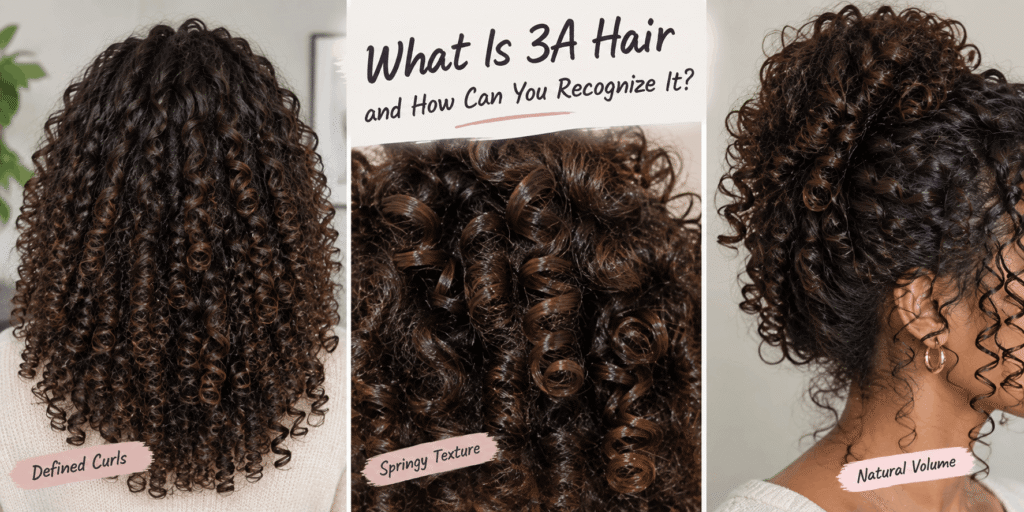
A single head of hair can also contain more than one pattern. Some sections may look closer to waves, while others may form more defined curls. That is completely normal and means you do not have to force every strand into exactly the same shape.
The 3A Curl Pattern Explained
A typical 3A hair curl has a visible loop or S-shaped formation. The curls are often relatively large and can have a naturally bouncy appearance.
When the hair is wet, the curl pattern may appear more elongated. As it dries, the curls can become more noticeable and spring back toward the head.
One of the defining characteristics of this pattern is that the curls can have plenty of movement. However, that movement can also mean the hair becomes fluffy or loses definition when it is handled too much.
The goal of a good routine is therefore not to make every curl perfectly identical. Instead, it is to support the natural pattern while keeping the hair comfortable, manageable, and conditioned.
What 3A Curls Typically Look Like
3A hair curls are generally loose rather than tightly coiled. They can range from soft, open curls to more defined ringlets depending on the person’s hair density, strand thickness, moisture level, and styling routine.
Freshly washed hair may form clearer curls, while humidity or excessive brushing can make the pattern appear much less defined.
Hair length also changes how the curls look. Longer hair can pull the curls downward, making them appear looser, while shorter hair may allow the curl pattern to spring upward more noticeably.
It is also possible for 3A hair to have different textures throughout the same head. The hair around the crown, sides, and underneath may respond differently to products or styling.
How 3A Hair Differs From Other Curl Types
The main difference between 3A hair and nearby curl patterns is the size and tightness of the curl. Type 2 hair is generally wavy, while type 3 hair is curly. Within type 3, 3A is usually the loosest curl category, followed by tighter 3B and 3C patterns.
This classification can be useful as a starting point, but it should not become a strict rule for your routine. Two people with a similar curl pattern may still need completely different products depending on their hair’s thickness, porosity, density, and condition.
That is why choosing products solely because they are marketed for a particular curl type does not always guarantee good results.
The Biggest Challenges of Caring for 3A Hair
One of the biggest challenges with curly hair is finding the right balance. Too little moisture can leave curls feeling dry and looking frizzy, while overly heavy products can make loose curls look weighed down.
3A hair often benefits from products that provide enough moisture and hold without creating a thick coating on the strands.
Frizz and Humidity
Frizz is a common concern for curly hair, especially when humidity affects the hair’s surface. Curly strands do not always lie as uniformly as straight hair, so changes in moisture in the environment can alter how the curls look.
Instead of trying to eliminate every strand of frizz, focus on creating a routine that keeps the curls conditioned and reduces unnecessary manipulation.
Applying styling products while the hair is still damp can help distribute the product more evenly. Allowing the curls to dry without repeatedly touching them can also help preserve their shape.
Dryness Without Losing Curl Definition
Curly hair can sometimes feel dry because the natural oils produced near the scalp do not travel along the bends of the hair as easily as they can along straighter strands.
However, adding more and more heavy products is not always the solution. If the curls begin looking flat, greasy, or coated, the routine may simply be using products that are too rich for the hair.
A lightweight leave-in conditioner or curl product can sometimes provide enough softness without overwhelming the curl pattern.
Detangling Without Disrupting the Curl Pattern
Brushing dry curls aggressively can separate curl groups and create a fluffy appearance. It can also make detangling more difficult if the hair is already dry and tangled.
A gentler approach is to detangle when the hair is damp and has enough slip from conditioner or a suitable detangling product.
Work through the hair gradually rather than pulling a brush from the roots to the ends in one motion. Starting closer to the ends and gradually working upward can make the process more manageable.
How to Build a Simple 3A Hair Care Routine
A good routine does not need to contain ten different steps. The basics are cleansing the scalp, conditioning the lengths, detangling carefully, adding suitable styling products when desired, and protecting the curls between wash days.
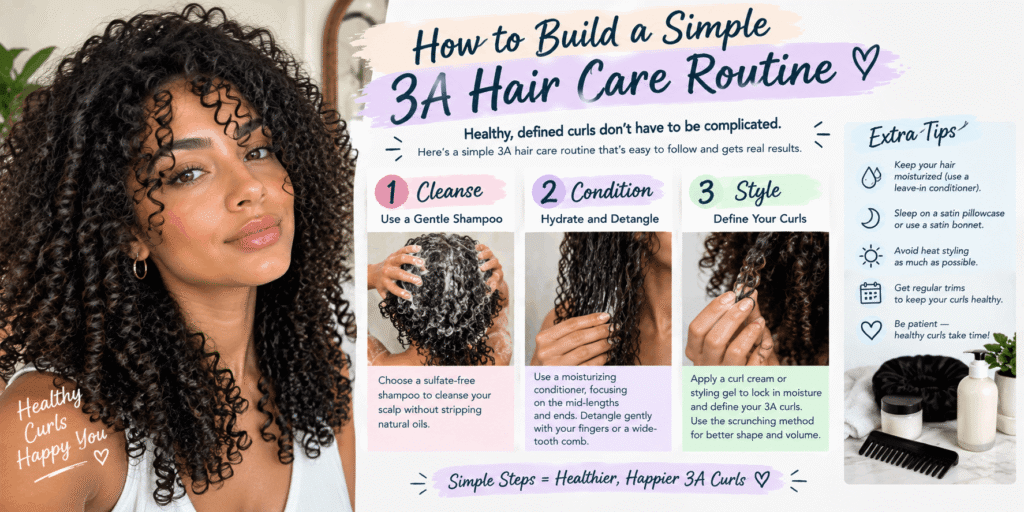
The exact frequency of washing depends on your scalp, lifestyle, product use, and personal preference. There is no universal schedule that every person with curly hair needs to follow.
Choose Products That Support Your Curl Pattern
Look for products based on what your hair actually needs rather than choosing something simply because the label says it is for curly hair.
If your curls become flat easily, lighter products may work better. If the hair feels rough or dry, you may benefit from a more conditioning formula.
A useful routine often includes a cleanser, conditioner, and one or two styling products. Adding more products does not automatically produce better curls.
Detangle Gently and Strategically
Detangling is easier when the hair has enough moisture and slip. Conditioner can help strands move against one another with less friction.
Use your fingers or a suitable wide-tooth comb or detangling brush, depending on what works best for your hair.
Be particularly gentle around areas that tangle easily, such as the nape and ends. Rushing through knots can lead to unnecessary pulling and breakage.
Keep Your Hair Properly Conditioned
Conditioning helps curly hair feel softer and easier to manage. Apply conditioner mainly through the lengths and ends, adjusting the amount according to your hair’s needs.
If your hair tends to become weighed down quickly, avoid automatically using very heavy formulas every time. If it feels dry between washes, a richer conditioning treatment occasionally may be useful.
The goal is balance rather than maximum moisture.
Trim When Your Ends Need Attention
Trimming does not change your natural curl pattern, but removing damaged or excessively split ends can make the hair easier to manage.
How often you need a trim depends on your hair condition, styling habits, length goals, and whether you frequently use heat or chemical treatments.
Instead of following an arbitrary calendar, pay attention to persistent tangling, rough ends, or visible splitting.
Balance Moisture With Lightweight Styling
Styling products can help curls hold their shape after washing. For looser curls, however, extremely heavy creams and oils may sometimes reduce volume.
A lightweight mousse, gel, or curl-defining product may provide definition while allowing the hair to remain bouncy.
Apply products evenly through damp hair and experiment with small amounts first. It is much easier to add more product than to remove too much after it has been applied.
How to Style 3A Hair Without Losing Definition
Styling 3A hair works best when you treat the curls as a pattern rather than trying to manipulate every strand individually.
After washing and conditioning, gently remove excess water and apply your preferred styling product. Scrunching the hair upward can encourage the curls to form without requiring excessive brushing.
Let the hair dry naturally or use a diffuser if that fits your routine. The less you disturb the curls while they are drying, the more likely they are to maintain their original grouping.
Defined Wash-and-Go Curls
A wash-and-go is one of the simplest ways to show off naturally curly hair. After cleansing and conditioning, apply a suitable curl product while the hair is damp.
Use your fingers or hands to distribute the product and gently scrunch the curls. Once the product is applied, leave the hair alone while it dries.
If the finished curls feel slightly firm because of a styling product, gently scrunching once the hair is completely dry can soften the feel.
Low Puff
A low puff can be a simple option when you want your curls away from your face while keeping some of their natural texture visible.
Gather the hair toward the lower back of the head without pulling it excessively tight. Use a soft hair tie or accessory that does not create uncomfortable tension.
You can leave some curls loose around the face if you prefer a softer finish.
Faux Hawk
A faux hawk-inspired style can create a more structured look without requiring a major haircut. The sides are gathered upward or toward the center while the curls remain concentrated through the middle.
This style can be adapted to different lengths. Use gentle securing methods and avoid pulling the hair too tightly.
Soft Updo and Space Buns
Space buns can work particularly well when you want a playful hairstyle that keeps curls controlled.
Divide the hair into two sections and gather each side into a bun. The finish can be sleek or intentionally loose depending on how much of the natural texture you want to show.
For a softer appearance, allow a few curls to remain around the front rather than trying to make every strand perfectly smooth.
The Plopping Method
Plopping is a technique that uses a soft T-shirt or similar fabric to help hold damp curls closer to their natural shape while excess water is absorbed.
After applying your styling products, gently place the curls into the fabric rather than rubbing the hair with a traditional towel.
The method does not work identically for everyone, but some people find that it helps reduce unnecessary manipulation.
If your curls become flat easily, lighter products may work better. If the hair feels rough or dry, you may benefit from a more conditioning formula.
A useful routine often includes a cleanser, conditioner, and one or two styling products. Adding more products does not automatically produce better curls.
Detangle Gently and Strategically
Detangling is easier when the hair has enough moisture and slip. Conditioner can help strands move against one another with less friction.
Use your fingers or a suitable wide-tooth comb or detangling brush, depending on what works best for your hair.
Be particularly gentle around areas that tangle easily, such as the nape and ends. Rushing through knots can lead to unnecessary pulling and breakage.
Keep Your Hair Properly Conditioned
Conditioning helps curly hair feel softer and easier to manage. Apply conditioner mainly through the lengths and ends, adjusting the amount according to your hair’s needs.
If your hair tends to become weighed down quickly, avoid automatically using very heavy formulas every time. If it feels dry between washes, a richer conditioning treatment occasionally may be useful.
The goal is balance rather than maximum moisture.
Trim When Your Ends Need Attention
Trimming does not change your natural curl pattern, but removing damaged or excessively split ends can make the hair easier to manage.
How often you need a trim depends on your hair condition, styling habits, length goals, and whether you frequently use heat or chemical treatments.
Instead of following an arbitrary calendar, pay attention to persistent tangling, rough ends, or visible splitting.
Balance Moisture With Lightweight Styling
Styling products can help curls hold their shape after washing. For looser curls, however, extremely heavy creams and oils may sometimes reduce volume.
A lightweight mousse, gel, or curl-defining product may provide definition while allowing the hair to remain bouncy.
Apply products evenly through damp hair and experiment with small amounts first. It is much easier to add more product than to remove too much after it has been applied.
How to Style 3A Hair Without Losing Definition
Styling 3A hair works best when you treat the curls as a pattern rather than trying to manipulate every strand individually.
After washing and conditioning, gently remove excess water and apply your preferred styling product. Scrunching the hair upward can encourage the curls to form without requiring excessive brushing.
Let the hair dry naturally or use a diffuser if that fits your routine. The less you disturb the curls while they are drying, the more likely they are to maintain their original grouping.
Defined Wash-and-Go Curls
A wash-and-go is one of the simplest ways to show off naturally curly hair. After cleansing and conditioning, apply a suitable curl product while the hair is damp.
Use your fingers or hands to distribute the product and gently scrunch the curls. Once the product is applied, leave the hair alone while it dries.
If the finished curls feel slightly firm because of a styling product, gently scrunching once the hair is completely dry can soften the feel.
Low Puff
A low puff can be a simple option when you want your curls away from your face while keeping some of their natural texture visible.
Gather the hair toward the lower back of the head without pulling it excessively tight. Use a soft hair tie or accessory that does not create uncomfortable tension.
You can leave some curls loose around the face if you prefer a softer finish.
Faux Hawk
A faux hawk-inspired style can create a more structured look without requiring a major haircut. The sides are gathered upward or toward the center while the curls remain concentrated through the middle.
This style can be adapted to different lengths. Use gentle securing methods and avoid pulling the hair too tightly.
Soft Updo and Space Buns
Space buns can work particularly well when you want a playful hairstyle that keeps curls controlled.
Divide the hair into two sections and gather each side into a bun. The finish can be sleek or intentionally loose depending on how much of the natural texture you want to show.
For a softer appearance, allow a few curls to remain around the front rather than trying to make every strand perfectly smooth.
The Plopping Method
Plopping is a technique that uses a soft T-shirt or similar fabric to help hold damp curls closer to their natural shape while excess water is absorbed.
After applying your styling products, gently place the curls into the fabric rather than rubbing the hair with a traditional towel.
The method does not work identically for everyone, but some people find that it helps reduce unnecessary manipulation
3A Hair Dos and Don’ts to Keep Curls Looking Better
Taking care of curly hair becomes much easier when you know which habits support your natural pattern and which ones can make styling more difficult. You do not need a complicated curl routine to get consistent results. Small changes in how you wash, detangle, dry, and style your hair can make your routine more manageable.
What You Should Do
Do apply conditioner regularly, especially if your hair tends to feel dry or becomes difficult to detangle. Well-conditioned strands are generally easier to work with and may respond better to styling.
Do handle your curls gently when they are wet. Wet hair can be more vulnerable to stretching and breakage, so avoid aggressive brushing or pulling through knots.
Do experiment with the amount of styling product you use. Start with a small amount and add more only if necessary. This is particularly useful when your curls become weighed down easily.
Do give your curls enough time to dry before repeatedly touching or rearranging them. Constant manipulation can separate curl groups and create more frizz.
Do pay attention to how your hair responds. If a product makes your curls feel heavy, sticky, or unusually dry, there is no reason to keep using it simply because it is marketed for curly hair.
What You Should Avoid
Avoid aggressively brushing dry curls if you are trying to maintain their natural definition. Dry brushing can separate the curl pattern and make the hair appear much fuller or less defined.
Avoid using excessive heat without considering the condition of your hair. Frequent high-heat styling can make hair feel dry and may contribute to damage over time.
Avoid piling several heavy products onto your hair at once. If you cannot tell which product is helping or causing buildup, simplify your routine and introduce products one at a time.
Avoid pulling your hair tightly into styles that feel uncomfortable. A hairstyle should not require constant tension to stay in place.
Most importantly, avoid assuming that every curly-hair routine you see online will work exactly the same way for you. Hair thickness, density, porosity, length, and previous treatments can all affect the result.
Products That Can Work Well for 3A Hair
There is no single product that every person with 3A curls needs. Instead, think about products according to their purpose. A cleanser removes buildup, a conditioner provides softness, and styling products help shape or hold the curls.
If your hair is easily weighed down, lightweight formulas may be a better starting point. If it frequently feels dry, you may prefer products with more conditioning properties.
Deep Conditioners for Extra Moisture
A deep conditioner can be useful when your regular conditioner does not seem to provide enough softness. It is typically used periodically rather than necessarily after every wash.
Apply it according to the product directions and focus on the lengths and ends if those areas tend to feel drier than the roots.
The right deep conditioner should leave the hair easier to manage rather than coated or excessively heavy.
Curl Refreshing Sprays
Refreshing sprays can be useful between wash days when curls have lost some of their shape.
Instead of completely redoing your hairstyle, lightly dampen the areas that need refreshing and apply a small amount of product if necessary. Gently scrunching the curls can help encourage them to regroup.
If the hair already has plenty of product buildup, adding another layer may not be the best solution. In that case, a regular wash may work better.
Lightweight Curl Mousses
Mousse can be a useful option for people who want some definition and hold without a very heavy finish.
Apply a moderate amount through damp hair and distribute it evenly. Scrunching can help encourage the curls to form as the product dries.
Different mousses have different levels of hold, so finding the right one may require some experimentation.
Clarifying Shampoos
A clarifying shampoo is designed to provide a deeper cleanse than many everyday shampoos. It may be useful when styling products, oils, or other residue have accumulated.
However, stronger cleansing does not automatically mean better cleansing. Using a clarifying shampoo too frequently may leave some hair feeling dry.
How often it belongs in your routine depends on your scalp, products, washing habits, and how your hair responds.
Leave-In Conditioners
A lightweight leave-in conditioner can make detangling easier and provide additional conditioning after washing.
For looser curls, start with a small amount. Too much leave-in can sometimes make the hair feel coated or reduce its natural movement.
Distribute it through damp hair, paying attention to areas that tend to become dry or tangled.
How to Keep 3A Hair Healthy Between Wash Days
The period between wash days can have a big effect on how your curls look and feel. You do not necessarily need to completely restyle your hair every morning.
A simple refresh can often involve lightly dampening the curls, reshaping a few sections, and allowing them to dry without excessive handling.
Refreshing Curls Without Starting Over
If your curls look slightly flattened after sleeping, use a small amount of water to reactivate them. You can then gently scrunch sections that have lost their shape.
For areas that need additional hold, use a small amount of your regular styling product rather than applying a full new layer everywhere.
This approach can save both time and product while allowing you to preserve the curl pattern you created on wash day.
Protecting Curls While Sleeping
Sleeping can flatten or disturb curls, particularly when the hair moves against a rough pillowcase throughout the night.
Some people find that a satin or silk-style pillowcase helps reduce friction. A loose protective style can also help keep the curls from becoming excessively tangled.
The key is to avoid creating unnecessary tension. A nighttime style should feel comfortable and should not pull firmly against the scalp.
Knowing When Your Routine Needs a Change
Your hair can respond differently over time. Changes in weather, hair length, styling habits, product use, or chemical treatments may all affect how your curls behave.
If your hair suddenly feels unusually dry, heavy, tangled, or difficult to style, look at your entire routine instead of immediately buying another product.
Sometimes the simplest solution is using less product, changing how you cleanse, improving detangling, or giving your hair more conditioning.
A useful routine should make your hair easier to manage rather than turning
3A Hair Dos and Don’ts to Keep Curls Looking Better
Taking care of curly hair becomes much easier when you know which habits support your natural pattern and which ones can make styling more difficult. You do not need a complicated curl routine to get consistent results. Small changes in how you wash, detangle, dry, and style your hair can make your routine more manageable.
What You Should Do
Do apply conditioner regularly, especially if your hair tends to feel dry or becomes difficult to detangle. Well-conditioned strands are generally easier to work with and may respond better to styling.
Do handle your curls gently when they are wet. Wet hair can be more vulnerable to stretching and breakage, so avoid aggressive brushing or pulling through knots.
Do experiment with the amount of styling product you use. Start with a small amount and add more only if necessary. This is particularly useful when your curls become weighed down easily.
Do give your curls enough time to dry before repeatedly touching or rearranging them. Constant manipulation can separate curl groups and create more frizz.
Do pay attention to how your hair responds. If a product makes your curls feel heavy, sticky, or unusually dry, there is no reason to keep using it simply because it is marketed for curly hair.
What You Should Avoid
Avoid aggressively brushing dry curls if you are trying to maintain their natural definition. Dry brushing can separate the curl pattern and make the hair appear much fuller or less defined.
Avoid using excessive heat without considering the condition of your hair. Frequent high-heat styling can make hair feel dry and may contribute to damage over time.
Avoid piling several heavy products onto your hair at once. If you cannot tell which product is helping or causing buildup, simplify your routine and introduce products one at a time.
Avoid pulling your hair tightly into styles that feel uncomfortable. A hairstyle should not require constant tension to stay in place.
Most importantly, avoid assuming that every curly-hair routine you see online will work exactly the same way for you. Hair thickness, density, porosity, length, and previous treatments can all affect the result.
Products That Can Work Well for 3A Hair
There is no single product that every person with 3A curls needs. Instead, think about products according to their purpose. A cleanser removes buildup, a conditioner provides softness, and styling products help shape or hold the curls.
If your hair is easily weighed down, lightweight formulas may be a better starting point. If it frequently feels dry, you may prefer products with more conditioning properties.
Deep Conditioners for Extra Moisture
A deep conditioner can be useful when your regular conditioner does not seem to provide enough softness. It is typically used periodically rather than necessarily after every wash.
Apply it according to the product directions and focus on the lengths and ends if those areas tend to feel drier than the roots.
The right deep conditioner should leave the hair easier to manage rather than coated or excessively heavy.
Curl Refreshing Sprays
Refreshing sprays can be useful between wash days when curls have lost some of their shape.
Instead of completely redoing your hairstyle, lightly dampen the areas that need refreshing and apply a small amount of product if necessary. Gently scrunching the curls can help encourage them to regroup.
If the hair already has plenty of product buildup, adding another layer may not be the best solution. In that case, a regular wash may work better.
Lightweight Curl Mousses
Mousse can be a useful option for people who want some definition and hold without a very heavy finish.
Apply a moderate amount through damp hair and distribute it evenly. Scrunching can help encourage the curls to form as the product dries.
Different mousses have different levels of hold, so finding the right one may require some experimentation.
Clarifying Shampoos
A clarifying shampoo is designed to provide a deeper cleanse than many everyday shampoos. It may be useful when styling products, oils, or other residue have accumulated.
However, stronger cleansing does not automatically mean better cleansing. Using a clarifying shampoo too frequently may leave some hair feeling dry.
How often it belongs in your routine depends on your scalp, products, washing habits, and how your hair responds.
Leave-In Conditioners
A lightweight leave-in conditioner can make detangling easier and provide additional conditioning after washing.
For looser curls, start with a small amount. Too much leave-in can sometimes make the hair feel coated or reduce its natural movement.
Distribute it through damp hair, paying attention to areas that tend to become dry or tangled.
How to Keep 3A Hair Healthy Between Wash Days
The period between wash days can have a big effect on how your curls look and feel. You do not necessarily need to completely restyle your hair every morning.
A simple refresh can often involve lightly dampening the curls, reshaping a few sections, and allowing them to dry without excessive handling.
Refreshing Curls Without Starting Over
If your curls look slightly flattened after sleeping, use a small amount of water to reactivate them. You can then gently scrunch sections that have lost their shape.
For areas that need additional hold, use a small amount of your regular styling product rather than applying a full new layer everywhere.
This approach can save both time and product while allowing you to preserve the curl pattern you created on wash day.
Protecting Curls While Sleeping
Sleeping can flatten or disturb curls, particularly when the hair moves against a rough pillowcase throughout the night.
Some people find that a satin or silk-style pillowcase helps reduce friction. A loose protective style can also help keep the curls from becoming excessively tangled.
The key is to avoid creating unnecessary tension. A nighttime style should feel comfortable and should not pull firmly against the scalp.
Knowing When Your Routine Needs a Change
Your hair can respond differently over time. Changes in weather, hair length, styling habits, product use, or chemical treatments may all affect how your curls behave.
If your hair suddenly feels unusually dry, heavy, tangled, or difficult to style, look at your entire routine instead of immediately buying another product.
Sometimes the simplest solution is using less product, changing how you cleanse, improving detangling, or giving your hair more conditioning.
A useful routine should make your hair easier to manage rather than turning wash day into a complicated project.
Final Thoughts
Understanding 3A hair is really about learning how your individual curls respond to moisture, cleansing, styling, and everyday handling. The curl-type label can give you a useful starting point, but your personal hair characteristics matter just as much.
Start with a simple routine: cleanse your scalp, condition your lengths, detangle gently, and choose a styling product that gives you the amount of definition or hold you actually want. From there, make small adjustments instead of changing everything at once.
Your curls do not need to look identical every day. Humidity, sleep, activity, and even the amount of water in your hair can change the final result. The goal is to develop a routine that keeps your hair comfortable, manageable, and easy for you to style.
With the right balance of conditioning, gentle handling, and suitable products, caring for 3A hair can become much simpler. Once you understand what your curls respond to, you can build a routine that works with your natural texture instead of constantly fighting against it.Add practical wash-day routine stepsReduce repeated general advice

3 Comments