
A slimmer-looking cheek area can completely change the way facial contours appear in a photograph, which is why buccal fat removal before and after searches continue to attract so much attention. But what exactly are you seeing when you compare these images—and how much of the change can actually be attributed to buccal fat removal?
Before-and-after photos can be useful for understanding the type of facial contour changes that may be associated with the procedure, but they should never be treated as a promise of a particular result. Every person’s facial structure, natural fat distribution, skin characteristics, age, and overall proportions are different. Even photography conditions such as lighting, camera angle, facial expression, and distance from the camera can influence how dramatic a difference appears.
Buccal fat removal is designed to reduce fullness in a specific area of the cheek by removing part of the buccal fat pad. Because this is only one component of overall facial structure, the results shown in online galleries can vary considerably. Some examples may show subtle changes, while others may appear more noticeable.
That is why looking at several examples can be more informative than focusing on one dramatic transformation. The goal is not to find a photograph that promises the look you want, but to understand how individual results can differ and what questions are worth asking when reviewing a cosmetic-surgery gallery.
Buccal Fat Removal Before and After: 7 Provider Examples
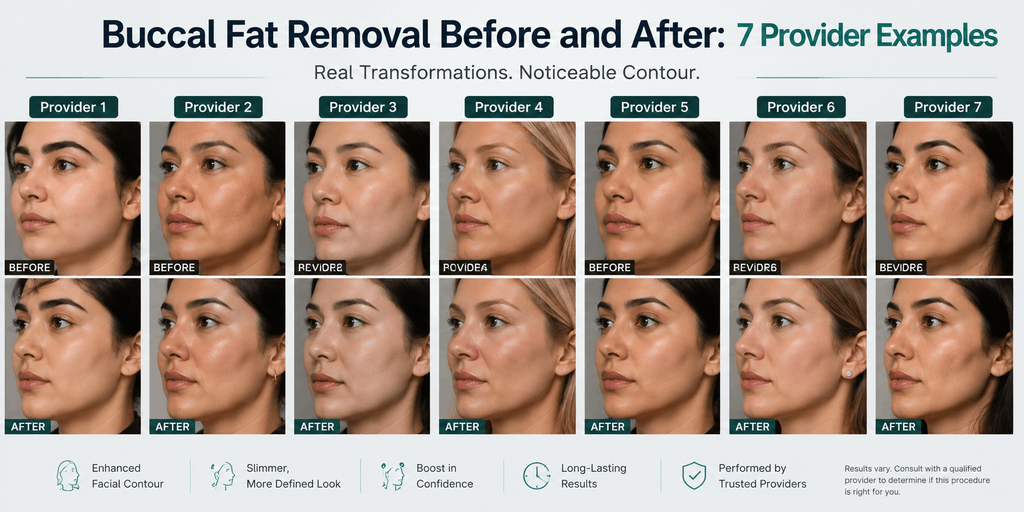
Several plastic-surgery practices publish before-and-after galleries featuring buccal fat reduction. These galleries can offer visual examples, but it is important to read the accompanying information carefully because some patients may have undergone additional facial procedures.
1. Stoker Aesthetics — Dr. David Stoker
Stoker Aesthetics has a dedicated collection of buccal fat reduction before-and-after photographs. The gallery presents multiple patient examples and, in some cases, provides several views of the face rather than relying on a single front-facing photograph.
That can be helpful because facial contour is three-dimensional. A change that looks subtle from the front may appear different from an angled view. Conversely, lighting or positioning can sometimes make a change appear stronger than it really is.
One published case from the practice features a young adult male and includes multiple facial views. The case information also identifies additional facial procedures, which is an important detail when interpreting the photographs. If more than one treatment was performed, it would be inaccurate to assume that every visible difference came from buccal fat reduction alone.
This is a useful lesson when reviewing any cosmetic before-and-after gallery: always look beyond the photograph. The procedure description, number of treatments, timing of the photographs, and whether other procedures were performed can provide important context.
2. Dr. Kimberly Lee — Beverly Hills Facial Plastic Surgery Center
Dr. Kimberly Lee’s practice also publishes a buccal fat removal before-and-after gallery with individual patient examples. Like other professional galleries, the photographs are intended to demonstrate potential aesthetic outcomes rather than establish a standard appearance.
When viewing these examples, pay attention to the cheek area and the overall balance of the face. Buccal fat removal does not simply make the entire face smaller. Its intended effect is more localized, particularly around cheek fullness and the transition toward the lower cheek.
The photos can therefore be more useful when you compare the same patient’s images rather than comparing one person’s face with another person’s face. Facial proportions differ so much between individuals that a direct comparison between unrelated patients can easily create unrealistic expectations.
3. L&P Aesthetics — Lieberman & Parikh
L&P Aesthetics is another practice associated with facial aesthetic treatments and before-and-after resources. When researching this type of gallery, it is important to determine whether a particular photograph represents buccal fat removal alone or part of a broader facial-contouring treatment.
That distinction matters because several different factors can influence facial definition. Bone structure, other facial fat compartments, muscle, skin, and natural genetics all contribute to the appearance of the cheeks and jawline.
A useful way to approach these photographs is to focus on patterns rather than searching for a perfect match. Do the cheeks appear less full? Does the overall contour look different? Is the change relatively subtle or more noticeable? Are the photographs taken from comparable angles?
These questions provide a more realistic way to interpret before-and-after images than simply deciding whether one photograph looks more attractive than another.
4. Dr. Kimberly Lee and Other Facial-Plastic-Surgery Galleries
Different practices may use slightly different photography setups, which makes comparisons across websites difficult. One provider might photograph patients under bright studio lighting, while another might use softer lighting. Some may show several angles, while others primarily use front-facing images.
This is why the strongest comparison is usually between photographs of the same patient taken under similar conditions. Even then, a photograph cannot show every factor that matters when considering an elective surgical procedure.
The purpose of a before-and-after gallery is primarily visual education. It can help someone understand the range of appearances reported by a particular practice, but it cannot establish what an individual person’s result will be.
Why Buccal Fat Removal Before and After Photos Can Look So Different
The buccal fat pad is a natural pocket of fat located within the cheek. Reducing it can change the appearance of cheek fullness, but the amount of visible change depends on the person’s existing anatomy.
Someone who naturally has more cheek fullness may show a different contour change from someone whose face is already relatively narrow. The underlying cheekbones and jaw structure also influence how any reduction in volume becomes visible.
Age can matter as well. Facial volume naturally changes over time, so a cosmetic decision involving facial fat should be considered with the long-term appearance of the face in mind. The American Society of Plastic Surgeons notes that buccal fat removal is generally not recommended for people with thin, narrow faces because reducing facial volume may contribute to a more gaunt appearance as the face ages.
This is one reason before-and-after photos should not be used as a simple checklist. A photograph can show what happened in one individual, but it cannot tell you whether the same approach would be appropriate for another person.
Photography itself can create another layer of confusion. A slightly different head position can alter the way cheek shadows appear. A smile can change cheek volume and facial contours. Different lenses can also affect proportions.
For that reason, dramatic-looking before-and-after images deserve careful interpretation rather than immediate comparison.
What You Should Notice When Looking at Before-and-After Images
Instead of asking only, “How much smaller does the face look?” consider the entire facial contour.
Look at whether the cheek area appears less full, whether the transition between the cheek and lower face looks different, and whether the overall proportions remain balanced. Also check whether the photographs appear to have been taken from similar angles.
It can also be useful to look for information about the timing of the photographs. Surgical swelling can affect early postoperative images, so a photograph taken soon after treatment may not represent the longer-term appearance.
Another important detail is whether the patient received other procedures. Facial contouring can involve multiple treatments, and combining procedures can make it difficult to isolate the visual effect of buccal fat removal.
The safest interpretation is therefore to view these galleries as examples rather than guarantees.
The Difference Between a Dramatic Change and a Realistic Result
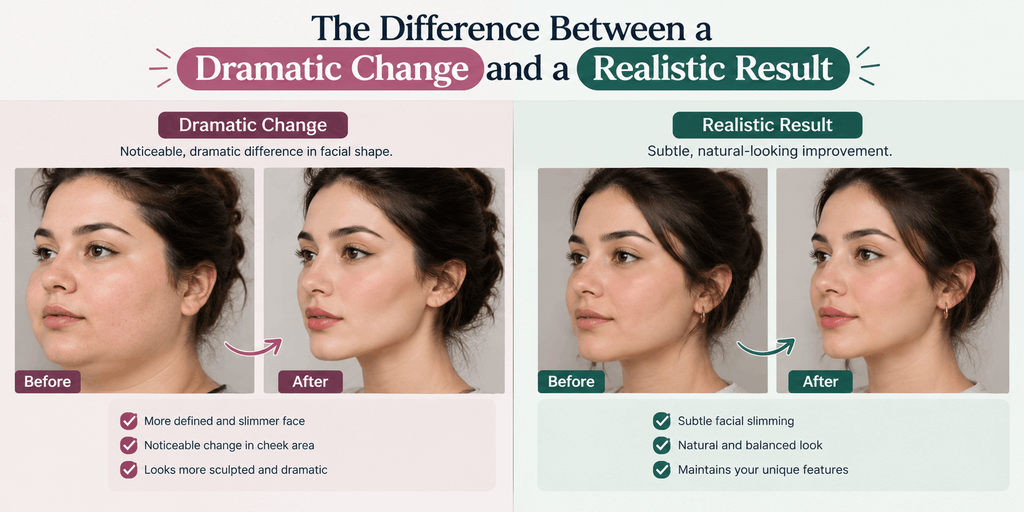
Online cosmetic galleries often highlight successful cases, which means they naturally represent a selected group of patients. This does not make the photographs useless, but it does mean they should be viewed with appropriate context.
A realistic result does not necessarily have to be dramatic. Facial aesthetics are often about proportion and balance, and a subtle change can look very different from an exaggerated transformation.
It is also worth remembering that removing facial fat is not the same thing as simply losing overall body weight. Buccal fat is a distinct anatomical structure, and its appearance is influenced by facial anatomy rather than only by general body composition.
For anyone researching the topic, this distinction can prevent a common misunderstanding: a before-and-after photograph should not be interpreted as a universal example of what happens when facial fullness changes.
Safety and Long-Term Considerations
Buccal fat removal is a surgical procedure, so photographs alone cannot communicate its potential risks. The American Society of Plastic Surgeons lists possible complications including infection, bleeding, asymmetry, changes in sensation, injury to nearby facial structures, and dissatisfaction with the aesthetic outcome.
There is also the possibility that removing facial volume can affect how the face looks as it naturally changes with age. This makes long-term considerations especially relevant when evaluating a procedure involving facial fat.
A qualified medical professional is the appropriate person to determine whether a procedure is medically and aesthetically appropriate for an individual. Online galleries can support general research, but they cannot replace an in-person medical assessment.
More Buccal Fat Removal Before and After Examples
5. Boston Center for Plastic Surgery — Boston, MA
The Boston Center for Plastic Surgery is another provider that can be included when researching published facial-plastic-surgery examples. Like other professional practices, its online resources can help readers understand the type of aesthetic changes that may be associated with facial procedures.
When reviewing a gallery from any provider, consistency is particularly important. Try to compare the same person’s photographs rather than placing several different people’s faces side by side. A person with naturally prominent cheekbones may have a completely different result from someone whose facial structure is softer or naturally fuller.
This is especially relevant for buccal fat removal because the procedure concerns a specific area of facial volume. The visible effect depends on what the person’s cheeks looked like before treatment and how the remaining facial structures interact with that change.
A photograph may therefore show a noticeable difference without that meaning the same degree of change would occur in another person. The most valuable information is often found in the details surrounding the photograph rather than in the photograph itself.
6. The Boston Center for Facial Plastics — Waleed Ezzat, MD
Another resource worth examining is the Boston Center for Facial Plastics, associated with Waleed Ezzat, MD. Facial-plastic-surgery galleries can provide useful visual context, particularly when they include multiple angles and clearly explain which procedure was performed.
Multiple angles are helpful because facial contour is not flat. The cheek can appear fuller or more sculpted depending on whether the photograph is taken straight on or from the side. This makes it important not to judge a result from a single image.
The timing of photographs is another factor worth considering. A recently treated face can look different from a face photographed after healing has progressed. Swelling can temporarily influence the appearance of facial contours, so the date or stage represented by an image matters.
When reading any provider’s gallery, look for information that distinguishes buccal fat removal from other procedures. If several treatments were performed, the overall transformation cannot automatically be credited to buccal fat removal alone.
7. Dr. Barry Weintraub — NYC Plastic Surgeon
Dr. Barry Weintraub is another provider whose facial-plastic-surgery resources may appear in searches for buccal fat removal and facial contouring. As with the other examples, the photographs can be useful for visual education, but they should be interpreted within the context supplied by the provider.
A strong before-and-after comparison should leave you with questions rather than certainty. What changed? Was the procedure performed alone? How much time passed between the photographs? Were the images taken under comparable lighting and camera conditions?
Those questions are more useful than trying to decide which patient’s face represents an ideal outcome.
Across all seven examples, one pattern becomes clear: there is no single “buccal fat removal look.” Some results may appear subtle, while others may create a more noticeable change in cheek contour. Facial anatomy determines much of that variation.
Comparing the Seven Before-and-After Resources
| Provider or Resource | What to Examine | Why It Matters |
|---|---|---|
| Stoker Aesthetics | Multiple views and procedure details | Helps show how facial contour can look from different angles |
| Dr. Kimberly Lee | Individual patient galleries | Useful for comparing the same face before and after |
| L&P Aesthetics | Facial-contouring examples | Helps demonstrate variation between facial structures |
| Other facial-plastic-surgery galleries | Procedure descriptions | Important for identifying whether additional treatments were involved |
| Boston Center for Plastic Surgery | Published patient examples | Offers another perspective on facial contour changes |
| Boston Center for Facial Plastics | Multiple facial views | Useful for understanding three-dimensional changes |
| Dr. Barry Weintraub | Facial aesthetic examples | Provides another reference point when researching published results |
This comparison should not be treated as a ranking of surgeons or as evidence that one provider produces better results than another. A gallery is a selected collection of cases, and different providers may photograph or present results differently.
The purpose of comparing several sources is simply to understand the range of published examples. Looking at more than one gallery can make it easier to recognize that facial proportions vary substantially between patients.
How to Read Buccal Fat Removal Before and After Photos
One of the easiest mistakes is to look at two photographs and immediately assume that every visible difference came from the procedure. A better approach is to examine the images systematically.
Start with the cheek area. Does the fullness appear different? Does the transition between the middle and lower face look more defined? Does the overall facial balance remain similar?
Then consider the photograph itself. Are both images taken from approximately the same angle? Is the person’s head positioned similarly? Is the expression comparable? Is the lighting similar?
Even small differences can influence how facial contours appear. A shadow across the cheek can make one side look more defined, while a different camera angle can change the apparent width of the face.
It is also important to look for other procedures. If a patient had multiple facial treatments, the final photograph represents the combined visual effect rather than an isolated buccal fat removal result.
The more carefully you examine these factors, the less likely you are to develop unrealistic expectations from a single dramatic photograph.
Why Results Can Change With Time
Facial appearance does not remain completely static after a cosmetic procedure. Healing, swelling, natural aging, changes in weight, skin characteristics, and other factors can influence how the face looks over time.
This is particularly relevant when considering a procedure that changes facial volume. The face naturally changes as a person ages, so a result that appears attractive at one point in time may not necessarily look identical years later.
The American Society of Plastic Surgeons specifically highlights long-term facial appearance as an important consideration with buccal fat removal. People with already thin or narrow faces may be at greater risk of developing an overly hollow or gaunt appearance after facial fat is removed.
That is why the goal should not simply be “less cheek fat.” Facial balance is more complicated than that. The cheekbones, jawline, skin, muscles, and different facial fat compartments all contribute to the appearance of the face.
Is Buccal Fat Removal the Same as Losing Facial Weight?
No. This is an important distinction when searching for before-and-after photographs.
Buccal fat removal targets a particular fat compartment located within the cheek. General changes in body weight can affect facial fullness differently and are not equivalent to surgically reducing the buccal fat pad.
A photograph showing a slimmer-looking face therefore does not automatically demonstrate the effect of buccal fat removal. Weight changes, aging, lighting, makeup, facial expression, and other cosmetic treatments can all affect facial appearance.
Understanding this difference makes it easier to interpret online photographs without assuming that every change in facial fullness comes from the same source.
What Makes a Before-and-After Gallery More Helpful?
A useful gallery provides enough context to understand what you are looking at. Multiple views are helpful, but so are consistent photographs, procedure descriptions, and information about when the images were taken.
Clear labeling is another positive sign. If a photograph represents more than one treatment, that information should be taken into account when interpreting the result.
It is also useful to look at several patients rather than becoming focused on one particularly dramatic case. A collection can demonstrate variation in facial anatomy and show that cosmetic outcomes are not identical.
Most importantly, before-and-after images should support realistic expectations rather than create pressure to achieve a particular appearance.
Making an Informed Decision
If someone is researching buccal fat removal seriously, online photographs should be only one small part of the research process. A qualified medical professional can evaluate facial anatomy and discuss whether a procedure is appropriate.
For teenagers in particular, cosmetic facial surgery should not be approached as a DIY beauty decision or based on comparisons with edited or carefully selected online photographs. Facial features continue to develop during adolescence, and decisions about elective surgery should involve appropriate medical guidance and a trusted parent or guardian.
For adults considering the procedure, an in-person consultation can provide information that photographs simply cannot. A professional can evaluate the person’s individual anatomy, discuss potential risks, and explain whether the expected benefits are realistic.
The goal should always be informed decision-making rather than trying to copy someone else’s before-and-after photograph.
Final Thoughts
Buccal fat removal before and after photographs can be fascinating because even a relatively localized change in cheek volume may alter the way facial contours appear. However, the most important lesson from comparing multiple galleries is that there is no universal result.
The seven provider examples offer different ways to explore published cases, but none should be treated as a promise of what another person’s face will look like. Differences in anatomy, photography, healing, age, and additional treatments can all influence the final appearance.
Instead of chasing the most dramatic transformation, use before-and-after images as a starting point for learning. Look carefully at the photographs, consider the context behind them, and remember that an informed medical evaluation is far more useful for an individual decision than comparing your face with an online example.



5 Comments