
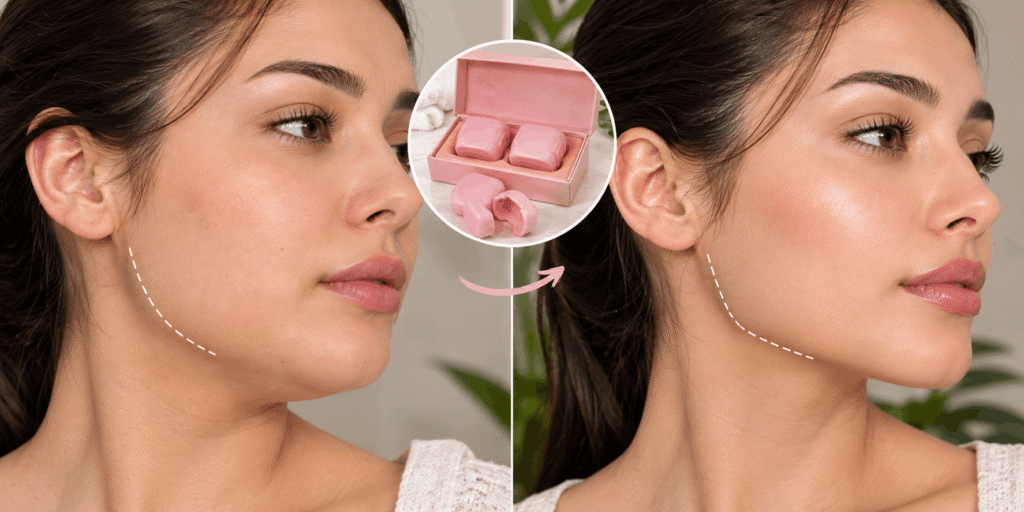
A slimmer-looking jawline can sometimes come from treating the masseter muscles rather than the skin. That is why masseter Botox before and after photos are so interesting—they can show how relaxing an overactive jaw muscle may gradually change facial contours without surgery.
Why the Masseter Changes the Appearance of the Jaw
The masseter botox is one of the major muscles involved in chewing. It sits along the sides of the jaw, and when it is particularly prominent, it can contribute to a wider or more square-looking lower face.
Masseter muscle enlargement, also called masseter hypertrophy, can have cosmetic as well as functional associations. Research describes it as a benign enlargement that can affect lower-face contour and, in some people, may occur alongside jaw discomfort or clenching-related symptoms.
This is why masseter Botox before and after comparisons can look different from typical wrinkle-treatment photographs. The change is not primarily about smoothing the skin. Instead, the appearance of the lower face may gradually change as the treated muscle becomes less prominent.
What Masseter Botox Means
Masseter Botox refers to the use of botulinum toxin type A in the masseter muscles. At a high level, botulinum toxin reduces muscle activity, which can lead to a gradual decrease in muscle bulk over time.
Studies have reported reductions in masseter thickness and improvements in lower-face contour after treatment, although the size of the change varies considerably between individuals. A 2026 systematic review and meta-analysis of five randomized controlled trials involving 536 participants found that botulinum toxin was associated with reductions in masseter thickness, improved masseter-prominence outcomes, and higher patient satisfaction compared with placebo. The authors also noted substantial variation between studies.
That variation is important when looking at before-and-after images. Two people can receive treatment and experience noticeably different changes.
Looking at Masseter Botox Before and After
Before-and-after photographs can help illustrate a potential cosmetic change, but they should not be treated as a guarantee of what another person will experience.
The starting point matters. Someone with more prominent masseter muscles may show a more obvious change in facial width than someone whose jaw shape is mainly determined by bone structure, fat distribution, or other facial features.
Photography can also affect how dramatic the result appears. Camera angle, lighting, facial expression, hairstyle, makeup, and even how tightly someone clenches their jaw can alter the appearance of the lower face.
What You May Notice in Photos
When a person responds to treatment, the lower face may gradually appear less broad around the jaw. The change is generally associated with reduced muscle prominence rather than a direct alteration of the underlying jawbone.
Research has found measurable reductions in masseter thickness during follow-up, with some studies observing the strongest visible changes around the three-month point.
Why Results Take Time
Masseter Botox is not typically an instant contouring change. Muscle activity decreases first, while visible changes in muscle bulk develop progressively.
A review of the evidence found that the maximum effect after a treatment session is often observed at around three months, while reported duration can extend several months or longer. The authors also emphasized that outcomes vary and that treatment approaches are not standardized.
Who May Be Evaluated for This Treatment?
Masseter Botox is generally discussed in the context of people whose facial width is substantially influenced by prominent masseter muscles.
A professional assessment is important because not every broad or square-looking jaw is caused by muscle enlargement. Bone structure, facial anatomy, soft tissue, and other factors can all contribute to facial shape.
Research into individualized treatment has used clinical examination and imaging to assess masseter size and prominence rather than relying on appearance alone.
For someone considering any cosmetic injectable, an appropriately qualified healthcare professional should determine whether it is medically and anatomically appropriate.
What the Research Says About Results
Older research and more recent reviews generally point toward a reduction in masseter muscle bulk after botulinum toxin treatment, but the evidence is not perfectly uniform.
A 2022 systematic review summarized 28 studies involving 748 patients treated for masseter hypertrophy. The authors found reductions in masseter thickness at three months but also noted significant variation and a high risk of bias across the available studies.
More recent evidence is encouraging but still emphasizes variability. The 2026 meta-analysis concluded that botulinum toxin appears to provide short-term improvements in masseter prominence, muscle thickness, and patient-reported outcomes, while also noting that further standardized studies with longer follow-up are needed.
This is why dramatic social-media transformations should be viewed carefully. A carefully selected clinical photograph may show a genuine change, but it does not establish what everyone will experience.
Cosmetic Goals vs. Jaw Symptoms

Masseter treatment can be discussed for cosmetic contouring as well as certain jaw-related concerns, but these are not the same thing.
Masseter hypertrophy has been associated in the literature with symptoms such as pain, fatigue, clenching, and discomfort during chewing in some patients.
However, jaw pain can have many causes. Temporomandibular disorders, dental problems, muscle tension, and other conditions require appropriate evaluation rather than assuming that cosmetic treatment is the answer.
When Jaw Pain Needs Proper Evaluation
Persistent jaw pain, difficulty opening the mouth, locking, swelling, significant headaches, or changes in chewing should be discussed with an appropriate healthcare professional.
Cosmetic terminology such as “jaw slimming” should not replace an evaluation of a genuine health concern.
What Can Affect the Before-and-After Difference?
Several factors can influence how noticeable the result appears. The size and prominence of the masseter muscles at baseline are important, as is individual anatomy.
Age, facial structure, muscle activity, treatment history, and the way photographs are taken can all affect comparisons.
The evidence also shows considerable variation between studies, meaning there is no single predictable before-and-after result that applies to everybody.
Understanding Expectations
One of the most useful things to remember about masseter Botox before and after images is that they show an outcome, not the entire treatment experience.
A photograph does not show how the person felt during or after treatment, whether they experienced side effects, how long the result lasted, or whether additional medical follow-up was needed.
For that reason, before-and-after images can be useful for understanding the general concept, but they should be considered alongside professional medical advice and reliable evidence.
How Long Do the Visible Changes Last?
The visible changes associated with masseter Botox before and after images are temporary. The effect gradually wears off as the treated muscle’s activity returns, although the exact timeline differs from person to person.
A 2026 phase 3 randomized trial found that improvements in masseter prominence and lower-face width were sustained through six months of follow-up. Earlier reviews have reported that the effect can sometimes persist for longer, but the evidence is variable and does not establish one universal duration.
This is why before-and-after photographs should always include their timeframe. A photograph taken several months after treatment may look different from one taken shortly afterward.
What Can the Before-and-After Photos Really Show?
Before-and-after images are most useful when they are taken under similar conditions. Ideally, the same lighting, camera angle, facial expression, and distance should be used.
Even then, photographs cannot show everything. They do not reveal differences in muscle activity, comfort, chewing function, or temporary side effects.
A 2026 clinical trial found a statistically significant average reduction in lower-facial width compared with placebo at Day 90, demonstrating that measurable contour changes can occur in appropriate patients.
However, the treatment is aimed at masseter muscle prominence. It cannot directly reshape the underlying jawbone, and a person’s overall facial appearance is influenced by many anatomical factors.
Risks and Side Effects
Although masseter botulinum toxin has been studied in clinical trials, it is still an injectable medical treatment and can have side effects.
A 2026 phase 3 study reported that most adverse events were mild and non-serious and resolved during follow-up. One treatment-related event of particular interest was difficulty with mastication, reported in 6.0% of participants in a separate 2026 one-year study of repeated treatment.
Other research has reported temporary issues involving muscle appearance or function. A large observational study of adverse events after masseter treatment found that reported events were temporary, although the study only included patients who returned with diagnosed adverse events, so its findings should not be interpreted as an overall complication rate.
Why Professional Assessment Matters
The location and anatomy of the masseter matter because nearby structures can be affected if botulinum toxin spreads beyond the intended area.
Recent research specifically notes that adverse effects may be influenced by factors such as diffusion into adjacent structures, inaccurate injection depth, or repeated high-dose treatment. The authors emphasize that their proposed anatomical approach is not yet an established clinical guideline.
For that reason, any discussion of treatment should take place with an appropriately qualified medical professional rather than relying on online before-and-after images.
Masseter Botox and Jaw Pain
Masseter Botox is sometimes discussed in connection with jaw clenching, bruxism, and temporomandibular disorders. However, cosmetic jaw slimming and treatment of jaw pain are not the same objective.
Recent systematic-review evidence continues to describe uncertainty around the duration and optimal use of botulinum toxin for myogenous temporomandibular disorders.
Jaw pain can also have dental, joint, muscular, or other causes. Anyone experiencing persistent pain, restricted movement, locking, or significant changes in chewing should receive an appropriate clinical evaluation rather than assuming the masseter muscle is responsible.
What About Long-Term Effects?
Long-term questions are still being studied. A 2023 systematic review and meta-analysis reported possible reductions in mandibular cortical thickness in human studies, while emphasizing that the evidence was limited and that repeated treatment and higher cumulative exposure were not adequately addressed.
More recent evidence is reassuring in some respects. A 2026 12-month placebo-controlled study using CT assessments found no detectable differences in several predefined mandibular measurements between treated and placebo groups after one or two treatments. The researchers noted, however, that effects emerging beyond 12 months could not be excluded.
This is an area where continued research matters, particularly for people considering repeated treatments over many years.
Final Thoughts
Masseter Botox before and after photographs can provide an interesting visual example of how reducing masseter muscle prominence may change the appearance of the lower face. Research published in 2026 supports a measurable reduction in masseter prominence and facial width in appropriately selected adults, with benefits observed through six months in a large randomized trial.
At the same time, photographs should not be treated as promises. Facial anatomy, baseline muscle size, photography conditions, treatment response, and follow-up time can all influence the apparent result.
Safety is equally important. Although recent clinical research generally describes a favorable short-term safety profile, side effects involving chewing and muscle function can occur, and researchers continue to investigate longer-term questions.
For anyone considering this type of treatment, the most useful next step is a proper evaluation by a qualified medical professional who can determine whether the masseter muscles are actually contributing to the concern and explain the potential benefits and risks.



4 Comments