Getting a little girl’s hair ready for school can become a surprisingly difficult part of the morning. There is usually very little time, children may not want to sit still for long, and the finished hairstyle needs to survive everything from classroom activities to recess. That is why the most useful little girl hairstyles are not necessarily the most complicated ones. They are the styles that look cute, stay comfortable, and can be completed without turning the morning into a struggle.
The five hairstyles in this guide offer different looks while keeping the process manageable. Some are playful and energetic, while others have a neat braided appearance that works especially well for busy school days. You can also adjust the tightness, accessories, and amount of hair used to make each style more comfortable for your child.
5 Easy Little Girl Hairstyles for School
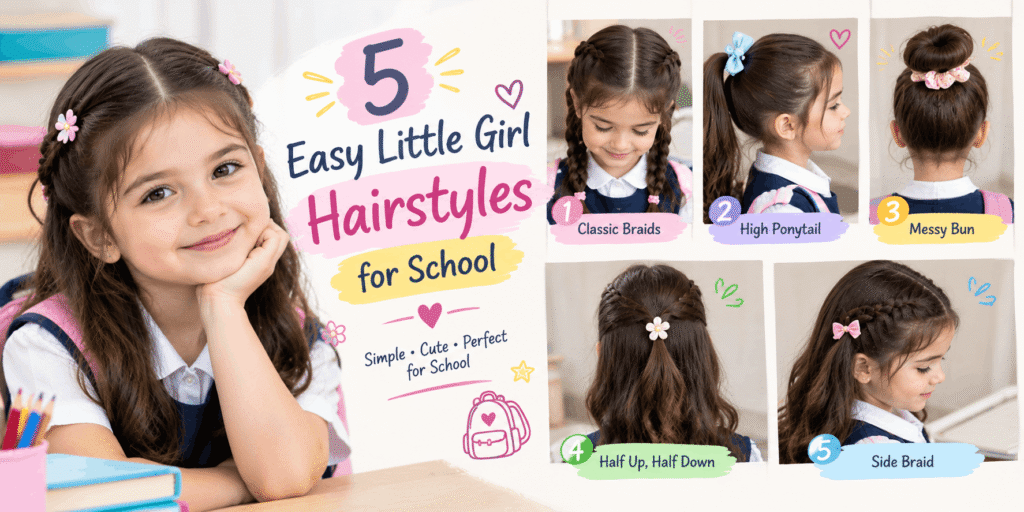
School hairstyles need to do more than simply look good in the first few minutes. Hair that constantly falls across the face can become distracting, while overly tight styles may feel uncomfortable throughout the day. A good school hairstyle should keep the hair reasonably controlled while allowing the child to move naturally.
It can also help to work with the child’s natural hair rather than fighting against it. Straight hair may make certain ponytail styles quick to create, while wavy or curly hair can give braids and buns additional texture. Thick hair may need a little more sectioning, whereas fine hair can often be styled with fewer steps.
Accessories can make a simple hairstyle feel completely different. A small ribbon, colorful elastic, or pair of simple clips can add personality without requiring a complicated technique. For school, however, it is usually better to choose accessories that are secure and comfortable rather than pieces that could easily fall out during the day.
The five ideas below are designed to give you a starting point rather than a strict set of rules. Once you understand the basic structure of a style, you can adjust it according to hair length, texture, and your child’s preferences.
Little Girl Hairstyle #1: Criss Cross Hot Buns
Criss cross hot buns are a playful option when you want a hairstyle that feels more special than an ordinary pair of buns. The criss-cross sections create visual interest while the buns keep the hair lifted and away from the face.
Begin by dividing the hair into two main sections. Create a clean part from the front toward the back, then divide each side according to where you want the crossed sections to sit. The cleaner the initial sections are, the more defined the finished pattern will appear.
Take a section from one side and guide it diagonally toward the opposite side before securing it. Repeat the process in the other direction so the sections create the crossed appearance. The remaining hair can then be gathered into two ponytails.
Twist each ponytail and wrap it around its base to create a bun. Secure each bun with a comfortable hair tie or suitable pins. For younger children, make sure any pins are firmly secured and do not press against the scalp.
The beauty of this hairstyle is that it can be made neat or slightly relaxed. A polished version works well with a school uniform, while a softer finish can look cute with casual clothing.
If the hair is slippery, lightly misting it with water or using a small amount of suitable styling product can make the sections easier to control. Avoid using excessive product, especially when the hairstyle is intended to be worn for several hours.
Little Girl Hairstyle #2: Boxer Braids
Boxer braids are useful when you need a hairstyle that keeps a large amount of hair organized. The two-braid structure divides the hair evenly and keeps it close to the head, making it a practical option for active school days.
Start by creating a center part that runs from the forehead toward the back of the head. Keep the division as even as possible so both braids have a similar amount of hair.
Take a small section near the front of one side and divide it into three pieces. Begin a Dutch-style braid by crossing the outer strands underneath the middle section while gradually adding hair as you move toward the back.
Continue the braid along the head, keeping the additions relatively even. Once you reach the nape, continue braiding the remaining length and secure the end.
Repeat the process on the other side. The finished style should sit comfortably against the head without pulling too tightly.
For a younger child, the braids do not need to be extremely tight to look neat. A slightly softer braid can actually be more comfortable while still keeping the hair controlled.
Boxer braids can also be adjusted according to hair length. With shorter hair, you may need to secure the ends earlier or use small elastics to keep shorter pieces in place. With longer hair, the remaining braid can hang down the back or be secured into small sections.
If the child has curly or textured hair, the natural pattern can give the braids a fuller appearance. Detangling gently beforehand can make the process easier, but there is no need to force every strand completely straight.
Little Girl Hairstyle #3: Bubble Ponytails
Bubble ponytails are one of those little girl hairstyles that can look complicated while actually requiring very little braiding skill. Instead of weaving the hair, you create sections along a ponytail using multiple elastics.
Begin by deciding whether you want one central ponytail, two ponytails, or several smaller sections. For school, two bubble ponytails can create a balanced look while keeping the hair away from the face.
Secure the first ponytail with a comfortable elastic. Move a short distance down the length and add another elastic. Gently pull the hair between the two elastics outward to create a rounded “bubble.”
Repeat this process until you reach the end of the ponytail. Try to keep the sections reasonably similar in size, although they do not need to be perfectly identical.
The amount you pull each section determines the final appearance. A gentle pull creates smaller bubbles, while a little more volume creates a fuller effect.
For an especially playful look, you can use matching colorful elastics. If the school dress code is more traditional, simple elastics in neutral shades can keep the style understated.
Bubble ponytails are also useful when a child dislikes having her hair tightly braided. Since the style does not require continuous tension along the scalp, it can feel lighter while still keeping the length organized.
Little Girl Hairstyle #4: Crown Dutch Braid
A crown Dutch braid gives the impression of a braided headband wrapping around the head. It looks detailed, but once the basic Dutch-braiding technique is familiar, the process becomes much easier.
Start near one side of the head, close to the front. Take a small section and divide it into three strands. Begin a Dutch braid by crossing the outer strands underneath the middle strand while adding small amounts of hair as you continue around the head.
Instead of bringing the braid straight down, guide it along the curve of the head. Keep adding hair from the direction of the braid so that it gradually creates the crown effect.
Continue toward the opposite side and around the back. When you reach the starting point, secure the remaining hair. Depending on the length, you can tuck the end beneath the braid or leave a short braided tail.
The braid does not have to be extremely tight. A comfortable, slightly relaxed crown can look softer and may be easier for a child to wear throughout the school day.
For a more decorative finish, a small ribbon or simple accessory can be added near the end of the braid. Keep anything attached to the hair lightweight and secure.
This hairstyle can be especially useful when you want the front sections completely controlled. It keeps loose pieces away from the face while still giving the hairstyle a more creative appearance than a standard ponytail.
Little Girl Hairstyle #5: Space Buns
Space buns are a fun choice for children who enjoy playful hairstyles. The two buns sit on opposite sides of the head and create a balanced look that can be customized for both shorter and longer hair.
Begin by creating a center part from the forehead to the back of the head. Divide the hair into two equal sections and secure each side into a ponytail.
Position the ponytails according to how high you want the buns to sit. Higher ponytails create a more noticeable space-bun appearance, while lower ones produce a softer version.
Twist the first ponytail and wrap the hair around its base. Secure it with an elastic or suitable pins, then repeat on the other side.
If the hair is long, you can create fuller buns by wrapping the length several times around the base. For shorter hair, smaller buns can work just as well.
Space buns also offer plenty of room for personalization. You can leave a few soft strands around the face, use colorful elastics, or keep everything sleek and tidy for a more school-friendly finish.
For children with curly or wavy hair, the natural texture can give the buns extra volume. There is no need to completely smooth every strand unless that is the look your child prefers.
One useful trick is to check the buns from the front before finishing the hairstyle. Adjusting their height slightly can make the overall look feel more balanced.
5 Easy Little Girl Hairstyles for School
Although these five styles have different appearances, they share one important quality: they can be adapted instead of followed exactly. That makes them useful when your child’s hair changes as it grows.
For very young children, simpler versions may be easier. A pair of bubble ponytails or basic space buns can take less time than a detailed crown braid. As you become more comfortable with braiding, you can gradually introduce more involved styles.
For school mornings, preparation can make a bigger difference than complicated technique. Detangle the hair gently before beginning and keep the elastics, brush, and other accessories within reach.
It can also help to avoid making the hairstyle unnecessarily tight. A style that looks extremely neat at the beginning may become uncomfortable after several hours. Comfortable sections and secure but gentle elastics are usually a better choice for a full school day.
If your child has fine hair, creating slightly smaller sections can help the hairstyle hold its shape. Thick hair may benefit from dividing the work into manageable sections rather than trying to control everything at once.
Curly and textured hair can be styled in all five looks, but the process may need to be adjusted. Detangling should be gentle, and the natural curl pattern can be incorporated into the finished style instead of being completely brushed out.
Another easy way to change the appearance is through accessories. Two hairstyles can look completely different when one uses simple elastics and the other includes colorful ribbons or small bows.
School rules should also be considered. Some schools have restrictions on accessories, hair length, or colors, so the hairstyle may need to be simplified to fit those requirements.
The most important thing is that the finished hairstyle feels comfortable. Children move around throughout the day, and a hairstyle that looks beautiful but constantly needs adjusting may not be the most useful choice.
How to Choose the Right Style for the Morning
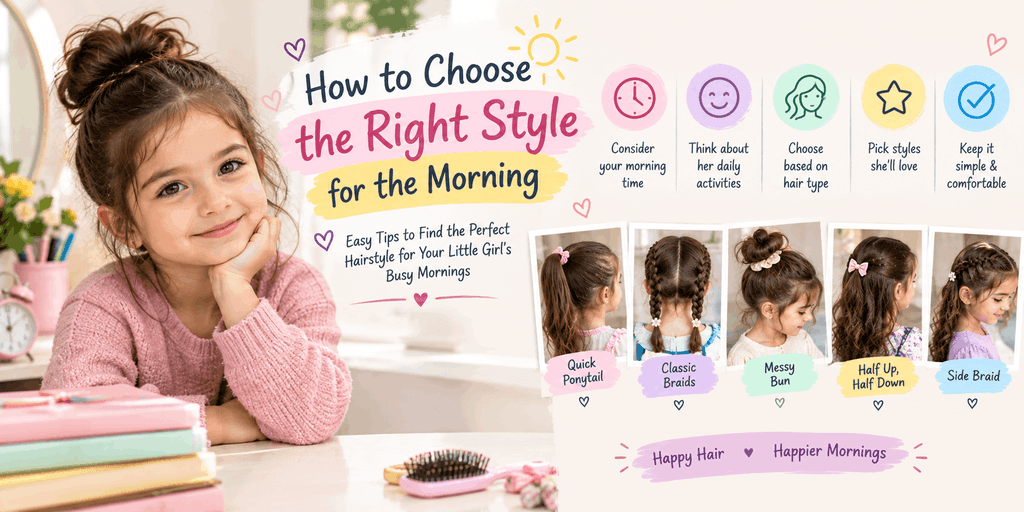
When there is almost no time before school, choose a hairstyle based on how much preparation the hair needs. Bubble ponytails and space buns can be relatively quick once the hair is divided and ready.
If you have a little more time, boxer braids or a crown Dutch braid can create a more detailed appearance. These styles require more technique, but they can also keep the hair controlled for longer.
Criss cross hot buns sit somewhere in the middle. The sections add visual detail, while the final buns keep the hairstyle relatively straightforward.
You can also alternate hairstyles throughout the week. For example, a simple ponytail-based style can work on a busy morning, while a braided look can be saved for a day when there is more time.
This prevents school mornings from becoming repetitive and gives your child the opportunity to choose which hairstyle she likes.
Keeping Hair Comfortable During School
A hairstyle should never depend on excessive pulling to stay in place. If a child complains that the scalp feels sore or the style feels too tight, loosen it rather than trying to make it last longer.
The same applies to accessories. Heavy clips, uncomfortable pins, or overly tight elastics can become irritating after several hours.
For active children, keeping the hair securely contained can be helpful, but comfort should remain part of the decision. A slightly softer hairstyle may be more practical than one that is extremely rigid.
It is also worth giving the hair a break from elaborate styling when possible. Not every school day needs an intricate hairstyle. Simple, comfortable options can be just as cute.
Final Thoughts
Little girl hairstyles for school do not need to be complicated to look thoughtful and fun. Criss cross hot buns, boxer braids, bubble ponytails, crown Dutch braids, and space buns each offer a different way to keep hair organized while adding personality to the school-day look.
The trick is to adapt the technique instead of worrying about making the hairstyle identical to a reference picture. Hair texture, length, and thickness will naturally change the final result.
A comfortable hairstyle is also more valuable than one that only looks perfect for the first few minutes. Keep the sections secure without making them unnecessarily tight, choose practical accessories, and consider how active your child will be during the day.
Once these five styles become familiar, they can also become starting points for dozens of variations. Change the part, combine two techniques, add a simple accessory, or adjust the placement of the buns and braids.
That flexibility makes these hairstyles useful beyond one school morning. With a little practice, getting a child’s hair ready can become quicker, easier, and much more enjoyable.
Simple ponytails, bubble ponytails, space buns, and basic braids are practical choices for school mornings. The easiest option depends on the child’s hair length, texture, and how much time is available.
Braids, buns, and securely positioned ponytails can keep the front sections controlled. A crown braid is another option when you want most of the hair contained around the head.
Yes. Shorter hair can still be styled into small buns, mini ponytails, partial braids, or other simple looks. Smaller sections and lightweight accessories can help manage shorter strands.
One Comment