
Lips can look uneven, feel rough, or develop small flakes even when the rest of the face feels comfortable. Changes in weather, frequent lip licking, irritating products, and everyday habits can all contribute to this feeling. When the surface of the lips becomes uncomfortable, it is tempting to reach for an exfoliating product immediately. However, the best approach begins with understanding what your lips actually need.
A lip scrub is a product designed to loosen some of the dead surface cells through gentle physical exfoliation. It may contain fine particles suspended in an emollient base that helps the product spread across the lips. Some formulas also include ingredients intended to leave the skin feeling conditioned after use. The purpose is not to make the lips feel aggressively polished; it is to improve their surface without causing unnecessary irritation.
Not everyone needs to exfoliate their lips regularly. If your lips already feel comfortable and look smooth, a moisturizing balm may be all you need. If they are cracked, inflamed, bleeding, or unusually sensitive, scrubbing can make the problem worse. Understanding this distinction is more useful than following a fixed exfoliation schedule.
Understand What Your Lips Are Telling You

Roughness Does Not Always Mean Your Lips Need Scrubbing
The surface of the lip scrub can become uneven for several reasons, and each situation may call for a different response. A little dryness after spending time in cold weather is not necessarily the same as persistent irritation caused by a product. Treating every form of roughness with exfoliation can overlook the underlying problem.
For example, lips that feel tight after being outdoors may benefit more from a protective balm than from a scrub. Repeatedly licking the lips can also leave them drier because saliva evaporates and may contribute to irritation. In that situation, changing the habit and protecting the skin can be more helpful than removing surface flakes.
Another possibility is a reaction to a lip product. Fragrance, flavoring, or other ingredients may bother some people, even when a product is marketed for cosmetic use. If redness, burning, or peeling begins after introducing something new, stop using the suspected product instead of trying to scrub the reaction away.
Pay attention to how your lips feel throughout the day. Mild surface roughness that disappears with moisturizing may not require exfoliation at all. Persistent cracking, swelling, pain, or recurring irritation deserves a more cautious approach and may require advice from a healthcare professional.
The Difference Between Dry Lips and Damaged Lips
Dry lips often feel tight or uncomfortable and may develop small flakes. Damaged lips can show more pronounced cracking, open areas, bleeding, or tenderness. Although the two conditions can overlap, they should not be treated as identical.
When the surface is intact and only mildly uneven, a suitable lip scrub may be an option for some people. The product should be used gently, and there should be no expectation that stronger pressure will produce better results.
When the lips are split or bleeding, physical exfoliation is a poor choice. Scrubbing can disturb the fragile surface further and increase discomfort. A simple, fragrance-free protective ointment may be a more appropriate first step, along with avoiding habits and products that aggravate the area.
Persistent dryness can also have causes that a scrub cannot address. Environmental exposure, irritation, certain medications, and some skin conditions may contribute to ongoing symptoms. If your lips repeatedly crack despite gentle care, do not keep increasing exfoliation. Consider discussing the problem with a qualified healthcare professional.
Why the Skin on Your Lips Needs a Different Approach
The visible part of the lips scrub from much of the surrounding facial skin. It has a thinner protective barrier and is particularly exposed to saliva, food, weather, and repeated movement. This makes unnecessary friction a concern.
A scrub intended for the body or face may be too abrasive for the lips. Products containing coarse particles, sharp fragments, or a rough texture can create small areas of irritation, especially when used with pressure.
The lips also move constantly when you speak, eat, and smile. A product that feels comfortable during application may become irritating if it leaves the surface sensitive afterward. That is why the immediate feeling of smoothness should not be the only measure of success.
A sensible lip-care routine emphasizes protection and comfort. Exfoliation, when appropriate, is an optional addition rather than the foundation of healthy-looking lips.
What Makes a Lip Scrub Worth Considering?
Examine the Exfoliating Particles
Physical lip scrubs use small particles to loosen surface flakes through contact with the skin. These particles can vary in size, shape, and texture, which affects how the product feels during application.
A product with a smooth, fine texture may be easier to distribute gently than one containing large or irregular pieces. However, the ingredient name alone does not tell you everything about how abrasive a formula will be. Particle size, concentration, the surrounding base, and the way the product is used all matter.
Sugar is a common ingredient in cosmetic scrubs because its crystals provide physical exfoliation and can dissolve with moisture. Even so, a sugar-based product is not automatically gentle. Coarse crystals and vigorous rubbing can still irritate delicate lips.
Avoid using products with particles that feel sharp, scratchy, or uncomfortable. If you notice stinging during application, rinse the product away and stop using it. Discomfort should not be treated as proof that exfoliation is working.
A useful product is one that can be applied without force. If you have to press hard to feel that it is doing something, it may not be the right formula for your lips.
Look at the Base, Not Just the Scrub
The particles attract attention, but the ingredients surrounding them also influence the experience. Many lip scrubs contain emollient substances that help the formula spread and reduce the dry feeling that might otherwise occur during application.
Ingredients such as petrolatum, certain oils, and waxes can help condition the surface or leave a protective film, depending on the formula. Their presence does not eliminate the possibility of irritation, but it can affect how the product feels when used.
Some products include fragrance, flavoring, cooling ingredients, or botanical extracts. These may appeal to people who enjoy a particular scent or sensory experience, but they are not necessary for exfoliation. For people with sensitive lips, additional fragrance or flavoring may be undesirable.
Read the complete ingredient list rather than judging a product by a prominent label such as natural, nourishing, or gentle. Marketing language does not guarantee that a formula will suit every person.
If you already know that certain ingredients irritate your lips, check for them before purchasing a new product. A simple formula may be a better starting point than one with many decorative or sensory additions.
Choose a Texture You Can Control
The texture of a lip scrub affects how easily you can spread it and how much pressure you may feel tempted to use. A thick formula may stay in place, while a softer product may spread more easily. Neither consistency is automatically better for everyone.
The key is control. You should be able to distribute a small amount across the lips without dragging the skin or repeatedly rubbing the same area. A product that slips around excessively may encourage more friction, while an overly stiff formula may require unnecessary pressure.
Pay attention to the sensation rather than relying on appearance alone. A glossy, luxurious-looking scrub can still be too abrasive, and a simple-looking product can be suitable if its formulation and use are appropriate.
Packaging also affects practical use. A jar may require clean fingers or a small clean spatula, while a tube can reduce direct contact with the remaining product. Keep the container clean and follow its storage instructions.
If the formula changes smell, color, or texture unexpectedly, check the product’s guidance and expiry information rather than continuing to use it automatically.
How to Use a Lip Scrub Without Overdoing It
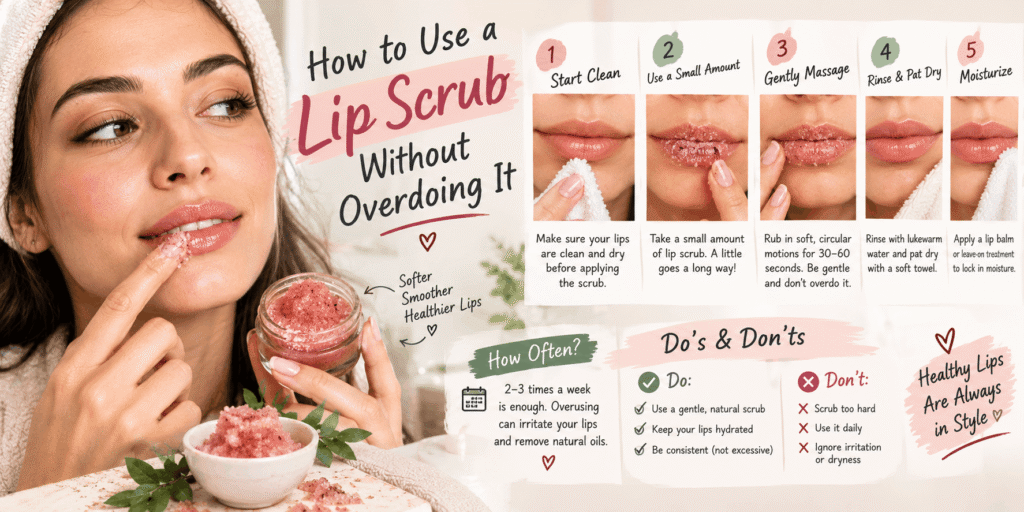
Prepare the Lips Before Application
Preparation should be simple. Begin by removing any lipstick or other product from the lips using a method that does not require aggressive rubbing. If the lips feel dirty or sticky, gently rinse them and pat them dry.
Check the condition of the skin before applying anything abrasive. If you see open cracks, bleeding, pronounced redness, or swelling, skip exfoliation. The same applies if the lips are already stinging or unusually tender.
If the lips are intact and you decide to use a scrub, start with a very small amount. There is no need to cover the area with a thick layer. A small quantity allows you to assess the texture and avoid unnecessary product waste.
Read the manufacturer’s instructions before use. Products differ in their formulation and recommended application method, so a routine that suits one scrub may not suit another.
Do not use a lip scrub simply because it is part of a beauty trend or because a particular day has arrived on your calendar. The condition of your lips should guide the decision.
Apply With Minimal Pressure
The purpose of a scrub is to loosen surface flakes, not to sand the lips smooth. If you choose to exfoliate, use a gentle touch and avoid forceful back-and-forth rubbing.
Follow the product instructions, paying attention to the recommended application time and removal method. Avoid extending the process because you believe additional rubbing will produce a better result.
Be especially cautious around the corners of the mouth, where cracks can develop, and around any areas that already feel sensitive. Do not attempt to remove flakes that remain firmly attached by pulling or scraping them away.
If the product causes burning, pain, or increasing redness, remove it promptly and discontinue use. A temporary sensation of irritation is not a desirable result.
After removing the scrub as directed, assess how your lips feel. They should not be left painfully tight, raw, or unusually sensitive. If irritation occurs, focus on gentle protection rather than repeating the exfoliation.
Follow With Protection Rather Than Another Treatment
After exfoliation, avoid turning the process into a long sequence of additional products. A simple, well-tolerated lip balm or protective ointment may be enough to reduce moisture loss and keep the lips comfortable.
Ingredients such as petrolatum can provide a protective layer, while other emollients may help improve the feel of the surface. The most suitable option depends on your individual tolerance and the product formulation.
During the day, consider using a lip product with broad-spectrum sun protection when appropriate, particularly if you spend time outdoors. Follow its directions and reapply as instructed. Sun exposure can contribute to lip damage, so protection is an important part of routine lip care.
Avoid applying several new products immediately after exfoliation. If irritation develops, using too many products can make it difficult to identify the cause.
The goal is a comfortable routine that supports the lips over time. A scrub should not become an excuse to compensate for inadequate moisturizing or sun protection.
Homemade Lip Scrubs: What to Consider Before Mixing Ingredients
Making a lip scrub at home may seem like an easy way to control the ingredients, but homemade does not automatically mean gentle or suitable for delicate skin. The texture of the mixture, the ingredients you choose, and the amount of pressure you use can all affect how your lips respond.
A homemade formula also lacks the testing and controlled formulation that a properly manufactured cosmetic may have undergone. Ingredients that are safe in one context can still cause discomfort when applied to sensitive lips, particularly if they are used in a concentrated form or combined without considering their properties.
Why Simple Ingredients Can Still Cause Problems
Sugar is frequently used in homemade scrubs because it provides a grainy texture. However, crystals can have uneven edges, and rubbing them against dry or cracked lips may increase irritation. Using a finer-looking mixture does not eliminate the need for caution.
Salt is another ingredient sometimes suggested for exfoliation, but it can sting when it comes into contact with small cracks. It is generally an unsuitable choice for already irritated lips.
Lemon juice is also worth avoiding. Its acidity may irritate the delicate skin around the mouth, and citrus ingredients can create additional concerns when skin is exposed to sunlight. A homemade scrub does not need acidic ingredients to perform its intended cosmetic function.
Strong essential oils, perfume, and concentrated flavoring ingredients can also be problematic for people who are sensitive to them. The fact that an ingredient comes from a plant does not guarantee that it will be gentle.
If your lips are currently sore, peeling extensively, or split at the corners, skip homemade exfoliation altogether. Focus on simple protective care until the surface has recovered. If the problem continues or repeatedly returns, seek advice from a healthcare professional.
Do You Actually Need a DIY Lip Scrub?
Before preparing a mixture, consider whether exfoliation will solve the problem you are experiencing. If your lips feel dry because of cold weather, indoor heating, or frequent licking, protecting them from further moisture loss may be more useful than removing surface flakes.
A plain, fragrance-free ointment can help protect the lips while they recover. Drinking enough fluids is also sensible for general health, although drinking extra water alone will not necessarily resolve persistent lip dryness.
If you still prefer exfoliation, consider whether a commercially formulated product with clear instructions would be more appropriate than a mixture prepared at home. Choose a product intended specifically for the lips and avoid formulas that feel rough or cause discomfort.
There is no need to exfoliate simply because a beauty routine recommends it. Comfortable lips do not require regular scrubbing as a maintenance rule.
Choose a Lip Scrub According to Your Needs
Not every product marketed for lip exfoliation serves the same purpose. Some emphasize a grainy texture, others focus on a conditioning base, and some include fragrance or flavor to create a particular sensory experience. Understanding these differences can help you make a more informed choice.
For People Who Prefer a Simple Formula
A straightforward formula may be a sensible starting point if you dislike heavily scented products or have experienced irritation from lip cosmetics. Look for clear ingredient information and avoid unnecessary extras if you already know that fragrances or flavorings bother you.
The label should identify the product as suitable for the lips and provide directions for use. Do not assume that a scrub intended for the face or body is appropriate for the lip surface.
A simple ingredient list is not a guarantee against reactions, but it can make it easier to identify ingredients you may need to avoid. If you have a history of cosmetic allergies, check the full list rather than relying on front-label claims.
For People Who Wear Lipstick Frequently
Long-wearing lip color can be difficult to remove, and repeated wiping may leave the lips feeling uncomfortable. However, a scrub should not be used as a substitute for gentle makeup removal.
Start by using a suitable remover that loosens the lip product without requiring forceful rubbing. Follow the product directions and wipe gently. If color remains, repeat the removal process as appropriate rather than scraping the surface.
Once the makeup has been removed, assess the condition of your lips. If they feel comfortable, apply a suitable balm. If they are irritated or cracked, avoid exfoliation until they have recovered.
When wearing lipstick regularly, pay attention to the products themselves. If a particular formula consistently causes dryness, burning, or peeling, stop using it and consider whether another product would be better tolerated.
For People With Sensitive Lips
Sensitive lips require a cautious approach because even products designed for cosmetic use can trigger irritation in some individuals. A scrub containing fragrance, flavoring, cooling agents, or multiple botanical ingredients may not be the most suitable option.
If your lips frequently react to products, avoiding physical exfoliation may be the safest choice. Use a simple protective product that you tolerate well and introduce new lip products one at a time.
Stop using a product if you develop persistent burning, redness, swelling, or worsening peeling. Do not repeatedly apply it in the hope that your skin will adjust.
If reactions happen with several different products, or if symptoms continue despite avoiding suspected irritants, a healthcare professional or dermatologist can help assess possible causes.
Common Lip Scrub Mistakes That Can Make Dryness Worse
A lip scrub is often treated as a quick beauty step, but the way it is used matters more than how long the routine takes. Small habits can turn an optional cosmetic treatment into an irritating experience.
Scrubbing Until Every Flake Disappears
Visible flakes can be tempting to remove, especially before applying lipstick. However, trying to eliminate every uneven patch in one session can damage the surface and leave the lips more sensitive.
Some flakes remain attached because the skin underneath has not fully recovered. Pulling, scraping, or repeatedly rubbing these areas can create tiny breaks in the surface.
If exfoliation does not remove the flakes easily, stop rather than increasing pressure. Apply a protective balm and allow the lips to settle. Avoid picking at loose skin with your fingers or teeth.
A smoother appearance should never come at the expense of comfort. If the lips look raw or feel painful after using a scrub, discontinue exfoliation.
Using a Scrub Every Day
Daily exfoliation is not necessary for most people, and frequent friction may aggravate dryness. There is no universal schedule that suits every lip scrub or every individual.
Follow the product’s directions, and do not exceed the recommended frequency. If the label does not provide clear instructions, choose a cautious approach rather than assuming that repeated use is beneficial.
Pay attention to your lips after application and over the following day. Increased tightness, tenderness, redness, or peeling may indicate that the product or routine is not suitable.
You may discover that a protective balm provides all the care you need. Exfoliation is optional, not a requirement for maintaining comfortable lips.
Applying Exfoliation to Cracked Skin
A scrub should not be used on lips that are bleeding, split, inflamed, or unusually painful. Physical friction can disturb the damaged surface and prolong discomfort.
Instead, stop exfoliating and avoid products that sting. A simple protective ointment may help shield the area while it recovers. Do not apply harsh household ingredients in an attempt to speed up healing.
If cracks are severe, occur repeatedly, spread around the corners of the mouth, or fail to improve, seek medical advice. Persistent lip problems may have causes that cosmetic exfoliation cannot address.
Assuming Natural Means Irritation-Free
Natural ingredients can still cause allergic reactions or irritation. Essential oils, citrus extracts, spices, and strongly flavored ingredients may be unsuitable for some people, even when they are included in homemade beauty recipes.
Likewise, a product labeled as organic or plant-based is not automatically safer for sensitive lips. The full formulation and your individual tolerance matter more than a single marketing term.
Avoid applying ingredients to your lips simply because they are commonly found in kitchen cupboards. Food ingredients are not necessarily formulated or tested for use as cosmetic exfoliants.
If you experience a reaction, stop using the product and avoid experimenting with additional ingredients until the irritation has settled.
A Simple Routine for Lips That Feel More Comfortable
An effective lip-care routine does not need several treatments. Consistent, gentle habits are often more practical than repeatedly trying new exfoliating products.
In the morning: Check whether your lips feel comfortable or dry. Apply a well-tolerated lip balm, and use a lip product with broad-spectrum sun protection when appropriate. Follow the label’s directions and reapply as instructed, especially when spending time outdoors.
During the day: Reapply your protective lip product when needed. Try not to lick, bite, or pick at your lips, as these habits can contribute to irritation. If a lipstick or balm causes burning or persistent discomfort, stop using it.
In the evening: Remove lip color gently instead of rubbing repeatedly. Apply a protective ointment if your lips tend to become dry overnight. You do not need to use a scrub every evening, and there is no benefit in exfoliating skin that is already comfortable.
When flakes appear: Consider what may have triggered them. Cold weather, irritating cosmetics, frequent licking, and other factors can contribute to dryness. Addressing the cause and protecting the lips may be more helpful than immediately removing the flakes.
If you choose to use a lip scrub, treat it as an occasional cosmetic step rather than the center of your routine. Stop if it causes irritation, and avoid it entirely while the lips are damaged.
Final Thoughts
A lip scrub can be useful for some people who want to improve the feel of mildly uneven lip surfaces, but exfoliation is not the answer to every form of dryness. The condition of your lips, the ingredients in the product, and the way you apply it all influence whether the experience is comfortable.
Before purchasing or preparing a scrub, consider whether your lips actually need exfoliation. When dryness is the main concern, a simple protective balm and fewer irritating habits may offer a more appropriate solution. When the lips are cracked or inflamed, allow them to recover instead of rubbing away the damaged surface.
Choose products with clear instructions, pay attention to ingredients you know you do not tolerate, and stop using anything that causes persistent discomfort. You do not need to follow a complicated routine or remove every visible flake to care for your lips well.
The most useful lip-care routine is one that protects the skin, respects its natural sensitivity, and helps you recognize when a cosmetic treatment is unnecessary.
A lip scrub is a cosmetic product designed to loosen some surface flakes through physical exfoliation. Its suitability depends on the formulation and the condition of your lips. It should not be used on cracked, bleeding, or irritated skin.
There is no single frequency that works for everyone. Follow the manufacturer’s instructions, avoid excessive rubbing, and stop if you experience irritation. Many people can maintain comfortable lips with moisturizing care alone.
Homemade scrubs are not automatically safe or gentle. Coarse particles, salt, citrus juice, and strongly scented ingredients can irritate the lips. If your lips are damaged or sensitive, avoid exfoliation and use a simple protective product instead.

3 Comments