Introduction
Gel nail polish has become a popular choice for people who want beautiful, glossy nails that maintain their appearance for longer than many traditional manicures. Available in countless colors and finishes, it offers a convenient way to achieve a professional-looking result at home or in a salon.
Unlike conventional nail polish, which generally dries as its solvents evaporate, most gel nail polish formulas harden through a chemical reaction triggered by a compatible ultraviolet (UV) or light-emitting diode (LED) lamp. This process creates a durable coating that can resist everyday wear and maintain its shine for an extended period.
However, achieving a long-lasting manicure involves more than choosing an attractive color. The ingredients, application technique, curing equipment, and removal process all influence the final result.
Understanding these factors can help you choose suitable products, avoid common mistakes, and care for your natural nails more effectively.
What Is Gel Nail Polish?
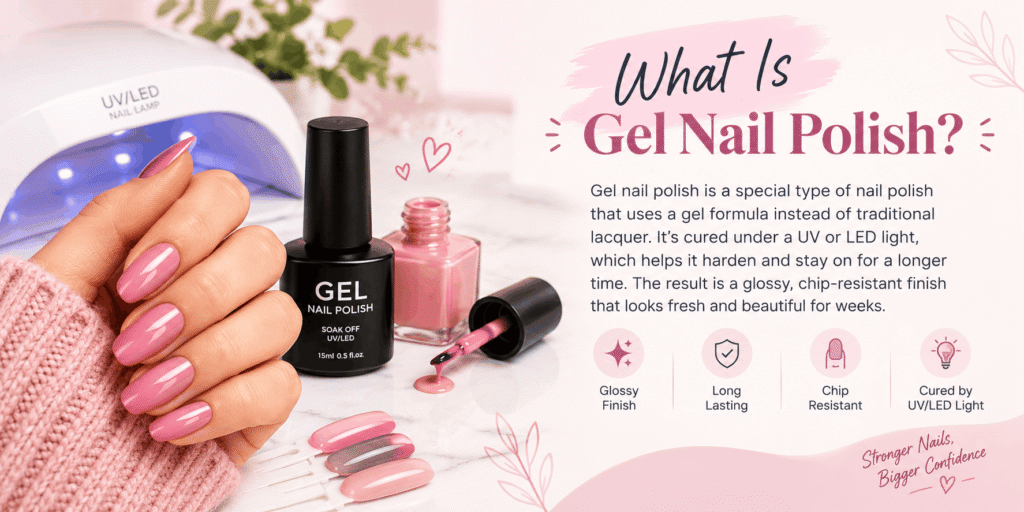
Gel nail polish is a cosmetic product designed to create a colored, glossy coating over natural nails or certain artificial nail enhancements. It is formulated to remain workable during application and then harden when exposed to the appropriate curing light.
Traditional nail polish usually contains film-forming ingredients dissolved or dispersed in a liquid mixture. After application, volatile solvents evaporate, leaving a colored film on the nail.
Gel nail polish works differently. Many formulas contain reactive chemical compounds that link together during curing, forming a polymer network. This structure gives the coating its characteristic durability and resistance to ordinary chipping.
Gel nail products are available in a wide variety of styles, including natural-looking nudes, bright seasonal colors, glitter finishes, metallic effects, and deep, dramatic shades. Some products are intended for professional nail technicians, while others are designed for consumers who prefer at-home manicures.
It is important to distinguish genuine UV- or LED-cured gel polish from conventional polish marketed as gel-effect or gel-like polish. Some gel-effect products air-dry and do not require a curing lamp.
Checking the label and following the manufacturer’s instructions helps ensure that you use the product correctly.
What’s That Stuff? Understanding the Science Behind Gel Nail Polish
The science behind gel nail polish explains why it can remain glossy and attractive for weeks when applied and maintained correctly.
Most conventional gel nail polish systems rely on a process called photopolymerization. During this process, light activates particular ingredients in the formula, allowing reactive molecules to form chemical bonds and create a larger polymer structure.
Before curing, the product remains fluid enough to spread across the nail. When exposed to the correct light, the chemical reaction begins, transforming the coating into a hardened material.
The finished coating is designed to balance hardness, flexibility, adhesion, and resistance to everyday wear.
Several factors affect this transformation. The type of gel formula, the thickness of each layer, the lamp’s wavelength, and the curing duration can all influence how effectively the product hardens.
A coating that appears dry or firm on the surface is not necessarily fully cured throughout its thickness. Inadequate curing can affect performance and may increase exposure to reactive ingredients.
For this reason, the curing equipment and timing recommended by the manufacturer are essential parts of the application process.
Nailing the Science: Why Does Gel Nail Polish Last Longer?
The durability of gel nail polish results from several properties working together.
1. Polymer Formation
During curing, reactive ingredients form a connected polymer network. This structure helps the finished coating resist many types of everyday wear.
2. Adhesion to the Nail
The coating must adhere appropriately to the nail surface. Suitable preparation and compatible base products can help improve adhesion, although aggressive filing may damage the natural nail and should be avoided.
3. Protective Surface Finish
Many gel manicures include a top coat that helps maintain shine and protect the colored layers from ordinary surface wear.
4. Correct Application
Applying thin, even layers and curing them according to the product instructions helps promote consistent results. Thick applications, incompatible products, or unsuitable curing equipment can interfere with the process.
Even a well-applied gel manicure is not permanent. Natural nails continue growing, creating a visible gap near the cuticle. Depending on the formula, application technique, and daily activities, many gel manicures remain presentable for approximately two to three weeks.
However, individual results vary. Lifting, cracking, or separation can occur earlier if the coating is damaged or does not adhere properly.
Key Ingredients in Gel Nail Polish
Gel nail polish contains different ingredients that contribute to its texture, color, stability, and durability. Formulations vary between manufacturers, but several ingredient categories are commonly used.
1. Oligomers and Reactive Monomers
Oligomers are relatively short molecular structures that help determine the properties of the final coating. Reactive monomers can participate in the curing reaction and influence characteristics such as flexibility, hardness, and viscosity.
Together, these compounds help create the durable film associated with gel manicures.
However, some reactive ingredients, including certain acrylates and methacrylates, can cause allergic contact dermatitis in susceptible individuals. Contact with uncured product is an important concern because exposure may contribute to sensitization.
Keeping the product away from the surrounding skin is therefore an important precaution.
2. Photoinitiators
Photoinitiators are ingredients that respond to particular wavelengths of light and help initiate the polymerization reaction.
Different formulas may require different light conditions. A lamp that works effectively with one gel product may not provide suitable curing conditions for another.
Using a compatible lamp and following the recommended curing time can help achieve the intended result.
3. Pigments and Colorants
Pigments provide the color and visual effects of gel nail polish. They allow manufacturers to create everything from transparent pink shades to highly opaque colors and glitter finishes.
The amount and type of pigment can influence how light travels through the coating. Thick or highly pigmented layers may make consistent curing more difficult if light cannot adequately reach the underlying material.
Applying thin layers as directed can help reduce this problem.
4. Stabilizers and Other Additives
Some formulations contain additives that help maintain stability during storage, control consistency, improve application, or support the final appearance.
These ingredients contribute to the product’s overall performance, although their exact types and quantities depend on the formula.
Consumers should review available ingredient information and follow the instructions provided for their particular product rather than assuming every gel polish has the same composition.
Different Types of Gel Nail Polish
Gel nail products come in several categories. Understanding their differences can help you choose a product suited to your manicure goals.
Soft Gel Polish
Soft gel polish is commonly used for conventional gel manicures. Many products in this category are designed to be removed through a controlled soaking process using an appropriate remover.
These products are popular for their glossy finish, wide range of colors, and relatively straightforward maintenance when used correctly.
However, removal requirements vary, so the manufacturer’s instructions should always be followed.
Hard Gel
Hard gel is often used to build nail extensions or create additional structure. Unlike many soft gel products, hard gel generally requires controlled filing for removal.
Because filing too deeply can damage the natural nail, removal may be best handled by a trained nail technician.
Builder Gel
Builder gel is designed to add structure, reinforce certain nail applications, or help create extensions.
Some builder gels are soak-off products, while others require filing. The name alone does not determine the removal method, so checking the product label is essential.
Gel-Effect Nail Polish
Gel-effect polish is designed to imitate some of the visual characteristics of a gel manicure, such as shine or a smooth finish.
Many products in this category dry through ordinary air drying and do not require a UV or LED lamp.
They may be suitable for people who want a gel-like appearance without using a light-cured system.
How to Choose the Right Gel Nail Polish
Choosing gel nail polish involves more than selecting a color that matches your style.
First, look for products from reputable manufacturers that provide clear instructions for application, curing, and removal. Ingredient information and suitable product guidance can help you make a more informed decision.
Second, check whether the product requires a particular curing lamp. Do not assume that every lamp will work effectively with every gel formula.
Third, consider your experience level. Beginners may find it easier to use a clearly documented product system instead of mixing products without confirmation that they are compatible.
Finally, think about the condition of your natural nails. If your nails are already painful, unusually thin, brittle, or damaged, applying additional coatings may not be the best immediate choice.
Selecting an appropriate formula and learning correct application techniques can help you achieve a more attractive manicure while reducing avoidable problems.
Benefits of Gel Nail Polish
Gel nail polish has become a popular option for people who want attractive nails without having to refresh their manicure every few days. Its durability, glossy appearance, and variety of finishes make it suitable for different preferences and lifestyles.
Ways to Reduce Unnecessary Exposure
Follow the recommended curing time: Use the duration specified for the product rather than extending exposure without a reason.
Choose compatible equipment: A suitable lamp should be selected according to the manufacturer’s recommendations. A device that does not provide appropriate curing conditions may produce an inadequate result.
Consider protective gloves: Fingerless gloves designed to protect the hands from UV exposure can reduce the amount of skin exposed during treatment.
Consider sunscreen: Broad-spectrum sunscreen applied to the backs of the hands before a manicure may help reduce UV exposure. Use it appropriately and avoid contaminating the nail surface before application.
Pay attention to personal risk factors: People who are particularly sensitive to sunlight or have concerns about their individual skin cancer risk should discuss suitable precautions with a healthcare professional.
It is also important to understand that LED describes the light source, not necessarily the absence of ultraviolet radiation. Many LED nail lamps emit UV wavelengths.
Can Gel Nail Polish Cause Allergic Reactions?
Yes. Some gel nail polish ingredients can cause allergic contact dermatitis, particularly when uncured product comes into contact with the skin.
Certain acrylates and methacrylates are known potential sensitizers. Sensitization occurs when the immune system develops an allergic response to a substance, meaning later exposure may trigger symptoms.
Common Symptoms
Possible symptoms of an allergic reaction include:
- Redness around the nails or fingertips.
- Itching or irritation.
- Swelling of the skin.
- Dryness, cracking, or blisters.
- Rashes on the hands or other areas, including the face and eyelids.
Symptoms may develop after repeated exposure rather than appearing immediately after the first manicure.
How to Reduce the Risk
Avoid allowing uncured gel polish to touch the skin. Apply products according to their instructions, use a compatible curing lamp, and ensure that the recommended curing process is followed.
Do not deliberately apply gel polish to the cuticles or surrounding skin.
If irritation or other signs of an allergic reaction develop, stop using the suspected product and seek medical advice. A dermatologist can assess the symptoms and determine whether allergy testing is appropriate.
Do not attempt to confirm an allergy by repeatedly applying the suspected product to your skin.
How to Remove Gel Nail Polish Without Damaging Your Nails
Removing gel nail polish properly is just as important as applying it correctly. Pulling, scraping, or peeling the coating can damage the natural nail surface and leave the nails weak or uneven.
The correct removal method depends on the type of gel product.
Removing Soak-Off Gel Polish
Some soft gel polishes are designed to be removed using acetone or a specific remover recommended by the manufacturer.
A typical process may involve gently reducing the top coat as directed, applying the appropriate remover, and allowing sufficient time for the coating to soften.
Once the product has loosened, it may be possible to remove it gently without aggressive scraping.
However, removal instructions differ between products. Follow the manufacturer’s directions rather than assuming every gel polish can be removed in the same way.
If the coating remains firmly attached, do not force it off. Stop and seek assistance from a trained nail professional.
Acetone can also dry the surrounding skin, so avoid unnecessary or prolonged exposure.
Removing Hard Gel
Hard gel generally does not dissolve easily in acetone and often requires controlled filing.
This process requires care because filing too deeply can remove layers of the natural nail. Professional removal may be the better option if you are unfamiliar with the product or the correct technique.
Aftercare Following Removal
Once the gel has been removed, gently clean the nails and apply a moisturizer or cuticle oil to help manage dryness.
Avoid immediately applying another coating if the nails are painful, unusually thin, or visibly damaged.
Allowing time between treatments may be helpful if your nails need recovery. Persistent pain, inflammation, or significant nail changes should be assessed by a healthcare professional.
Common Gel Nail Polish Mistakes to Avoid
Even high-quality gel nail polish may produce disappointing results when applied incorrectly. Avoiding common mistakes can improve the manicure and reduce unnecessary risks.
Applying Thick Layers
Thick layers can interfere with light penetration and may prevent adequate curing. Applying thin, even coats according to the manufacturer’s instructions is generally preferable.
Allowing Product to Touch the Skin
Uncured gel on the cuticles or surrounding fingers can increase the risk of sensitization. Carefully remove accidental contact before curing.
Using an Incompatible Lamp
Different gel formulations may require particular curing conditions. Using unsuitable equipment can result in incomplete curing, even if the surface appears firm.
Peeling Off the Polish
Peeling or picking at gel polish can remove layers of the natural nail. This may cause thinning, roughness, and breakage.
Use the correct removal method instead.
Ignoring Irritation
Redness, swelling, itching, and blistering should not be treated as normal parts of a manicure. Stop using the suspected product and seek appropriate medical advice if symptoms appear.
Overlooking Nail Condition
Repeated aggressive filing and removal can weaken natural nails. Handle the nail surface gently and avoid continuing treatments on nails that are already damaged.
Gel Nail Polish vs. Traditional Nail Polish
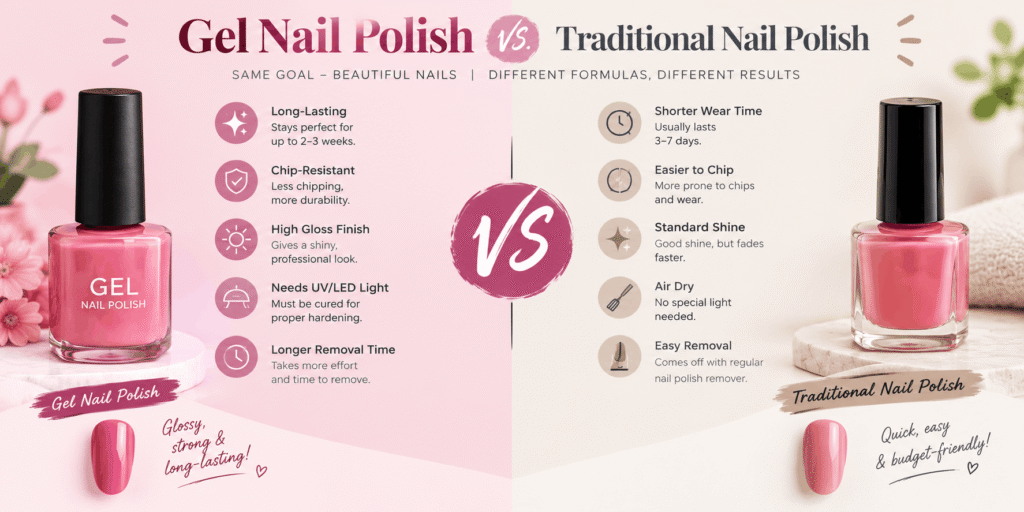
Gel nail polish and traditional nail polish both provide color and decoration, but their formulas and application methods differ.
Traditional nail polish usually dries as solvents evaporate. It generally does not require a curing lamp and is often easier to remove when changing colors.
Gel nail polish typically relies on light-activated polymerization. When properly cured, it can offer a longer-lasting finish, but it requires suitable equipment and careful application.
The main differences can be summarized as follows:
| Feature | Gel Nail Polish | Traditional Nail Polish |
|---|---|---|
| Hardening method | Usually light-activated curing | Usually solvent evaporation |
| Curing lamp | Generally required for true gel polish | Generally not required |
| Wear time | Often longer-lasting | Often requires more frequent touch-ups |
| Finish | Commonly high-gloss | Available in glossy, matte, and other finishes |
| Removal | Depends on the gel formulation | Often removable with conventional nail-polish remover |
| Application | Requires careful curing and product handling | Usually simpler for beginners |
| Main concerns | Incomplete curing, skin sensitization, removal damage, and UV exposure | Smudging, chipping, and potential irritation from ingredients or removers |
Neither type is automatically the best choice for everyone. Personal preference, convenience, nail condition, and application habits all influence which option is most suitable.
Conclusion
Gel nail polish combines cosmetic design with polymer chemistry to create a glossy coating that can last longer than many conventional manicures. Its durability comes from a curing process that transforms reactive ingredients into a connected polymer structure.
Understanding how gel polish works makes it easier to choose appropriate products, apply them correctly, and maintain an attractive manicure.
However, durability should not come at the expense of nail health. Using compatible curing equipment, preventing uncured product from touching the skin, minimizing unnecessary UV exposure, and following the correct removal method are important precautions.
With appropriate products and careful techniques, gel nail polish can be a convenient option for people who enjoy long-lasting color and decorative nail designs.
Ultimately, the best manicure is one that balances appearance, durability, and safety while protecting the natural nails and surrounding skin.
However, understanding both its advantages and limitations is important before deciding whether it is the right choice for you.
1. Long-Lasting Results
One of the main advantages of gel nail polish is its ability to maintain an attractive appearance for an extended period. When applied and cured correctly, it can resist many forms of everyday wear better than conventional nail polish.
Depending on the product and individual circumstances, a gel manicure may remain presentable for approximately two to three weeks.
2. Glossy and Professional Appearance
Gel nail polish can create a smooth, reflective finish that enhances the appearance of natural nails. Many formulas retain their shine throughout normal wear, making them popular for everyday manicures and special occasions.
The finish can range from a natural-looking gloss to bold, high-shine colors.
3. Extensive Color Selection
Gel nail polish is available in a wide range of shades and finishes. Neutral colors can create a subtle appearance, while brighter shades and decorative effects provide opportunities for more expressive nail designs.
Depending on the compatible products used, nail technicians can also create gradients, glitter effects, layered patterns, and other decorative styles.
4. Less Frequent Touch-Ups
Because gel manicures can last longer than many conventional manicures, users may spend less time repairing minor chips or reapplying color.
This can be convenient for people with busy schedules who prefer a manicure that requires fewer routine touch-ups.
5. Quick Hardening After Curing
Once the appropriate curing process is complete, the gel coating is generally ready for normal handling according to the product instructions.
This reduces the smudging risk associated with some traditional polishes that remain vulnerable while their solvents evaporate.
Nevertheless, these benefits depend on correct application, suitable curing equipment, and appropriate aftercare.
How to Apply Gel Nail Polish Correctly
A successful gel manicure requires careful nail preparation, controlled product application, and the correct curing process. Although professional nail technicians may use different techniques depending on the product system, the following steps explain the general process.
Step 1: Prepare Your Nails
Start with clean, dry nails. Remove any previous polish using a method appropriate for the product already on your nails.
Shape your nails with a file and gently manage the cuticles without cutting or damaging the surrounding skin.
Avoid excessive buffing because aggressive filing can thin the natural nail plate. If the product instructions require a particular nail cleanser or preparation solution, use the recommended product.
Proper preparation can help the coating adhere more consistently.
Step 2: Apply a Base Coat
Apply a thin layer of the compatible gel base coat. Keep the product away from the cuticles and surrounding skin.
Cure the base coat using the lamp and timing specified by the manufacturer.
Not every base coat has identical curing requirements, so follow the instructions for your particular system.
If uncured gel touches your skin, remove it before curing according to the product’s safety instructions.
Step 3: Apply the Color
Apply a thin, even layer of gel nail polish over the prepared nail surface.
Cure the layer as directed. If additional coverage is needed, apply another thin layer and repeat the curing process according to the manufacturer’s instructions.
Avoid applying thick coats to achieve a darker color in a single application. Excessive thickness can interfere with light penetration and may prevent the material from curing adequately throughout.
Step 4: Finish With a Top Coat
Apply a compatible top coat to protect the colored layers and create the desired finish.
Keep the product away from the surrounding skin and cure it according to the manufacturer’s directions.
Some top coats leave a tacky surface after curing, while others are designed to finish without one. Follow the product instructions to determine whether an additional finishing step is required.
Step 5: Maintain Your Manicure
After the manicure is complete, moisturize the surrounding skin and cuticles regularly.
Avoid using your nails to open containers or perform tasks that may cause the coating to lift. Wear suitable protective gloves when cleaning or handling household chemicals.
If the polish starts separating from the nail, do not peel or pull it off. Arrange appropriate removal instead.
Illuminating Safety: Are UV and LED Nail Lamps Safe?
UV and LED nail lamps are commonly used to cure gel nail polish. They provide the light needed to activate particular ingredients in compatible formulations.
However, the safety of repeated exposure deserves attention.
Many nail-curing lamps emit ultraviolet radiation, particularly UVA wavelengths. UVA exposure can contribute to skin aging and cellular damage, although the level of risk from nail-lamp use depends on several factors, including exposure duration, frequency, and the characteristics of the device.
Research into the long-term effects of repeated exposure to nail-curing lamps is ongoing. It is therefore inappropriate to claim that all exposure is dangerous or that these devices are entirely risk-free.
Final Thoughts
Gel nail polish has transformed modern manicures by combining attractive colors, glossy finishes, and long-lasting performance. Its unique curing process creates a durable coating that can remain presentable for weeks, making it a popular option for both salon treatments and at-home nail care.
Understanding the ingredients, application techniques, and differences between gel products can help you choose the right option for your needs. Proper curing, careful application, and suitable removal methods are essential for achieving good results while protecting the natural nails.
Safety should remain a priority throughout the process. Avoid contact between uncured gel and your skin, use compatible curing equipment, minimize unnecessary UV exposure, and pay attention to any signs of irritation or an allergic reaction.
Ultimately, the best gel manicure is one that combines beauty, convenience, and responsible nail care. By following the appropriate techniques and manufacturer recommendations, you can enjoy attractive nails while reducing the risk of preventable problems.
Gel nail polish is a nail coating that usually hardens under a compatible UV or LED lamp. It creates a glossy, durable finish that can last longer than many traditional nail polishes.
Gel nail polish can typically last around two to three weeks when applied and cured correctly. Its durability depends on the product, nail preparation, application technique, and everyday activities.
Most conventional gel nail polishes require a compatible UV or LED lamp to cure properly. However, some products marketed as gel-effect polish dry naturally without a lamp. Always check the manufacturer’s instructions.
Gel nail polish can be used without significant problems when applied and removed correctly. However, aggressive filing, peeling, incomplete curing, and repeated exposure to uncured ingredients can damage nails or cause allergic reactions.