
A keratin smoothing treatment is a salon service designed to reduce frizz, improve shine, and make hair easier to style. Depending on the formula, it may soften curls or make hair appear straighter, but it does not always permanently straighten hair. Before booking, understand how the treatment works, how it may affect your hair, and what to ask about product safety.
Table of Contents
- What Is a Keratin Smoothing Treatment?
- How Does a Keratin Smoothing Treatment Work?
- Benefits and Limitations
- Who Should Consider a Keratin Treatment?
- What Happens During the Treatment?
- Keratin Treatment vs. Other Hair Treatments
- Risks and Safety Considerations
- Keratin Treatment Aftercare
- Practical Examples and Decision Checklist
- Frequently Asked Questions
- Conclusion
Key Takeaways
- Keratin smoothing treatments primarily target frizz, manageability, and shine.
- Results vary depending on the formula, application technique, hair condition, and aftercare.
- Smoothing is not the same as permanent straightening.
- Some heated hair-smoothing products can release formaldehyde, which presents health risks.
- Bleached, fragile, or previously chemically treated hair needs an individualized assessment.
- Product-specific instructions matter more than generic aftercare rules.
What Is a Keratin Smoothing Treatment?
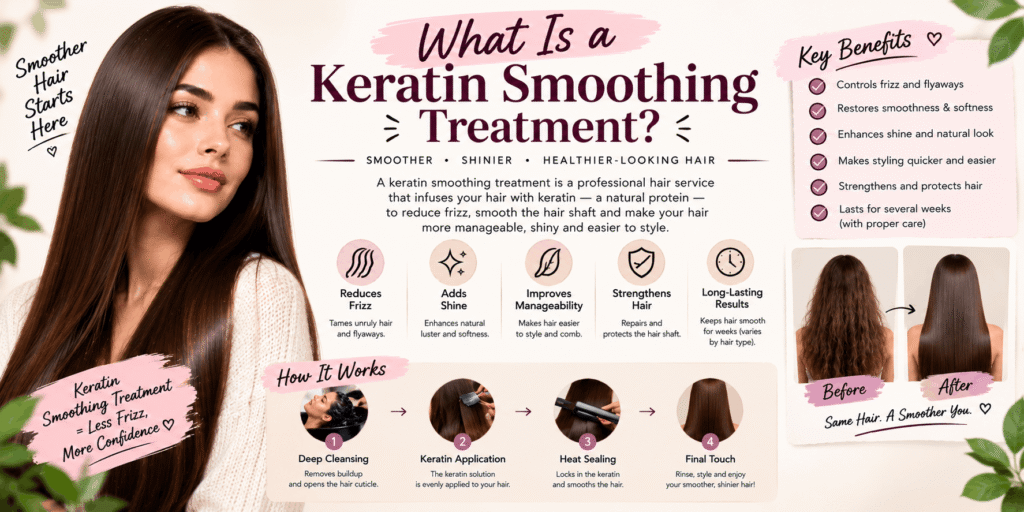
A keratin smoothing treatment is a professional hair service that uses a smoothing formula and, commonly, heat to reduce frizz and improve manageability. Keratin is a structural protein naturally present in hair, but the presence of keratin in a product does not guarantee that the service will repair all hair damage or produce identical results for everyone.
Hair can become rougher and harder to manage because of weather, repeated heat styling, chemical processing, and physical wear. A smoothing service aims to make the hair surface behave more smoothly and reduce the amount of time needed to style it.
The name “keratin treatment” does not describe one universal formula. Different products use different ingredients, application methods, and heat settings. Some mainly reduce frizz, while others can significantly relax a person’s natural curl pattern.
Is Keratin Treatment the Same as Permanent Straightening?
No. Many keratin smoothing services gradually lose their effect as the hair is washed and grows. Permanent chemical straightening, by contrast, changes the structure of treated hair more extensively. A smoothing treatment may leave curls looser or less defined, but the outcome depends on the specific product and procedure.
How Does a Keratin Smoothing Treatment Work?
A typical salon process involves applying a smoothing solution, allowing it to process according to the product directions, and using heat to finish the service. The precise method varies by formula.
The Treatment Process Explained
- Preparation: The stylist assesses the hair and cleanses it as directed by the manufacturer.
- Application: The smoothing formula is applied in sections, following the specified amount and placement.
- Processing: The product remains on the hair for the time stated in its instructions.
- Heat styling: Depending on the formula, the stylist may blow-dry and flat-iron the hair. This stage can help produce the intended finish, but it can also create a risk of chemical exposure or heat damage.
- Finishing and aftercare: The stylist explains whether the hair can be washed immediately and which products or styling practices to avoid.
Not every service follows the same sequence. Some formulas have different rinsing requirements, heat settings, or post-treatment instructions.
Why Does Hair Look Smoother Afterward?
The formula and finishing technique can reduce surface roughness and make strands align more evenly. That can improve reflected light, giving hair a shinier appearance. The treatment may also reduce the expansion and disruption associated with humidity.
However, a shinier appearance does not necessarily mean that damaged hair has returned to its original healthy state. Hair that has split or suffered structural damage cannot be made permanently new by a smoothing service.
Benefits and Limitations
The main advantage of a keratin smoothing treatment is improved manageability. The main limitation is that its results, longevity, and suitability depend heavily on the formula and the condition of the hair.
Potential Benefits
- Less visible frizz: Hair may look smoother in humid conditions.
- Easier styling: Blow-drying and daily styling may take less effort.
- More shine: A smoother-looking surface can reflect light more evenly.
- Softer feel: Hair may feel easier to comb and handle.
- A different finish: Some formulas can reduce curl volume or loosen the appearance of curls.
What It Cannot Guarantee
A keratin service cannot guarantee permanent straight hair, eliminate all breakage, or repair every form of chemical damage. It may also be unsuitable for some people because of the formula’s ingredients or the amount of heat required.
Results are not identical across hair types. Fine hair may lose some volume, tightly curled hair may retain considerable texture, and highly processed hair may need a gentler alternative.
Who Should Consider a Keratin Treatment?
A keratin smoothing treatment may suit people who want less frizz and easier styling without necessarily seeking a permanent straightening service. The decision should depend on the hair’s history, current condition, and the finish the person wants.
Frizzy or Humidity-Sensitive Hair
If your hair expands in humid weather and takes a long time to smooth with a blow-dryer, a suitable smoothing service may help. Ask the stylist whether the chosen formula is designed to control frizz while preserving some natural movement.
Curly or Coily Hair
Curly and coily hair can be treated, but the desired result needs careful discussion. A person who wants to keep defined curls may prefer a conditioning routine or a treatment specifically designed to preserve curl shape. A stronger smoothing formula may loosen the pattern, so do not book without understanding that possibility.
Color-Treated or Bleached Hair
Previously colored hair is not automatically unsuitable, but bleaching and repeated chemical services can make strands more fragile. Ask the stylist to assess elasticity, breakage, and the timing of other services. A strand test may help identify an undesirable response, although it cannot rule out every risk or predict all long-term results.
Fine or Damaged Hair
Fine hair may become flatter or appear less full after smoothing. Hair that is already breaking may also be vulnerable to additional heat and handling. If your main concern is breakage rather than frizz, prioritize identifying its cause and improving your hair-care routine before considering a smoothing procedure.
What Happens During a Keratin Smoothing Treatment?
A salon appointment typically includes consultation, preparation, formula application, processing, heat styling where required, and aftercare instructions. The total time varies by hair length, density, technique, and the product used, so ask the salon for an estimate instead of relying on a universal duration.
Before starting, tell the stylist about:
- Recent bleaching, coloring, relaxing, or straightening.
- Previous reactions to hair products.
- Scalp irritation or sensitivity.
- Existing breakage and areas of thinning.
- Your desired result: reduced frizz, looser curls, or a straighter finish.
Ask to see the product’s ingredient information and Safety Data Sheet (SDS), where applicable. The SDS helps identify hazards and recommended precautions, but it is not a guarantee that the product is risk-free.
Keratin Treatment vs. Other Hair Treatments
These services are not interchangeable. Their intended effects, chemical processes, and maintenance requirements differ, and brand names alone do not establish what a formula contains.
| Treatment | Main purpose | Important consideration |
|---|---|---|
| Keratin smoothing treatment | Reduce frizz and improve manageability | Formula-dependent; some products require substantial heat |
| Brazilian blowout | A branded category of professional smoothing service | Check the exact product and its ingredient and safety information |
| Hair botox | A marketing term commonly used for conditioning or smoothing services | It is not injectable Botox; formulations vary |
| Deep conditioning | Improve softness and reduce dryness-related roughness | Usually temporary conditioning rather than major curl-pattern alteration |
| Chemical relaxer | Straighten or relax curls through chemical restructuring | Can cause significant damage if poorly selected or applied |
A useful distinction is the amount of change you want. If you mainly want softer, easier-to-comb hair, start by considering conditioning and styling changes. If you want substantial frizz reduction, ask about smoothing formulas. If you want a major, lasting change to the curl pattern, discuss the separate risks of chemical straightening with a qualified professional.
Risks and Safety Considerations
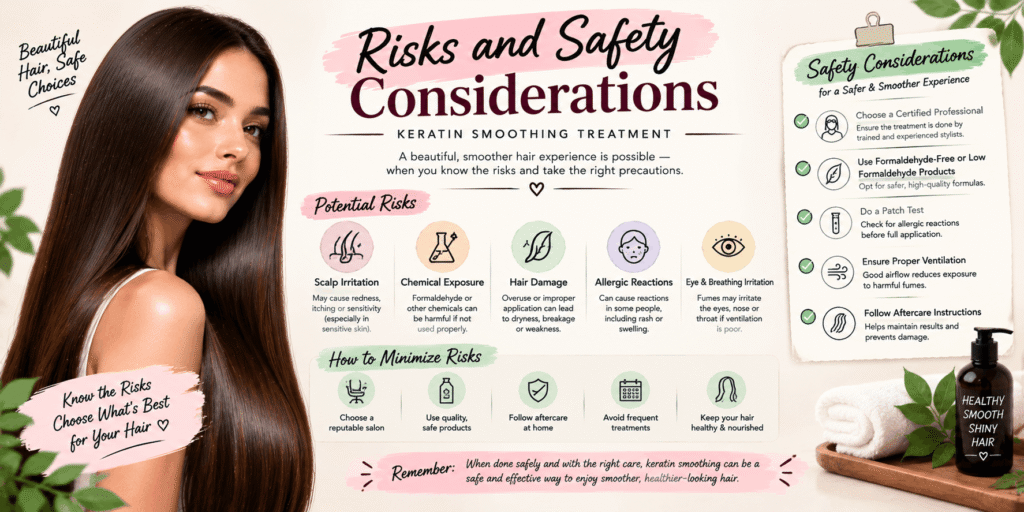
The ingredients and application method matter more than the word “keratin” on a salon menu. Some hair-smoothing products release formaldehyde when heated, and exposure can affect both customers and salon workers.
The U.S. Food and Drug Administration (FDA) identifies formaldehyde, formalin, and methylene glycol as ingredient names consumers should look for when assessing these products. The FDA advises against applying professional hair-smoothing products yourself at home and recommends asking salon professionals about ingredients, safety documentation, training, and ventilation.
The Occupational Safety and Health Administration (OSHA) has also documented cases where salon smoothing products exposed workers to formaldehyde, including products with misleading or incomplete labeling. A “formaldehyde-free” claim alone should not replace a review of the formula and its safety documentation.
Possible Adverse Effects
Depending on the product and exposure, concerns can include:
- Eye, nose, or throat irritation.
- Coughing, wheezing, or other breathing symptoms.
- Headaches, dizziness, or nausea.
- Skin irritation or allergic dermatitis.
- Hair dryness, breakage, or unwanted texture changes from unsuitable processing or excessive heat.
These risks do not mean every smoothing product has the same hazards. They mean that the exact formula, its use conditions, and appropriate controls must be assessed.
How to Check a Salon’s Safety Practices
Ask these questions before booking:
- What is the exact product name and manufacturer?
- Can I review the ingredient list and applicable Safety Data Sheet?
- Does the formula contain formaldehyde, formalin, methylene glycol, or ingredients that may release formaldehyde when heated?
- What ventilation and protective measures are used during application and heat styling?
- Is this product appropriate for my hair’s chemical history and current condition?
- Are there alternatives that meet my goals with fewer relevant hazards?
If the salon cannot explain the product or its safety precautions, postpone the service until you have enough information. Do not attempt a professional smoothing treatment at home simply because a kit is available online.
Keratin Treatment Aftercare
Aftercare helps maintain the cosmetic result and reduce avoidable stress on the hair. The correct routine depends on the product, so follow the instructions supplied by the manufacturer and stylist.
1. Follow the Correct Washing Schedule
Some formulas require a waiting period before washing, while others allow immediate washing. There is no single rule that applies to every keratin treatment. Confirm the instructions before leaving the salon.
2. Choose Compatible Cleansing Products
Ask whether the formula requires a particular shampoo or has restrictions on ingredients. Sodium chloride and certain cleansing systems may affect some treatments, but not every formula has identical requirements. Check the manufacturer’s guidance rather than assuming that all sulfate-free products are automatically suitable.
3. Reduce Unnecessary Heat
Use the lowest effective heat setting when styling and avoid repeated flat-ironing just to recreate the salon finish. Excessive heat can weaken hair over time, especially when strands are already bleached or fragile.
4. Condition According to Your Hair’s Needs
Use a suitable conditioner and, when appropriate, a deep-conditioning product. Conditioning can improve softness and manageability, but it does not reverse every form of structural damage.
5. Be Gentle With Wet Hair
Detangle gradually with an appropriate comb or brush, starting at the ends. Avoid forceful brushing, tight hairstyles, and repeated friction if your hair is prone to breakage.
6. Plan Maintenance Realistically
The smoothing effect gradually changes with washing, styling, and new hair growth. Instead of booking repeated treatments automatically, assess how much benefit remains and whether your hair is still in good condition. Ask the stylist whether another session is necessary and how frequently the specific product is intended to be used.
Practical Examples and Decision Checklist
A simple decision framework can help you choose a service based on your actual needs rather than a salon trend.
Example 1: Frizz Is the Main Problem
Imagine your hair is healthy but becomes puffy after blow-drying in humid weather. You want a smoother finish and less styling time, but you do not mind keeping some natural wave.
A smoothing treatment designed for frizz reduction might be worth discussing with a stylist. Compare the expected finish, safety documentation, and maintenance requirements before deciding. You may also find that conditioning, an appropriate leave-in product, and improved blow-drying technique meet your needs with less commitment.
Example 2: Your Hair Is Bleached and Breaking
Imagine you have recently lightened your hair and notice short broken strands around the crown. You want a keratin service because your hair feels rough.
In this case, the priority should be a professional assessment of the breakage and the hair’s ability to tolerate further processing. Adding a heat-intensive service may not be the best first step. A gentler routine and a pause from additional chemical services may be more appropriate until the condition is assessed.
These examples are decision scenarios, not claims about individual treatment outcomes.
Before-You-Book Checklist
- I know whether I want frizz reduction, looser curls, or straighter hair.
- I have disclosed all recent chemical treatments.
- The salon has identified the exact product and manufacturer.
- I have asked about ingredients and relevant safety documentation.
- The salon has explained its ventilation and application precautions.
- My hair’s condition has been assessed, with a strand test if appropriate.
- I understand the expected maintenance and aftercare.
- I have compared the service with less intensive alternatives.
If several answers are unclear, delay the appointment until the salon can address them.
A keratin smoothing treatment is used mainly to reduce frizz, improve the appearance of smoothness, and make hair easier to style. Some formulas also relax waves or curls, but the outcome varies by product and hair type. It is not a universal solution for damaged hair, and it does not guarantee permanently straight hair.
The duration depends on the formula, application, hair texture, washing habits, and maintenance routine. Because treatments differ, there is no single duration that applies to everyone. Ask the salon for the manufacturer’s expected result and the maintenance schedule for the exact product. Treat a general estimate as guidance, not a guarantee.
Safety depends on the ingredients, application conditions, exposure, and individual sensitivity. The FDA warns that some hair smoothing products release formaldehyde when heated, which can irritate the eyes, skin, and respiratory system. Ask about the exact product, ingredients, Safety Data Sheet, and ventilation. Do not proceed if the salon cannot explain its safety practices.
2 Comments