Orange nails can go far beyond the typical bright summer manicure. Depending on the shade and finish, orange polish can look warm and autumnal, soft and understated, playful and colorful, or bold enough to become the main feature of an entire manicure. From translucent jelly finishes to metallic copper and detailed nail art, there is plenty of room to experiment with the color.
The easiest way to make orange nails feel fresh is to think about more than the polish shade itself. Finish, shape, placement, and color combinations can completely change the result. A sheer peachy orange can create an almost barely-there manicure, while a saturated tomato shade delivers a much stronger statement.
For fall, deeper orange tones naturally pair well with warm neutrals, reds, metallics, and muted shades. But you do not have to stick to traditional autumn colors. Pink, lilac, turquoise, and even translucent finishes can make orange feel unexpected and modern.
Warm Orange Looks for an Autumn Manicure
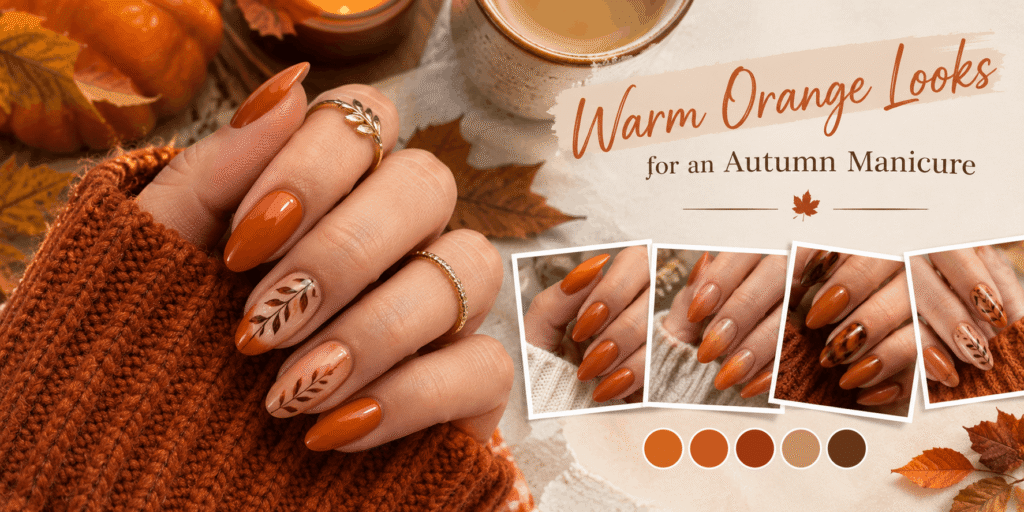
One of the simplest ways to wear orange nails is to choose a shade that already has some depth. Richer tones tend to work particularly well when you want the manicure to feel seasonal without relying on complicated nail art.
Copper
Copper orange sits somewhere between a traditional orange polish and a warm metallic shade. Its reflective finish gives the color more dimension, particularly when light moves across the nails.
This look works especially well when you want something sophisticated without adding multiple colors or elaborate designs. A smooth copper finish can stand completely on its own, while a few nails with a slightly different finish can create a subtle variation.
Copper is also easy to adapt to different nail lengths. On short nails, the metallic surface can make a simple manicure feel intentional, while longer nails provide more space for the reflective shade to catch the light.
Vivid Tomato Orange
Tomato orange has a stronger red influence than a classic pumpkin shade, giving it a bright and energetic appearance. It is an excellent option when you want orange nails to remain the main focus.
The shade can be worn as a completely solid manicure or used selectively as a French tip or accent. A glossy topcoat is particularly effective because it emphasizes the richness of the color.
If you prefer a more understated result, a slightly muted tomato shade can provide the same warm effect without looking quite as intense.
Solid Spritz Nails
A solid spritz-inspired orange manicure takes its inspiration from the bright citrus tones associated with refreshing summer drinks, but the shade can easily transition into fall when paired with the right nail shape and finish.
The beauty of this idea is its simplicity. Every nail uses the same color, allowing the shade itself to do the work.
For a more modern appearance, choose a slightly muted or creamy orange rather than an extremely neon formula. A glossy finish keeps the manicure fresh, while a satin finish creates a softer effect.
Short Pale Peach Nails
Orange does not always have to be bold. Pale peach is a softer interpretation that works particularly well for short nails and minimalist manicures.
The shade can be applied opaquely for a clean pastel appearance or layered lightly for a more translucent finish. Its subtle warmth makes it easy to wear when you want something different from nude without moving into a dramatic color.
Short nails can look especially polished with this approach because the simple color does not overwhelm the available nail space.
Sheer, Jelly, and Aura Effects
If a traditional orange nails feels too straightforward, changing the finish can completely transform it. Jelly and aura techniques allow the color to look dimensional without requiring complicated illustrations on every nail.
Jelly Orange Skittles
A jelly skittle manicure uses several translucent orange-related shades rather than making every nail identical. You might use pale peach on one nail, a richer orange on another, and a deeper amber tone elsewhere.
Because the formulas remain somewhat transparent, the colors have a glossy, glass-like quality. Light can pass through the layers, making the manicure appear softer than a conventional opaque polish.
The different shades should still share a similar undertone so the set feels coordinated. You do not need five dramatically different colors to create the effect.
Jelly Pumpkin
Jelly pumpkin nails give a traditional fall orange a more translucent finish. Instead of using a solid pumpkin polish, the color appears slightly see-through and layered.
This can make the shade feel lighter and more contemporary while retaining its warm autumn character. Adding a glossy topcoat can emphasize the depth of the jelly finish.
For extra detail, a small accent such as a tiny pumpkin-inspired shape or subtle shimmer can be added to one or two nails rather than decorating the entire set.
Cat Eye Aura
Combining an aura effect with a cat-eye finish creates a manicure that changes appearance as the light moves across the surface. The center of the nail can be slightly lighter or darker, while the magnetic shimmer creates a reflective line.
Orange works particularly well with this technique because the warm base allows the shifting metallic effect to stand out.
The result is more dimensional than a conventional solid polish, but it does not require a large amount of painted artwork. This makes it a good choice if you want something visually interesting while keeping the overall manicure cohesive.
Pink and Orange Aura Nails
Pink and orange make an energetic combination because the two colors can blend without losing their individual warmth. An aura design allows the shades to fade gradually into one another rather than creating a hard boundary.
You can make orange the dominant shade and place pink toward the center, or reverse the arrangement for a softer result. A translucent base can make the transition even more subtle.
This design works particularly well on medium or longer nails where there is enough surface area for the gradient to become visible.
Spritz Aura Nails
A spritz-inspired aura manicure uses warm orange tones in a soft, diffused pattern rather than applying one solid shade from cuticle to tip.
The center of the nail can carry a lighter citrus tone surrounded by a richer orange edge. A glossy finish helps blend the colors visually and gives the design a polished appearance.
Because the color transition does most of the work, additional nail art is optional. A tiny metallic detail on one or two nails can be enough if you want another element.
Playful Orange Nail Art
Orange nails becomes especially versatile when paired with contrasting colors or simple graphic shapes. You can use the color as a small accent instead of covering the entire nail.
Orange Squiggle French Tips
A squiggle French tip replaces the traditional straight or curved French line with an irregular, flowing shape. Orange works particularly well for this design because the color immediately makes the pattern more noticeable.
Start with a sheer, milky, or pale base and place the orange squiggle close to the free edge. The line does not need to be perfectly symmetrical across every nail.
Keeping the base relatively simple allows the unusual tip shape to remain the focal point. You can also alternate orange with another warm shade if you want a more colorful set.
Pink Shimmer Orange French Tips
For a softer version of orange French tips, use a pink-shimmer base underneath the orange detail. The subtle sparkle gives the manicure dimension without overpowering the tip.
The orange can be painted as a conventional French curve or shaped into a thinner, more modern line. A slightly translucent base works particularly well because it allows the shimmer to remain visible.
This combination is useful when you want the manicure to feel feminine and colorful without relying on large decorative elements.
Pink and Orange Alternating Nails
Instead of combining pink and orange on the same nail, alternate the shades across the manicure. This keeps the design simple while creating enough variation to make the set more interesting than a single-color manicure.
The colors can be glossy, matte, or slightly translucent depending on the desired finish. Keeping the nail shape consistent helps the two shades feel like part of one coordinated set.
For a more subtle result, choose a muted peachy pink with a softer orange. For a bolder manicure, use saturated versions of both shades.
Groovy Swirls
Swirling lines can turn orange into a retro-inspired nail design. Curved bands of orange can be paired with cream, pink, brown, yellow, or another complementary shade.
The lines do not need to cover every part of the nail. Leaving some negative space between the curves can prevent the design from becoming visually crowded.
For a coordinated manicure, repeat the same few colors across each nail but vary the direction and size of the swirls. This creates an intentionally mismatched appearance while keeping the palette consistent.
Lilac, Orange, and Turquoise Nails
Lilac and turquoise may not be the first colors associated with orange, which is exactly what makes this combination interesting. The three shades create a playful contrast that moves the manicure away from predictable autumn palettes.
You can divide the colors between different nails, create small sections of each shade, or use them as thin accents over a neutral base.
The key is to control the amount of each color. If all three shades are used heavily on every nail, the manicure can become busy. Using one shade as the main color and the others as accents usually creates a clearer visual balance.
Orange Daisies
Small orange daisies provide a simple floral interpretation without making the manicure overly detailed. A pale base can make the flowers stand out, while a warmer orange background can create a more tonal appearance.
The flowers do not have to be identical. Slight differences in petal size can make the manicure feel hand-painted rather than mechanically repeated.
For a fall-inspired version, use cream or muted yellow for the flower centers instead of a very bright contrast. This keeps the design connected to the warmer palette associated with the season.
Orange Evil Eye Nails
An evil-eye motif gives orange nails a graphic focal point. The design can be created using several concentric shapes, usually with contrasting colors that make the central eye immediately recognizable.
Orange can be used as the outer detail, the main background, or one of the inner rings. Keeping the remaining nails relatively simple prevents the motif from competing with too many other patterns.
This idea works particularly well as an accent nail. You can wear solid orange on most fingers and reserve the detailed design for one or two nails.
Koi Fish Nails
Koi-inspired nail art brings a delicate illustrated quality to an orange manicure. The design can take inspiration from the warm orange, white, and darker markings commonly associated with koi fish without attempting to recreate every tiny detail.
A sheer or pale base provides a clean background for the orange shapes. Small curved patches can be placed across the nail to suggest the flowing pattern of a fish while keeping the overall manicure wearable.
You can also use a glossy finish to enhance the watery feeling of the design. A few tiny darker accents can add definition, but the artwork does not need to become extremely detailed.
This style works especially well when only one or two nails carry the koi-inspired artwork while the rest use a coordinated orange shade.
Mango Cuticle Cutouts
Mango-inspired cuticle cutouts offer a more unexpected way to use orange. Instead of covering the entire nail, the color is concentrated around the cuticle area or incorporated into a negative-space design.
Leaving part of the natural or neutral base visible creates contrast around the orange detail. This makes the manicure feel lighter and gives the color a more graphic appearance.
The cutout can be curved to follow the natural shape of the cuticle or designed as a more deliberate geometric accent. Keeping the surrounding area simple allows the placement of the orange to become the main feature.
This approach can also be adapted for shorter nails because it does not depend on having a large surface for complicated artwork.
Orange Jelly Meets Confetti
Orange jelly polish and confetti details make a playful combination. The translucent base gives the manicure depth, while tiny pieces of glitter or decorative particles add flashes of contrast underneath the glossy surface.
The confetti can be concentrated on selected nails rather than spread evenly across the entire set. This prevents the design from becoming overly busy.
For a more sophisticated version, use metallic gold or copper accents. For something more playful, mix several colors that complement the orange base.
The translucent finish is important because it allows the decorative elements to appear layered instead of simply sitting on top of an opaque background.
Orange Mismatch Gradient Nails
A mismatch gradient manicure allows every nail to follow the same general color story while using a slightly different transition.
One nail might fade from pale peach into orange, another from orange into red, while another uses orange against a warm nude or pink. The individual nails look different, but the shared color family keeps everything connected.
This technique is particularly useful if you cannot decide on one exact shade of orange. Instead of choosing between several colors, you can incorporate them into one coordinated set.
The gradients can also vary in direction. Some may transition from the cuticle toward the tip, while others can have a centered aura effect.
Red and Orange Ombré
Red and orange create a naturally warm ombré because both shades sit close together visually. The transition can be dramatic with saturated colors or much softer with muted autumn tones.
For a classic appearance, place the lighter orange toward the tip and allow the red to deepen around the base. Reversing the placement creates a different effect without changing the color combination.
A glossy finish can make the gradient look particularly smooth. If you prefer a softer manicure, a satin or velvet-like topcoat can reduce the intensity of the color.
This design is also easy to personalize according to the season. Bright orange and red create a lively result, while burnt orange and deep red feel more suited to cooler-weather styling.
Sheer Pink and Orange Bullseye Nails
Bullseye nails use concentric shapes to create a target-like pattern. Combining orange with a sheer pink base gives the design a softer appearance than using several dark or highly contrasting colors.
The circles can be perfectly centered for a clean graphic look or slightly irregular for a more playful handmade effect.
You do not need to cover every nail with multiple rings. One or two bullseye accents can provide enough detail, while the remaining nails can use a sheer pink or orange finish.
A thin outline between the colors can make each ring more visible, although leaving the shades to blend slightly can create a softer result.
Soft and Minimal Orange Ideas
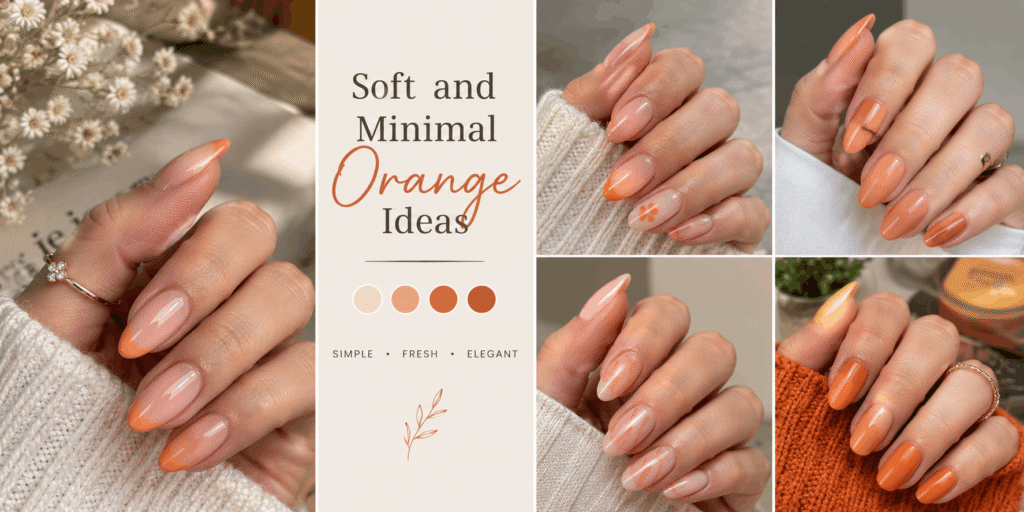
Not every orange manicure needs elaborate artwork. Some of the most wearable designs rely on subtle changes in shade, placement, or finish.
Jelly Center
A jelly-center design places a translucent or slightly brighter orange area toward the center of the nail while allowing the surrounding base to remain softer.
The result resembles a glow coming from inside the nail rather than a conventional block of color. This technique works especially well with sheer bases because the transition can remain delicate.
You can use a deeper orange around the edges and a lighter tone in the middle, or reverse the combination for a different visual effect.
The design looks particularly polished under a high-shine topcoat, which helps emphasize the transparent layers.
Orange Evil Eye Nails
For another interpretation of orange evil-eye nails, use the motif more sparingly. Instead of placing a large eye on every nail, create one detailed accent and keep the remaining nails relatively clean.
A warm orange background can frame the design, while contrasting blue, cream, and darker details create the recognizable circular pattern.
This version works well for anyone who likes decorative nail art but does not want every finger covered in illustrations.
Spritz Aura Nails
A soft spritz aura can be built around a pale orange center that gradually becomes deeper toward the outer portion of the nail.
The diffused edges are what distinguish an aura design from a standard gradient. Rather than seeing a clear line between two shades, the colors should appear to melt into each other.
A translucent finish can make the manicure look especially soft. If you want additional dimension, a subtle shimmer layer can be placed over the design without adding complicated artwork.
Orange French and Statement Finishes
French designs are another way to introduce orange without committing to a completely orange manicure. The tip becomes the focal point while the base remains neutral or translucent.
Pink Shimmer Orange French Tips
A delicate pink-shimmer base combined with orange tips creates a manicure that sits between playful and polished. The shimmer catches the light while the orange provides the stronger color contrast.
The tips can be kept thin for a minimalist result or made wider for a more noticeable French effect.
A curved tip is the classic option, but an angled or slightly irregular edge can make the manicure feel more contemporary.
Short Pale Peach Nails
For a quieter version of the trend, pale peach provides a soft orange alternative that works beautifully on shorter nails.
The color can be worn as a creamy opaque polish or layered sheer enough to retain some natural depth. A glossy finish gives the nails a clean appearance without requiring any additional decoration.
This is also a useful option if you want an orange manicure that can transition easily between casual and more formal settings.
How to Choose the Right Orange Nail Design
With so many versions of orange available, choosing the right design often comes down to the finish and amount of detail you actually enjoy wearing.
If you prefer low-maintenance nails, a solid orange, pale peach, copper, or simple French tip can provide plenty of impact without requiring complicated artwork. These designs are also easier to recreate and touch up.
If you enjoy nail art, jelly finishes, aura effects, floral details, swirls, bullseyes, and koi-inspired patterns provide more room for creativity.
Nail length can also influence the choice. Short nails can look particularly clean with solid colors, tiny accents, French tips, or strategically placed negative space. Longer nails offer more room for gradients, detailed illustrations, and larger decorative patterns.
Your preferred orange undertone matters too. Yellow-based oranges tend to feel brighter and more citrus-like, while red-based oranges can appear richer and warmer. Peachy oranges offer a softer middle ground.
You can also use the finish to change the mood. Glossy polish emphasizes brightness, shimmer introduces reflected light, jelly formulas create transparency, and metallic finishes make the color feel more dramatic.
Rather than trying to copy one design exactly, consider combining one or two features you like. For example, a copper base could receive a simple French detail, or a jelly orange manicure could include one small floral accent. This creates a personalized set without making every nail compete for attention.
Final Thoughts
Orange nails offer far more variety than a single bright polish might suggest. The color can move from pale peach and translucent jelly to deep red-orange, metallic copper, and vibrant citrus shades, making it easy to create completely different moods with the same basic color family.
The most interesting designs often come from changing one element at a time. A new finish can transform a solid shade, a small accent can change a simple manicure, and an unexpected color pairing can make traditional orange feel completely new.
For fall, richer oranges, copper tones, red-orange gradients, and warm jelly finishes can create a seasonal effect. If you prefer something lighter, peach, pink, and sheer orange combinations offer a softer alternative.
Whether you choose an intricate koi-inspired design or a simple glossy orange manicure, the key is finding a version that fits your nail length, personal style, and preferred level of maintenance.
Yes, orange nails can work across many seasons and styles. Bright orange creates a bold look, while softer peach, burnt orange, and sheer shades offer more subtle options.
Orange pairs well with white, pink, nude, red, yellow, purple, turquoise, and metallic shades. The best combination depends on whether you want a soft, playful, or high-contrast manicure.
Yes. Burnt orange, pumpkin, copper, and warm terracotta shades naturally complement fall-inspired manicures. They can also be paired with neutral or earthy colors for a seasonal look.
Absolutely. Sheer orange, glossy finishes, delicate French tips, and minimal accents can create a polished appearance without making the manicure feel overly bold.
3 Comments