
Squoval nails sit in that sweet spot between soft and structured. They keep the straight edge associated with square nails but round off the corners, creating a shape that feels polished without looking overly sharp. That small difference makes them surprisingly adaptable to everything from delicate French tips to colorful nail art.
If you usually find square nails too angular or oval nails too rounded, squoval nails can offer a middle ground worth trying. The shape also gives nail art a clean surface while maintaining a softer outline around the fingertips. Whether you prefer subtle manicures or designs that attract attention, the squoval shape gives you plenty of room to experiment.
Pastel Diagonal Tip
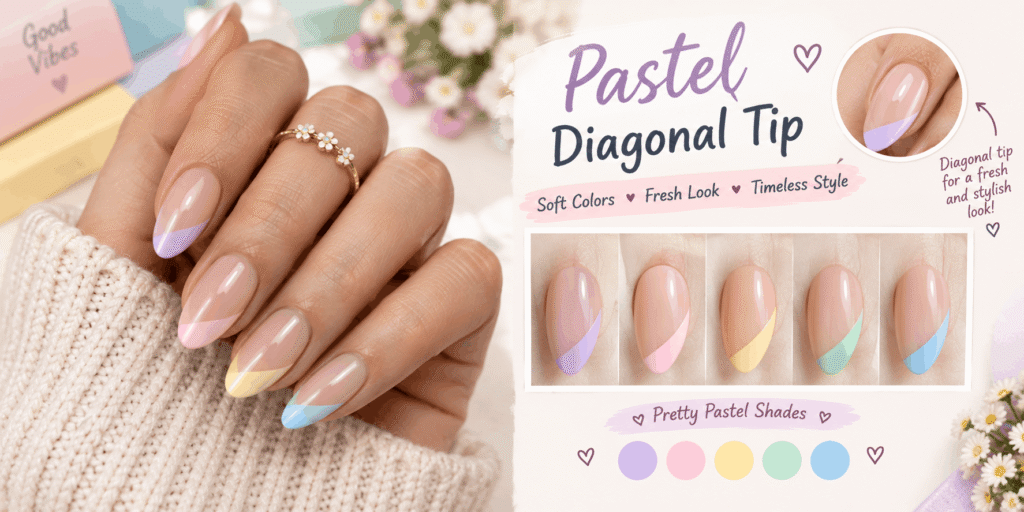
French tips do not have to run straight across the nail. A diagonal tip gives the familiar idea a more modern direction, and the squoval shape provides a particularly neat canvas for the angled line.
Soft pastel shades work beautifully here. Think powder blue, pale lavender, butter yellow, muted peach, or a combination of several tones. Instead of placing one color across every nail, you can switch the shade while keeping the same diagonal placement.
The straight outer edge of squoval nails makes the diagonal detail especially noticeable. At the same time, the rounded corners stop the manicure from looking too severe.
For an understated version, keep the base sheer and make the diagonal tips very thin. If you want something more playful, increase the width of the colored section and use a different pastel on each nail.
Another option is to leave a small gap between the natural-looking base and the colored tip. That negative space creates a cleaner separation and gives the design a slightly editorial feel.
Groovy Mani
A groovy manicure brings movement into the design through curved lines, unexpected color combinations, and playful shapes. Squoval nails work well with this style because their relatively straight sides provide contrast against the flowing artwork.
You can use two or three shades for a coordinated appearance or create a more colorful set with several complementary tones. Wavy lines can move vertically, diagonally, or across the nail in loose arcs.
The design does not need to be perfectly symmetrical. In fact, allowing each nail to have a slightly different arrangement can make the manicure feel more artistic.
A neutral base is a useful starting point if you want the colors to stand out. For something bolder, use a colored base and layer contrasting curves over it.
The important part is maintaining enough space between the shapes so the artwork remains easy to see. When every area is filled, the curves can lose their visual impact.
Glossy Buffed Finish
Sometimes the shape itself can be the star. A glossy buffed finish puts attention on the clean outline of squoval nails rather than relying on complicated artwork.
This look can begin with a sheer nude, pale pink, creamy beige, or translucent peach. The goal is to create an even surface with a reflective finish that catches light as the hands move.
Because squoval nails have a defined edge, a glossy monochromatic manicure can look especially crisp. It is an excellent option when you want your nails to appear polished but do not want obvious nail art.
You can also add a subtle twist by choosing a slightly translucent color instead of a completely opaque polish. This allows some of the natural nail to remain visible and gives the finish more depth.
For a more distinctive version, apply a delicate glazed or pearlescent layer over the base. The result stays minimal while creating a noticeable shift in the way the nails reflect light.
Cheetah Manicure
Animal print does not have to cover the entire nail. A cheetah manicure can be adapted into small sections, accent nails, or scattered spots for a more wearable interpretation.
A warm neutral base creates a natural background for the pattern, but you can move away from traditional colors if you want something more creative. Pink, blue, lavender, or even a pastel combination can transform the familiar print.
The spots can also vary in size. Larger markings create a stronger visual effect, while tiny irregular shapes make the manicure more delicate.
Squoval nails are useful for this design because the straight sides give the artwork a defined boundary. The rounded corners keep the overall result softer than it might appear on an extremely angular shape.
Instead of making every nail identical, consider placing the pattern heavily on a few nails and using only a handful of spots on the others. This creates variation without making the manicure feel crowded.
Framed Flowers
Framed flowers turn the edge of the nail into part of the artwork. A thin outline follows the perimeter while tiny floral details sit inside the frame, creating the impression of a miniature picture.
A sheer or pale base works particularly well because it gives the flowers enough room to stand out. The frame can be white, metallic, or a deeper shade that contrasts with the base.
The flowers themselves can remain extremely simple. Small petals, tiny dots, and miniature leaves are enough to create the effect without requiring highly detailed painting.
This design can also be personalized through color. White flowers create a delicate appearance, while bright flowers can make the same layout much more cheerful.
The squoval shape is particularly suited to framed designs because its straighter sides make it easier to follow the perimeter. The softened corners then prevent the outline from looking excessively rigid.
For a subtle manicure, frame only one or two nails and leave the others with a coordinating solid shade.
Celestial Nails
Stars, moons, tiny dots, and shimmering details can transform squoval nails into a small night-sky-inspired manicure. The design can be dramatic with a deep base or surprisingly subtle with softer colors.
A navy, muted purple, or dark blue background provides strong contrast for stars and metallic details. If you prefer a lighter manicure, use a pale lavender or translucent base and keep the celestial artwork delicate.
The stars do not need to be identical. A combination of tiny dots, small four-point stars, crescent shapes, and scattered sparkles can make the set feel more natural.
You can also use a gradient background to give the impression of a changing sky. Darker color near one edge can gradually transition into a lighter shade toward the center.
For everyday wear, reduce the number of decorative elements and let one or two larger details become the focal points. This keeps the celestial theme recognizable without turning the manicure into an overly elaborate design.
Speckled Mani with Painted Moons
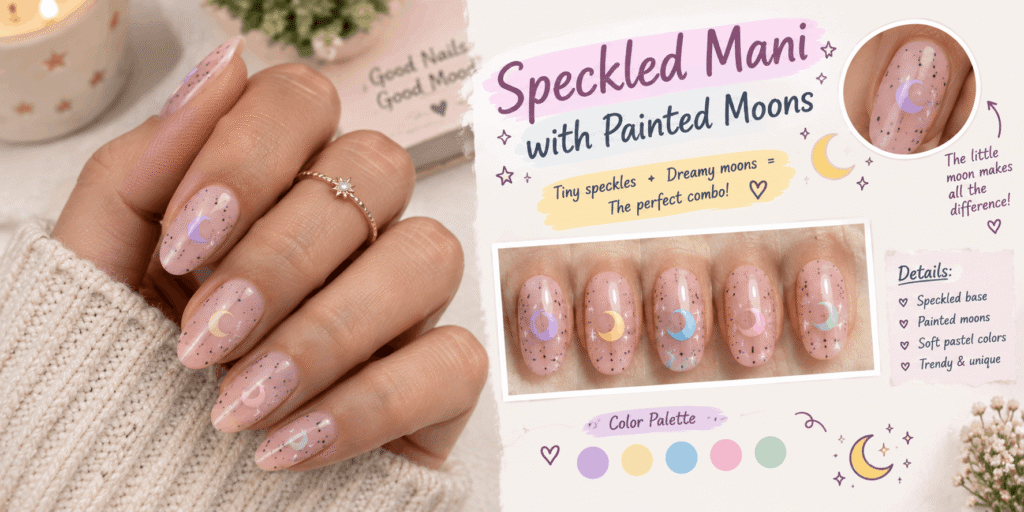
A speckled manicure gives the nails an almost handmade appearance. Instead of aiming for a completely uniform surface, tiny scattered dots create a subtle layer of visual texture.
A creamy, beige, pale pink, or muted blue base can work well as the background. The speckles can then be added in a contrasting shade, either randomly distributed or concentrated toward particular areas.
The painted moons introduce a second detail without overwhelming the pattern. Small crescent shapes can sit near the cuticle, creating a quiet focal point on each nail.
You can keep the moons consistent across the set or slightly change their position from nail to nail. A metallic finish can make them catch the light, while a flat cream or white shade gives the manicure a softer appearance.
For a more artistic result, combine different sizes of speckles rather than using dots that are all exactly the same. The irregularity makes the design feel less mechanical and more like hand-painted artwork.
Because squoval nails have a relatively broad central surface, there is enough room for the speckles and moons to remain visually separate. This helps the design stay readable instead of becoming one busy pattern.
Slim French Mani
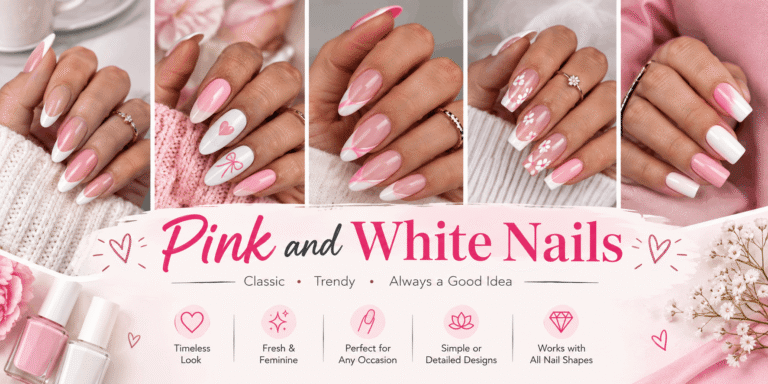
A slim French manicure is a simple way to emphasize the outline of squoval nails without covering much of the nail with color. The tip is kept narrow, creating a fine border across the free edge.
A sheer pink, nude, or milky base can make the French line appear especially clean. White is the traditional choice, but softer colors can create a completely different mood.
Try pale blue for a cool finish, muted green for something unexpected, or a delicate metallic line for a more dressed-up manicure.
The width of the tip matters. On shorter nails, a very thick French tip can visually reduce the space available on the nail. Keeping the line slim can help preserve the proportions of the squoval shape.
You can also experiment with the corner area. Rather than creating a perfectly straight line from side to side, the tip can follow the natural curve of the softened corners.
This makes the manicure look customized to the shape instead of simply placing a generic French tip over it.
Supermodel French Tip
The supermodel French tip takes the clean appearance of a classic French manicure and gives it a softer, more refined finish. The base is usually kept natural-looking, while the tip provides just enough contrast to define the nail.
A translucent pink or nude base can make the manicure look particularly effortless. The white tip should complement the length of the nail rather than overpowering it.
On squoval nails, the design can look especially balanced because the straight edge supports the crisp tip while the rounded corners soften the transition.
If you want a less traditional version, use an off-white shade instead of a stark white. This can produce a slightly warmer appearance while still maintaining the recognizable French effect.
The beauty of this design is that it does not require elaborate decoration. The shape, proportions, and clean finish do most of the work.
A glossy top coat can complete the look and give the base and tips a smooth, unified surface.
Soft Gradient
A soft gradient replaces a noticeable line between colors with a gradual transition. This can make squoval nails appear smooth and polished while adding more dimension than a single shade.
Pink fading into white is one possible combination, but there are plenty of alternatives. Lavender can fade into a pale blue, peach can transition into cream, or two closely related nude shades can blend together.
The transition does not need to be dramatic. In fact, a very subtle difference between the colors can create a sophisticated result.
For a more noticeable manicure, choose colors with stronger contrast but keep the transition soft. This gives you the visual interest of multiple shades without creating a hard dividing line.
The technique also works with finishes. A translucent base with a pearly gradient can produce a luminous effect, while a matte gradient creates a quieter appearance.
Because squoval nails have enough surface area for a gradual transition, the colors have room to blend rather than appearing compressed.
Abstract Art
Abstract nail art gives you almost unlimited freedom because there is no requirement for every shape to represent something recognizable. Curves, blocks, dots, thin lines, and irregular forms can all become part of the composition.
A neutral base makes colorful artwork stand out, while a colored base can turn the entire manicure into a more expressive piece.
One approach is to choose a small palette and repeat those shades in different arrangements. Each nail can then have its own composition while still looking connected to the rest of the set.
Another option is to combine glossy and matte sections. The colors can remain similar while the different surfaces create contrast.
Squoval nails are particularly useful for abstract designs because the shape provides both straight and curved boundaries. Geometric sections can echo the straight sides, while rounded artwork can complement the softened corners.
Do not worry about making every line perfectly identical. Small differences are part of what makes abstract artwork interesting.
If you are doing the manicure at home, start with larger shapes and add smaller details afterward. This makes it easier to control the overall composition and prevents the design from becoming crowded.
A restrained abstract manicure can be just as striking as a highly colorful one. For example, two neutral shades with one metallic accent can create a sophisticated result without relying on bright colors.
Finding the Right Squoval Look for You
The best squoval manicure is not necessarily the one with the most complicated artwork. The shape itself already provides a strong foundation, so the right design depends on what you want the finished nails to communicate.
If you prefer a clean appearance, glossy buffed nails, a slim French manicure, or a supermodel-inspired tip can emphasize the shape without adding much decoration.
If you enjoy colorful designs, the pastel diagonal tip and groovy manicure provide more room to experiment. They can be adapted with different color combinations while keeping the overall structure easy to recognize.
For people who like artwork, framed flowers, celestial details, and abstract designs offer more creative possibilities. These can also be scaled up or down depending on nail length.
Animal print and speckled designs provide another route if you want texture and pattern without covering the entire manicure in elaborate illustrations.
Length should be considered alongside the design. Short squoval nails can look especially clean with narrow French tips, glossy finishes, or small decorative details. Longer versions provide more space for patterns and layered artwork.
The finish can be just as important as the color. A glossy surface emphasizes smoothness, while shimmer, pearl, chrome, or matte finishes can completely change the character of the same base shade.
Most importantly, do not feel restricted to one design. You can take the base color from one idea, the tip style from another, and a decorative element from a third. The result can become a completely original manicure rather than a direct copy of a reference.
Final Thoughts
Squoval nails offer a useful balance for anyone who likes the clean geometry of square nails but prefers softer corners. That combination gives the shape a polished appearance while leaving plenty of room for different manicure styles.
From delicate French tips and subtle gradients to animal prints, celestial artwork, and colorful abstract designs, there is no shortage of ways to use the shape. The same squoval outline can look minimal one week and dramatically artistic the next.
When choosing your next manicure, consider more than just the color. Think about how the design interacts with the shape, how much maintenance it requires, and whether the length fits your everyday routine.
A simple manicure can be just as effective as an elaborate one when the proportions are right. Sometimes a glossy finish and carefully shaped edge are enough to make squoval nails look polished.
The real advantage of this shape is its flexibility. You can keep it understated, make it colorful, experiment with artwork, or combine several ideas into something completely your own. That makes squoval nails a reliable starting point whenever you want a manicure that feels both neat and creative.
Squoval nails combine the straight edge of a square nail with gently rounded corners. The result is a balanced shape that looks structured without having the sharp edges of a traditional square manicure.
Yes. Squoval nails can work particularly well on shorter nails because the shape follows a compact outline while the softened corners keep the manicure looking neat.
Square nails have straighter, sharper corners, while squoval nails keep a similar straight edge but soften the corners. This small change gives squoval nails a less angular appearance.
2 Comments