Mood ring colors have fascinated people for decades because a single ring can shift through shades such as black, yellow, green, blue, and purple. Many people use a mood ring color chart to connect these changes with emotions, but the real reason behind the color changes is more scientific than magical. The ring responds to changes in temperature around your finger, which can sometimes happen when your body reacts to different situations.
If you have ever looked down at your ring and wondered why it suddenly changed from blue to green or from purple to dark blue, the color itself is only part of the story. Understanding how mood rings work makes the different shades much easier to interpret.
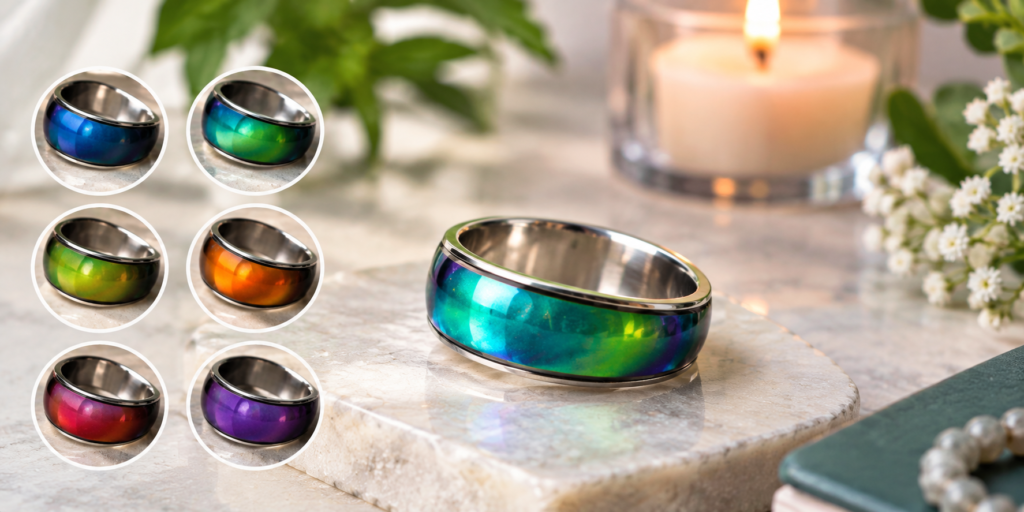
The Intriguing Origins of Mood Rings
Mood rings became especially popular during the 1970s, when colorful jewelry and unusual accessories were everywhere. Their appeal came from a simple but entertaining idea: wear a ring and let its changing color supposedly reveal how you were feeling.
The original concept combined temperature-sensitive materials with jewelry. Instead of using a traditional gemstone that remained the same color, mood rings contained a thermochromic material that could react to changes in temperature. This gave the ring a constantly changing appearance and helped create the idea of a wearable emotional indicator.
The name “mood ring” made the concept even more interesting. People naturally began associating certain colors with feelings such as happiness, calmness, excitement, nervousness, or sadness. Over time, different mood ring color charts appeared, giving particular meanings to the shades displayed by the ring.
However, these charts should be viewed as a fun interpretation rather than a reliable way to measure someone’s emotions. A mood ring does not directly detect feelings, thoughts, or personality. Instead, it responds primarily to temperature changes.
That distinction is important because your hands can become warmer or cooler for many reasons that have nothing to do with your emotional state. Weather, room temperature, physical activity, circulation, and even holding a cold drink can influence the color you see.
The Science Behind Mood Ring Color Changes
The secret behind mood ring colors is thermochromism. Thermochromic materials can change their visible color when their temperature changes. Mood rings traditionally use temperature-sensitive liquid crystals or similar materials beneath the surface of the ring.
When the temperature around your finger changes, the structure of these materials changes as well. That affects which wavelengths of light are reflected toward your eyes, producing a different visible color.
This is why a mood ring may appear dark when your finger is cold and become brighter as the ring warms up. The transition is not the ring “reading” your emotions. Instead, it is responding to a physical change in temperature.
Your body temperature can change slightly when you experience different situations, which is one reason the mood-ring idea can sometimes seem surprisingly accurate. For example, nervousness may cause changes in blood flow to the hands, while relaxation may be associated with warmer, steadier hands. But these relationships are not consistent enough for a ring to diagnose or identify a specific emotional state.
The same color can therefore appear for different reasons. A blue ring does not automatically mean you are calm, and a black ring does not necessarily mean you are upset. The color chart is best treated as a playful guide rather than a scientific emotional test.
Understanding the Mood Ring Color Spectrum
A mood ring color chart usually moves through a broad spectrum, from very dark shades to warmer colors and then into green and blue tones. Different manufacturers may use slightly different materials and color ranges, so there is no single universal chart that applies perfectly to every mood ring.
Black
Black is commonly associated with colder temperatures in traditional mood ring charts. Some charts connect it with stress, tension, or a negative mood, but the practical explanation is usually much simpler: the temperature-sensitive material has shifted into one of its darkest states.
A black-looking ring can appear when your finger is cold or when the surrounding environment lowers the ring’s temperature. If you have just stepped outside during cold weather, the ring may become dark regardless of how you feel.
Gray
Gray is often considered a transition shade. It may appear when the ring is beginning to warm up or cool down rather than remaining at one stable temperature.
Traditional interpretations sometimes associate gray with nervousness, worry, or uncertainty. Scientifically, however, the color mainly tells you that the thermochromic material is responding to a particular temperature range.
White
White is one of the lighter shades that may appear on certain mood rings. Traditional charts sometimes associate it with confusion, frustration, or heightened emotions.
Because mood ring formulas vary, white may not appear at all on every mood ring. When it does, its appearance is generally linked to a specific temperature range rather than a particular emotional condition.
Brown
Brown is another transitional color that some mood ring charts associate with tension, restlessness, or uncertainty. It can occur as the ring moves between darker and warmer shades.
The exact meaning depends heavily on the specific ring because manufacturers may use different temperature-sensitive materials.
Amber or Gold
Amber or gold tones are often interpreted as signs of mixed feelings, alertness, or mild emotional tension. These warm shades can appear as the material responds to increasing temperature.
Because amber sits between several other colors, it is often viewed as a transition rather than a fixed emotional state.
Yellow
Yellow is commonly linked with emotions such as nervousness, curiosity, or excitement in traditional mood ring charts. It is also one of the brighter shades that can make the ring look particularly noticeable.
From a scientific perspective, however, yellow simply represents a particular temperature response. Your ring may become yellow because your finger has warmed or because the surrounding temperature has changed.
Pink
Pink is often associated with affection, excitement, or emotional warmth in popular mood ring interpretations. It can make a mood ring look especially vibrant because it sits toward the warmer side of many traditional color charts.
Still, the ring cannot determine whether you are excited, happy, or affectionate. It can only react to the physical conditions affecting the thermochromic material.
Orange
Orange is frequently connected with excitement, energy, or emotional intensity. On many traditional charts, it appears between yellow and red, making it part of the warmer section of the spectrum.
If your ring changes to orange, it may simply indicate that the ring has reached another temperature range as your finger becomes warmer.
Red
Red is one of the most recognizable mood ring colors. Traditional charts often associate it with strong emotions, excitement, passion, or heightened energy.
The scientific explanation remains the same: the thermochromic material is responding to temperature. A warmer finger can cause the material to display a warmer shade, but that does not prove that a particular emotion is responsible.
Green
Green is often considered one of the most recognizable “neutral” mood ring colors. Traditional interpretations commonly connect it with balance, calmness, comfort, or an ordinary emotional state.
Green can also be a common resting color because many mood rings are designed around temperature ranges that make green appear under relatively comfortable conditions. This is one reason people may see green frequently during everyday wear.
Blue-Green
Blue-green shades sit between green and blue and are often associated with relaxed or positive feelings. They can appear when the ring reaches a slightly cooler temperature range.
Because this is a transition shade, it may change quickly depending on the temperature of your finger and surroundings. That makes it particularly interesting to watch throughout the day.
More Mood Ring Colors and Their Traditional Meanings
Light Blue
Light blue is commonly associated with calmness, relaxation, and a comfortable emotional state. It is one of the shades people often enjoy seeing because it gives the ring a cool, peaceful appearance.
The color may appear when the ring reaches a cooler but relatively stable temperature. If your hands are comfortable and the surrounding temperature is moderate, the ring may settle into a blue-toned shade.
A sudden change to light blue does not necessarily mean your mood has changed. The ring may simply be responding to the temperature of your skin or the environment around you.
Blue
Blue is probably one of the most recognizable colors on a traditional mood ring color chart. It is frequently associated with calmness, contentment, relaxation, and emotional stability.
There is also a practical reason blue can appear regularly. The temperature of your fingers can remain within the range that produces blue for extended periods, particularly when you are indoors and relatively comfortable.
If your ring stays blue for a long time, there is no need to assume that it is measuring a particular emotion. It is more useful to think of the shade as an indication of the ring’s current temperature response.
Dark Blue
Dark blue is often interpreted as a deeper version of the relaxed or positive meanings associated with ordinary blue. Traditional charts may connect it with happiness, confidence, affection, or a particularly calm state.
The distinction between blue and dark blue can be subtle, though. Lighting, the ring’s material, and the exact temperature can all influence how the shade looks to your eyes.
For that reason, trying to identify an exact emotional meaning from a small color difference can be misleading. Dark blue is better understood as another point within the ring’s temperature-sensitive range.
Indigo
Indigo sits between blue and purple and can be one of the more distinctive shades found on a mood ring. Traditional interpretations sometimes associate it with deep relaxation, strong emotions, or a thoughtful state.
The color itself can be difficult to identify because it may look more blue or more purple depending on the lighting. A ring viewed outdoors may appear noticeably different from the same ring under indoor lighting.
This is another reason mood ring color charts should be treated as general guides rather than exact measurements.
Purple
Purple is commonly associated with excitement, creativity, affection, or heightened emotional energy on traditional mood ring charts. It is also one of the most visually striking colors a mood ring can display.
Purple can appear as the ring reaches a particular temperature range, sometimes after the material has moved through blue or indigo. Watching the ring transition between shades can be part of the fun of wearing one.
Although people may attach personal meanings to purple, the physical mechanism remains temperature-based. The ring does not have a sensor that identifies happiness, excitement, creativity, or any other specific emotion.
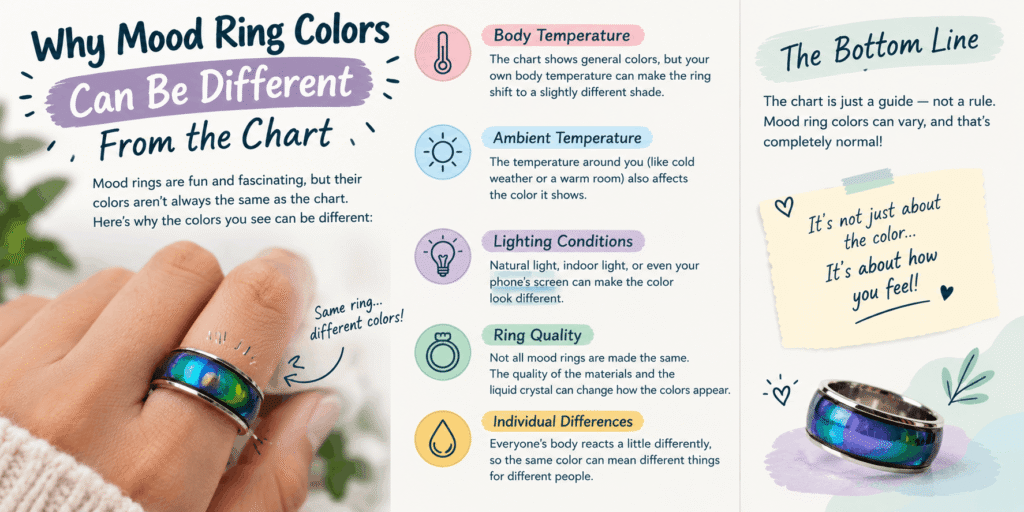
Why Mood Ring Colors Can Be Different From the Chart
One of the biggest misunderstandings about mood rings is expecting every ring to follow exactly the same color sequence. In reality, manufacturers can use different thermochromic materials, temperature ranges, and designs. As a result, one ring may display a particular shade while another ring shows something slightly different under similar conditions.
Even the same ring can look different depending on the environment. Cold weather can cool the ring and your finger, while a warm room can have the opposite effect. Washing your hands with cool or warm water can also cause a noticeable temporary change.
Lighting matters too. A deep blue shade under one light source may look almost purple under another. Reflections from the ring’s surface can further change how the color appears.
This means you should not worry if the color on your ring does not perfectly match a chart you found online. There is no universal emotional code that every mood ring follows.
Factors Influencing Mood Ring Color Accuracy
The word “accuracy” can be slightly misleading when discussing mood rings because these accessories are not designed to measure emotions scientifically. What they can do is respond to temperature changes, and several factors can influence that response.
Body temperature is one of the most obvious factors. Your hands may become warmer or cooler throughout the day, which can change the appearance of the ring.
Room temperature can have an equally noticeable effect. A ring worn outside during cool weather may display a different color from the same ring worn indoors.
Physical activity can also influence the temperature of your hands. After moving around, your circulation and skin temperature may change, which can affect the thermochromic material.
Contact with objects can temporarily alter the ring as well. Holding something cold or warm may cause the ring to shift even though your emotional state has not changed.
Individual differences matter too. People’s hands do not always have the same temperature, and circulation can vary from person to person. Therefore, two people wearing similar rings may see different colors at the same time.
The condition and age of the ring can also matter. Temperature-sensitive materials can become less reliable over time, particularly if the ring is repeatedly exposed to unsuitable temperatures, moisture, chemicals, or rough handling.
Because of all these factors, a mood ring should not be used to judge someone’s mental or emotional condition. Its color is best viewed as a fun visual response to changes in temperature.
The Enduring Appeal of Mood Rings
Despite the fact that mood rings cannot actually read emotions, their popularity has lasted because they combine science, fashion, curiosity, and nostalgia in a very simple accessory.
Part of the attraction is that the ring never looks completely static. A normal piece of jewelry usually has one fixed appearance, while a mood ring can look different throughout the day. Every color change gives the wearer something to notice.
Mood rings also encourage people to create their own interpretations. Someone may associate blue with a peaceful afternoon, purple with excitement, or green with feeling comfortable. These personal associations can make the ring more meaningful without requiring the traditional chart to be scientifically accurate.
They can also be an easy conversation starter. A person wearing a changing ring may naturally attract questions about why the color changed or what the current shade supposedly means. That playful mystery is a major part of the accessory’s appeal.
For some people, mood rings are also connected with retro fashion. Their strong association with the 1970s gives them a nostalgic quality, while modern versions can be found in many different shapes, colors, and styles.
Ultimately, the most useful way to understand mood ring colors is to separate the fun interpretation from the actual science. The chart can give you an entertaining idea of what a shade traditionally represents, but the ring itself is reacting to temperature rather than directly detecting emotions.
So if your mood ring suddenly changes from green to blue or purple, you do not need to treat it as a definitive message about how you feel. Instead, consider what may have changed around your finger. Temperature, surroundings, activity, and even lighting can all play a role.
That combination of simple science and playful mystery is exactly why mood rings continue to attract attention. They may not reveal your feelings with scientific precision, but watching the colors shift can still make an ordinary piece of jewelry surprisingly interesting.